



In little more than a decade, Ethereum has grown from an experimental blockchain into one of the most important foundations of the digital asset ecosystem. Its ability to support programmable smart contracts has enabled developers to build everything from decentralised finance (DeFi) protocols and NFTs to gaming platforms and other Web3 applications. Rather than simply enabling digital value transfer, Ethereum introduced an infrastructure where applications could operate without depending on traditional intermediaries.
The network has continued to evolve as it works towards becoming faster, more efficient, and capable of supporting greater demand. Its move to Proof-of-Stake marked a major shift in how Ethereum secures the network, while rollups and other scaling technologies are helping increase transaction capacity and improve efficiency. These developments, combined with Ethereum’s large developer community and extensive application ecosystem, have strengthened its position as a key infrastructure layer for Web3.
Ethereum’s growing utility has also kept it firmly in the spotlight among investors and institutions. Its price performance has fuelled interest in Ethereum price predictions, with market participants looking at factors such as adoption, network activity, developer growth, scaling progress, and institutional demand to assess its future potential. Although no Ethereum price prediction can accurately determine future performance, the network’s continued development suggests that its role in the evolving digital economy extends well beyond its native asset, Ether (ETH).
Also Read: What is Ethereum Option Trading? A Beginner’s Guide
What is Ethereum and Why Does its Price Matter?
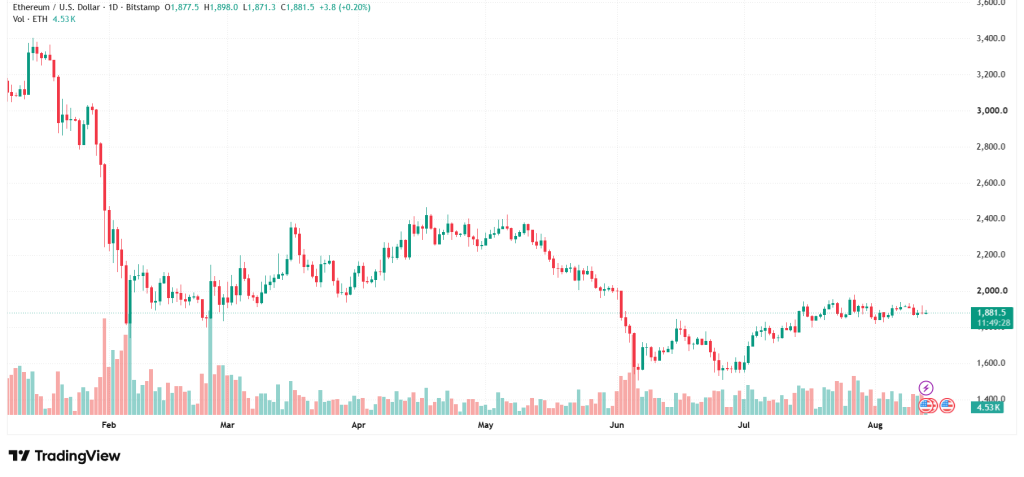
Ethereum is a decentralised blockchain that allows developers to create applications that run without relying on a central authority. Its smart contract functionality has made it a foundation for much of Web3, supporting use cases ranging from decentralised finance (DeFi) and NFT marketplaces to blockchain gaming and digital identity. Unlike Bitcoin’s primary focus on digital money, Ethereum is designed as a programmable network where developers can build and connect different applications.
At the centre of this ecosystem is Ether (ETH), Ethereum’s native crypto asset. ETH is used to pay transaction fees, interact with applications, and secure the network through staking. Its role within the network means that demand for Ethereum’s infrastructure can have a direct bearing on ETH, making factors such as network activity, developer adoption, and application growth important to its broader market outlook.
This connection between network utility and the value of ETH is one reason Ethereum price predictions attract considerable attention. Traders and investors often assess factors such as adoption, network upgrades, on-chain activity, and broader market conditions when evaluating its potential trajectory. While no price forecast can predict the future with certainty, these factors can offer useful context for understanding where Ethereum may be headed.
Also Read: What is Ethereum 2.0
Ethereum (ETH) Price and Technical Analysis
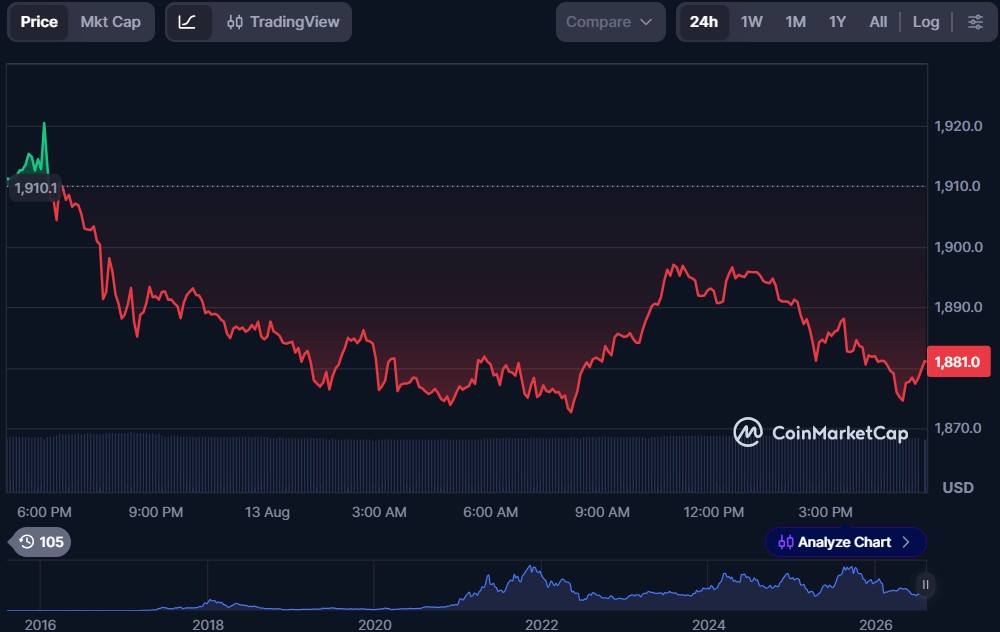
| Current Price | $1,881.53 |
| Market Capitalization | $227.08 billion |
| 24-Hour Volume | $7.70 billion |
| 50 Day SMA (1 Day) | $1,817.8 |
| 100 Day SMA (1 Day) | $1,884.3 |
| 200 Day SMA (1 Day) | $2,029.4 |
| 14-Day Relative Strength Index (1 Day) | 51.5 |
| All-Time High | $4,955 |
| Circulating Supply | 120.68 million |
Also Read: Everything You Need to Know About dApps
Key Factors That Influence Ethereum Price Predictions
Supply and Demand Dynamics
At its core, Ethereum’s price is shaped by basic economic principles. The introduction of mechanisms like EIP-1559, which burns a portion of transaction fees, has added a deflationary aspect to ETH’s supply. Combined with staking in Ethereum’s Proof-of-Stake model, a significant portion of ETH is locked, reducing circulating supply. When demand rises, driven by DeFi, NFTs, or new applications—this supply constraint can amplify price movements, making it a critical input in Ethereum price predictions.
Network Upgrades and Ethereum Development
Ethereum’s roadmap plays a major role in shaping market expectations. Upgrades aimed at improving scalability, reducing gas fees, and enhancing security often act as catalysts for price momentum. Developments such as rollups, sharding, and continued optimization of the network strengthen Ethereum’s long-term value proposition, directly influencing any forward-looking price prediction for Ethereum.
Institutional Adoption
Institutional interest has grown steadily, with asset managers, hedge funds, and corporations increasingly exploring Ethereum-based solutions. From staking services to tokenized assets, institutional participation adds credibility and liquidity to the ecosystem. This growing adoption is often viewed as a bullish signal in Ethereum price predictions, as it indicates long-term confidence in the network.
Global Macroeconomic Conditions
Ethereum does not exist in isolation. Broader economic factors, such as interest rates, inflation, regulatory developments, and global liquidity, can significantly impact crypto markets. In risk-on environments, capital tends to flow into assets like ETH, while tighter financial conditions may lead to pullbacks. These macro trends are essential when forming any realistic price prediction for Ethereum.
Role of Technical Analysis in Ethereum Price Forecasts
Technical analysis is a widely used approach to evaluate price trends and identify potential entry and exit points. While it doesn’t guarantee outcomes, it provides structured insights that complement fundamental analysis in forming Ethereum price predictions.
Moving Averages
Moving averages smooth out price data to identify trends over specific time periods. Common indicators like the 50-day and 200-day moving averages help traders determine whether Ethereum is in a bullish or bearish phase. Crossovers between these averages are often used as signals in short- and long-term price prediction for Ethereum.
Relative Strength Index (RSI)
The RSI measures the speed and magnitude of price movements to identify overbought or oversold conditions. Typically ranging from 0 to 100, an RSI above 70 suggests overbought conditions, while below 30 indicates oversold territory. Traders use this to anticipate potential reversals, making it a key component in Ethereum price predictions.
MACD Indicator
The Moving Average Convergence Divergence (MACD) tracks momentum by comparing two moving averages. It helps identify trend direction and strength, along with potential buy or sell signals. MACD crossovers and divergences are often incorporated into technical frameworks for refining a price prediction for Ethereum.
Ethereum Price Prediction Models Explained
On-Chain Analysis Models
On-chain analysis focuses on blockchain data such as transaction volumes, active addresses, staking activity, and gas usage. These metrics provide direct insight into network health and user behavior. For instance, rising active addresses or increasing total value locked (TVL) in DeFi can signal growing adoption—an important factor in Ethereum price predictions.
Market Sentiment Indicators
Market sentiment plays a powerful role in crypto price movements. Indicators such as social media trends, news cycles, funding rates, and fear-and-greed indices help gauge investor psychology. Positive sentiment can drive rapid price appreciation, while negative sentiment can trigger sharp corrections. Incorporating sentiment analysis adds another layer of depth to any comprehensive price prediction for Ethereum.
Network Activity Metrics
Network activity metrics provide valuable insight into how actively Ethereum is being used, making them an important factor in Ethereum price predictions. Indicators such as daily active addresses, transaction volume, gas fees, and total value locked (TVL) reflect real user demand and ecosystem growth. Rising activity often signals stronger adoption and utility, which can positively influence market sentiment and support a more optimistic price prediction for Ethereum.
Also Read: How to Keep Your Crypto Safe with Cold Wallets: A Beginner’s Guide
Price Predictions
2026
By the end of 2026, Ethereum is projected to hover around the $2,750 mark, reflecting steady but measured growth.
2027
Moving into 2027, the price prediction for Ethereum suggests a gradual climb toward the $3,000 level, indicating strengthening market confidence.
2028
For 2028, Ethereum price predictions point to a potential rise up to $3,150, driven by continued ecosystem expansion and adoption.
2029
By 2029, Ethereum is anticipated to trade close to $3,250, maintaining a consistent upward trajectory.
2030
Looking ahead to 2030, Ethereum could approach the $3,300 milestone, signaling long-term optimism around its role in the evolving blockchain landscape.
Risks and Uncertainties in Ethereum Price Predictions
Ethereum price predictions can provide a useful framework for assessing potential market scenarios, but they should not be treated as definitive forecasts. ETH’s price can be influenced by a wide range of factors, including regulatory developments, technological changes, market sentiment, liquidity, and broader economic conditions. Shifts in any of these areas can quickly change the market outlook and alter expected price trajectories.
Even Ethereum’s established ecosystem is not immune to unexpected developments. Security incidents, network issues, changes in upgrade timelines, or shifts in user and developer activity can affect market confidence and valuation. Therefore, any price prediction for Ethereum is best viewed as a possible scenario based on available information and assumptions, rather than a guaranteed indication of future performance.
How Investors Use Price Predictions in Crypto Strategies
Ethereum price predictions can serve as one of several inputs when developing an investment strategy. Investors may use them to assess potential entry and exit levels, plan long-term accumulation, or manage portfolio risk, while traders may combine forecasts with technical indicators to identify possible short-term opportunities. Strategies such as rupee-cost averaging (RCA) can also use price outlooks as a broader planning reference. By combining forecasts with technical and fundamental analysis, investors can evaluate potential scenarios more systematically rather than relying on predictions alone.
Key Considerations Before Relying on Ethereum Price Forecasts
Before using any Ethereum price prediction to guide an investment decision, it is important to look beyond the forecast itself and consider the factors behind it. No single model can capture every variable that may influence ETH’s price, so investors should compare different sources of information, including on-chain activity, technical indicators, market sentiment, network developments, and broader market conditions. Looking at multiple signals can provide a more balanced view of potential price scenarios.
Investors should also consider their own financial goals, risk tolerance, and investment horizon before acting on any forecast. Ethereum price predictions are best treated as analytical tools rather than definitive answers, particularly in a market where conditions can change rapidly. Combining price projections with independent research and sound risk management can help investors approach the Ethereum market with greater perspective and discipline.
Is Ethereum a Good Investment?
As Ethereum persists in its inventive strategies and punctual objective accomplishment, there are anticipations of robust token performance. Despite the existence of potential contenders aiming to surpass Ethereum, the blockchain has effectively preserved its supremacy in the domains of NFTs and dApps, resolutely cementing its role in shaping the future of Web 3.0.
Also Read: Crypto Trading Strategies
Should I Invest in Ethereum?
Ethereum has attracted renewed attention from investors as institutional participation in digital assets continues to expand. The growing availability of Ethereum-based investment products and evolving regulatory frameworks have contributed to a more supportive market environment, strengthening interest in ETH and its broader ecosystem. These developments have also added to discussions around Ethereum’s role within an increasingly institutionalised crypto market.
Beyond market sentiment, Ethereum’s continued development remains a key part of its long-term outlook. Ongoing improvements in scalability, network efficiency, and infrastructure, along with sustained developer activity, are helping the ecosystem adapt to growing demand. Its ability to evolve with changing technology and market conditions has reinforced Ethereum’s position as one of the most significant blockchain networks in the digital asset space.
However, Ethereum should not be viewed solely through the lens of short-term returns. Its investment case is closely linked to the growth and utility of the underlying network, while ETH remains subject to market and technology-related risks. Investors should consider their objectives, risk tolerance, and investment horizon, and conduct independent research before making any investment decision.
In the grand scheme of things, ZebPay blogs are here to provide you with crypto wisdom. Get started today and join 6 million+ registered users to explore endless features on ZebPay!
FAQs on Ethereum Price Prediction
What factors influence Ethereum price predictions?
Ethereum price predictions are shaped by a mix of factors, including supply and demand dynamics, network activity, technological upgrades, institutional adoption, and broader market sentiment. Macroeconomic conditions and regulatory developments also play a significant role in determining the price trajectory of Ethereum.
How reliable are Ethereum price prediction models?
No prediction model is entirely reliable, as the crypto market is highly volatile and influenced by unpredictable events. While models based on historical data, on-chain metrics, and technical analysis can provide useful insights, they should be treated as directional indicators rather than precise forecasts.
How do network upgrades impact Ethereum price forecasts?
Network upgrades often improve scalability, efficiency, and security, which can enhance Ethereum’s long-term value proposition. Positive developments tend to boost investor confidence, making them a key consideration in any price prediction for Ethereum.
How do analysts use technical indicators to forecast Ethereum prices?
Analysts rely on indicators such as moving averages, RSI, and MACD to identify trends, momentum, and potential reversal points. These tools help structure Ethereum price predictions by offering data-driven insights into market behavior.
Can institutional adoption impact Ethereum’s future price?
Yes, increasing participation from institutions can significantly influence Ethereum’s price. Institutional adoption brings greater liquidity, credibility, and long-term capital, all of which are often viewed as bullish signals in Ethereum price predictions.
What risks should investors consider when relying on Ethereum price predictions?
Investors should account for risks such as market volatility, regulatory uncertainty, technological challenges, and sudden shifts in sentiment. Even strong price prediction models cannot fully eliminate these uncertainties.
How do macroeconomic trends affect Ethereum price forecasts?
Macroeconomic factors like inflation, interest rates, and global liquidity conditions can impact investor appetite for risk assets. These trends directly influence Ethereum price predictions, as they determine how much capital flows into the crypto market.
Should investors rely solely on Ethereum price predictions when making decisions?
No, relying solely on predictions can be risky. Investors should combine Ethereum price predictions with fundamental analysis, technical insights, and their own financial goals to make well-informed decisions in a rapidly evolving market.