

Have you ever wondered if the “big money” would ever truly leave centralized platforms? Is it possible for a decentralized protocol to offer the same lightning-fast execution as a top-tier CEX while letting you keep your keys? In 2026, these are no longer theoretical questions; they are the reality of a transformed financial landscape.
The year 2026 marks a definitive shift in the crypto ecosystem. While the previous cycles were dominated by “spot” trading and memecoin manias, 2026 is the year of On-Chain Finance (OnFi). The engine driving this revolution isn’t just basic token swapping; it is the explosive growth of decentralized derivatives, particularly Perpetual Futures (Perps).
The 2026 Landscape: By the Numbers
The statistics tell a story of aggressive migration. As of March 2026, the combined trading volume for crypto perpetuals has grown 75% in just two years, reaching over $7.24 trillion. More impressively, the market share of Decentralized Exchanges (DEXs) in the derivatives sector has expanded fivefold, moving from a mere 2% in early 2024 to over 10% today.
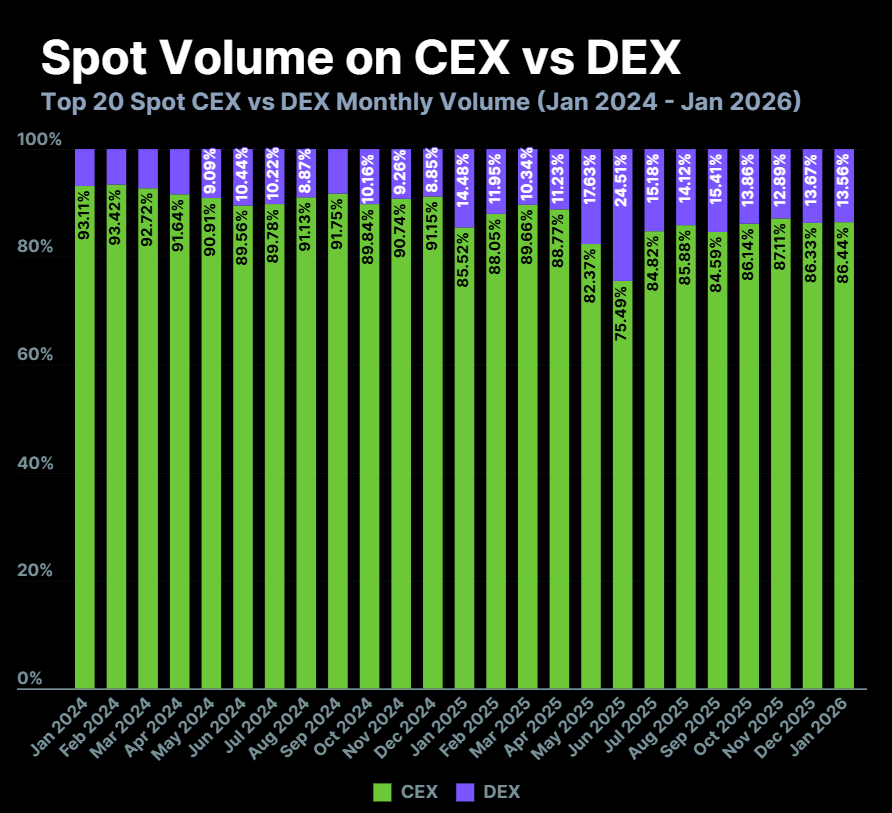
Image Source: CoinGecko
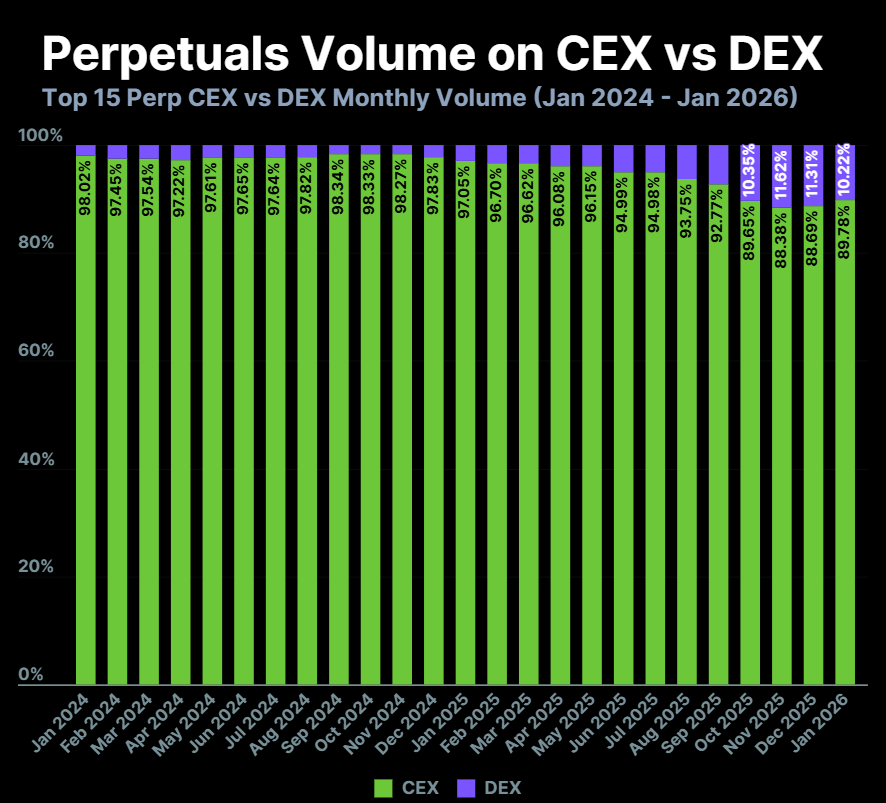
Image Source: CoinGecko
This growth is fueled by a simple realization among traders: why risk counterparty failure on a centralized exchange when you can get 20x leverage directly from your wallet with 100% transparency?
Why Derivatives Are the “Golden Key” for DEXs?
In any mature financial market, derivatives volume typically dwarfs spot volume. This is because derivatives allow for sophisticated strategies, hedging, speculation, and arbitrage, without requiring the movement of the underlying physical (or digital) asset.
In the context of 2026, derivatives are driving DEX growth through three main pillars:
- Capital Efficiency: Newer DEX models allow traders to open large positions with minimal collateral, often outperforming the liquidity available on smaller CEXs.
- Self-Custody & Transparency: Following the “trust-but-verify” mantra, every position, liquidation, and funding rate is now verifiable on-chain.
- Real-World Asset (RWA) Integration: Perpetuals have become the “synthetic bridge” for traditional assets. Traders can now get exposure to tokenization of equities, commodities, and even intellectual property without the legal friction of physical delivery.
Read more: CEX vs DEX: Understanding The Differences
The Technological Enablers: How We Got Here
The “DEX Revolution” of 2026 didn’t happen by accident. It was built on the back of Layer-2 (L2) scaling and modular blockchain designs that finally solved the “On-Chain Trilemma” of decentralization, performance, and security.
In early 2024, gas fees and high latency made high-frequency trading on-chain nearly impossible. Today, purpose-built app-chains and ZK-rollups (Zero-Knowledge) have brought transaction costs down to near-zero, enabling “deterministic sequencing”, order matching that doesn’t have to wait for block finality. According to reports from Nasscom, nearly 85% of all daily Ethereum-based transactions are now processed via L2 solutions, a massive jump from years prior.
Top 5 Perpetual Futures DEX Development Models Dominating 2026
According to industry experts at Antier Solutions, five specific development models have survived the “stress tests” of 2025 to lead the market in 2026:
1. Hybrid Orderbook with On-Chain Settlement
This model, championed by leaders like Hyperliquid and dYdX v4, matches orders off-chain for CEX-like speed but settles every trade on-chain for transparency and custody guarantees. This allows for professional-grade futures trading with sub-second latency.
2. Multi-Asset Liquidity Pools (GMX Style)
Instead of an order book, these DEXs use a shared pool of assets (like BTC, ETH, and stablecoins) as the counterparty for all trades. It provides “zero slippage” for major pairs, though at the cost of higher risk for liquidity providers.
3. Virtual Automated Market Makers (vAMMs)
These models use mathematical formulas to provide leverage without needing a direct liquidity provider for every trade, making them highly efficient for “long-tail” or niche tokens in the crypto market futures.
4. Oracle-Centric Synthetic Platforms
Protocols like Synthetix use real-time price feeds (from providers like Chainlink or Pyth) to allow synthetic trading of any asset, from gold to forex, all backed by on-chain collateral.
5. Intent-Based Trading
The newest entrant in 2026, where “solvers” compete to fill a trader’s “intent” at the best possible price across multiple chains. This reduces fragmentation and ensures that users get the best possible execution for their perpetual futures positions.
Institutional Adoption: The “Suits” have Arrived
Perhaps the biggest driver for 2026 growth is the entry of institutional capital. According to Nasdaq’s 2026 outlook, the derivatives market is at an “inflection point.” Large asset managers are no longer just buying Bitcoin; they are looking for yield and risk management through on-chain futures market instruments.
Institutional-grade DEXs now offer:
- Embedded Compliance Logic: “Permissioned” pools where only KYB-verified (Know Your Business) entities can trade.
- Safe Storage: While DEXs are non-custodial, institutional users often use Multi-Party Computation (MPC) wallets or “qualified custodians” to manage their keys.
The Future of Bitcoin in a Derivative-Led World
While DEXs are evolving into complex financial machines, the foundation remains Bitcoin. In March 2026, a symbolic milestone occurred: the mining of the 20 millionth Bitcoin.
Bitcoin’s programmatic scarcity (capped at 21 million) serves as the ultimate collateral in the derivatives market. As global debt levels rise, the “digital gold” narrative has solidified, with Bitcoin being used both as a long-term treasury asset and as high-quality collateral for on-chain leverage.
Final Thoughts: Staying Ahead in 2026
The growth of DEX derivatives is not just a trend; it is a structural redesign of how global markets function. By 2026, the question is no longer “What can crypto do?” but “How fast can we move it on-chain?”
For traders, the opportunities in futures trading are vast, but the risks remain real. Hacks and exploits still cost the industry over $2.4 billion annually, with private-key compromises being the leading cause. Whether you are trading on a DEX or a registered platform, practicing “Safe Storage” and using reputable protocols is non-negotiable.
In the grand scheme of things, ZebPay blogs are here to provide you with crypto wisdom. Get started today and join 6 million+ registered users to explore endless features on ZebPay!
FAQs
What is a “Perpetual Future” (Perp) in a DEX?
A perpetual future is a type of derivative that allows you to speculate on an asset’s price without an expiry date. On a DEX, these are managed by smart contracts rather than a central clearinghouse.
Why is 2026 considered the “Institutional Era” for crypto?
2026 is marked by the passage of major global legislation (like the US Genius and Clarity Act) and the mining of the 20 millionth Bitcoin, which has solidified crypto as a standard institutional asset class.
How many Bitcoins will ever exist?
The protocol caps supply at 21 million BTC. As of March 2026, 20 million have already been mined.
How do L2s help DEX growth?
Layer-2 (L2) solutions like Arbitrum, zkSync, and specialized app-chains reduce fees by up to 99% and increase transaction speeds, making decentralized trading as fast and affordable as centralized trading.