

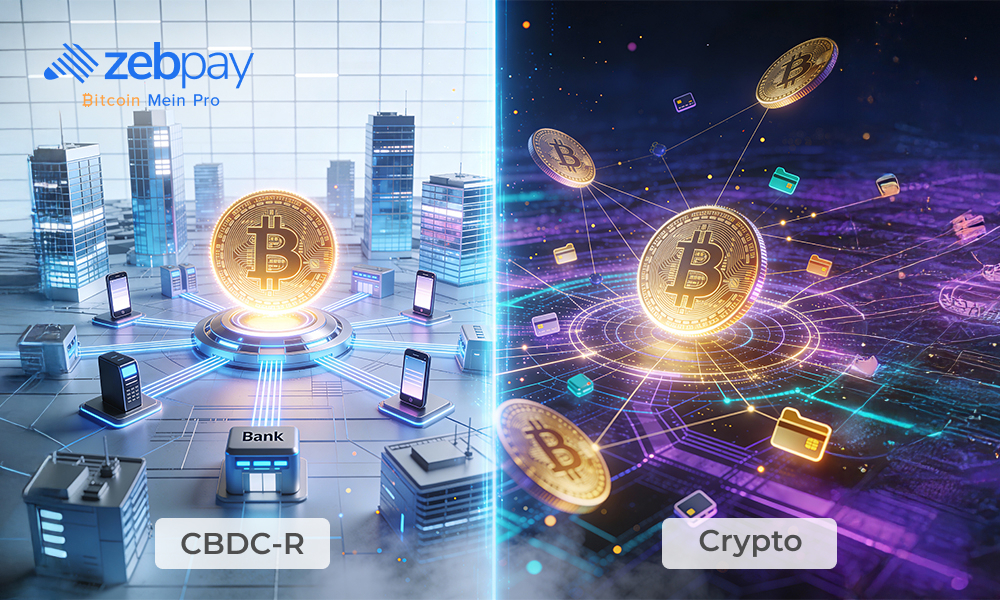


The world is not just moving toward digital payments, but it is moving toward digital money itself. On one side, central banks across more than 130 countries (representing over 98% of global GDP) are actively researching or piloting Central Bank Digital Currencies (CBDCs). On the other side, the total crypto market capitalization has grown into a multi-trillion-dollar ecosystem over the past decade, driven by Bitcoin, Ethereum, and thousands of decentralized applications.
Governments are building state-backed digital money. At the same time, crypto networks are creating borderless, permissionless financial systems.
What is Central Bank Digital Currency (CBDC)?
A Central Bank Digital Currency (CBDC) is the digital version of a country’s fiat currency issued directly by its central bank. Think of it as a digital rupee, digital dollar, or digital euro, but one that is officially backed and regulated by the government.
Unlike UPI or online banking balances, which are liabilities of commercial banks, a CBDC is a direct liability of the central bank itself.
Why Are Governments Creating CBDCs?
The motivation behind CBDCs is not crypto competition alone. Central banks are responding to structural shifts in finance:
- Decline in Physical Cash Usage
- Rise of Private Stablecoins
- Payment System Modernization
- Financial Inclusion
Read more: Pros and Cons of CBDC
How Does a CBDC Actually Work?
CBDCs can operate in different models:
- Retail CBDC: Available to individuals for everyday payments.
- Wholesale CBDC: Used by financial institutions for interbank settlements.
For example, in India, the Reserve Bank of India (RBI) launched pilot programs for the Digital Rupee (e₹) aimed at testing retail and wholesale use cases.
Read more: Role of CBDC in Ensuring Economic Stability
What is Crypto? A Decentralized Financial Revolution
Crypto is fundamentally different from CBDCs because it removes centralized authority.
Bitcoin, launched in 2009, is a peer-to-peer electronic cash system that does not require banks or governments to validate transactions.
Since then, the crypto ecosystem has evolved dramatically.
Real-World Use Cases of Crypto
Crypto is often misunderstood as purely speculative. In reality, its use cases are expanding:
- Cross-border remittances without intermediaries
- Decentralized finance (lending, borrowing, staking)
- Tokenization of assets
- Digital ownership (NFTs)
- Hedge against currency inflation
In countries with high inflation or capital controls, crypto adoption often increases as people seek alternative stores of value.
CBDC vs Crypto: What’s the Difference?
| Parameter | Central Bank Digital Currency (CBDC) | Crypto |
| Issuing Authority | Issued and regulated by a country’s central bank (e.g., RBI, Federal Reserve). Sovereign liability, fully government-backed. | Not issued by any central authority. Created via decentralized blockchain networks like Bitcoin or Ethereum. |
| Control & Governance | Fully centralized. Central bank controls supply, monetary policy, transaction rules, and network governance. | Decentralized governance. Maintained by network participants (miners/validators) via consensus. No single authority changes rules. |
| Legal Status | Legal tender. Must be accepted for payments in the issuing country. | Not legal tender in most countries. Depends on regulation and merchant adoption. |
| Monetary Policy Flexibility | Central banks adjust supply, interest rates, or add programmable tools (e.g., stimulus). | Fixed or algorithmic supply (e.g., Bitcoin’s 21M cap). No discretionary intervention. |
| Price Stability | Stable, pegged 1:1 to national fiat (e.g., ₹1 digital rupee = ₹1 physical). | Market-driven, highly volatile due to demand, speculation, and macro events. |
| Primary Objective | Modernize payments, boost financial inclusion, and maintain monetary sovereignty. | Decentralized finance, digital ownership, borderless transactions, programmable ecosystems. |
| Transparency Model | Visible to regulators for compliance and anti-money laundering. | Public blockchain records, pseudonymous (wallet addresses, not real names). |
| Privacy Level | Limited; governments track to prevent fraud/illicit activity. | Higher autonomy; public data lacks inherent identity links. |
| Technology Infrastructure | Centralized databases or permissioned DLT controlled by central banks. | Public blockchains with Proof-of-Work or Proof-of-Stake consensus. |
| Innovation Layer | Focused on digital payments and settlement efficiency. | Smart contracts, DeFi, NFTs, Web3, DAOs, tokenization, and more. |
| Cross-Border Utility | Improves central bank settlements within regulatory frameworks. | Borderless by design, no intermediaries needed globally. |
| Inflation Risk | Tied to government monetary policy. | Deflationary (e.g., Bitcoin cap); others are inflationary by design. |
| Regulatory Framework | Fully regulated and backed by national laws. | Evolving varies by country. |
| Adoption Drivers | Government mandate, banking integration, and inclusion goals. | Investor interest, innovation, decentralization, inflation hedge, Web3. |
| Risk Profile | Lower volatility, but privacy and central control risks. | High volatility, but decentralization and high-return potential. |
What Will Be the Future of Digital Currency?
According to global financial surveys, more than 90% of central banks are exploring CBDCs. Simultaneously, crypto wallet adoption continues to grow worldwide.
This suggests that digital currency evolution is not a zero-sum game.
1. CBDCs Will Digitize Sovereign Money
Governments will likely implement CBDCs to:
- Maintain monetary control.
- Improve tax compliance.
- Modernize payments.
- Counter private stablecoins.
In India, the Digital Rupee pilot reflects cautious experimentation rather than aggressive replacement of cash.
2. Crypto Will Continue Driving Innovation
Crypto will likely remain dominant in:
- Decentralized finance
- Borderless digital payments
- Web3 infrastructure
- Asset tokenization
Institutional adoption and clearer regulations could accelerate this growth.
3. Stablecoins Could Become the Bridge
Stablecoins may connect both worlds:
- They offer price stability like fiat.
- They operate on blockchain networks.
- They enable global settlements.
Some policymakers even see regulated stablecoins as complementary to CBDCs.
4. Regulation Will Be the Deciding Factor
Regulatory clarity can:
- Encourage innovation.
- Protect investors.
- Reduce systemic risk.
Countries that strike a balance between innovation and control may lead the digital currency revolution.
Conclusion: A Dual Digital Future, Not a Single Winner
The future of digital currency is unlikely to be a battle where CBDC replaces crypto or vice versa. Instead, global trends suggest the emergence of a parallel financial ecosystem where both coexist, serving different but complementary purposes. CBDCs will likely strengthen sovereign monetary systems, improve payment efficiency, and enhance regulatory oversight. They represent the digitization of traditional finance, preserving central bank authority while modernizing infrastructure.
Ultimately, the future of digital currency will not be defined by ideology alone but by adoption, regulation, technological scalability, and public trust. CBDCs may dominate regulated payment systems, while crypto will likely expand as an innovation engine and alternative asset class.
In the grand scheme of things, ZebPay blogs are here to provide you with crypto wisdom. Get started today and join 6 million+ registered users to explore endless features on ZebPay!
FAQs
Is CBDC the same as crypto?
No. CBDCs are government-issued digital currencies, while crypto operates on decentralized networks.
Can CBDC replace crypto?
CBDCs may replace certain payment functions, but they cannot replicate decentralization or blockchain-based innovation.
Is India using a CBDC?
Yes, the RBI has launched pilot programs for the Digital Rupee.
Which has more long-term potential?
Both have potential in different areas, CBDCs in regulated payments and crypto in decentralized innovation.