

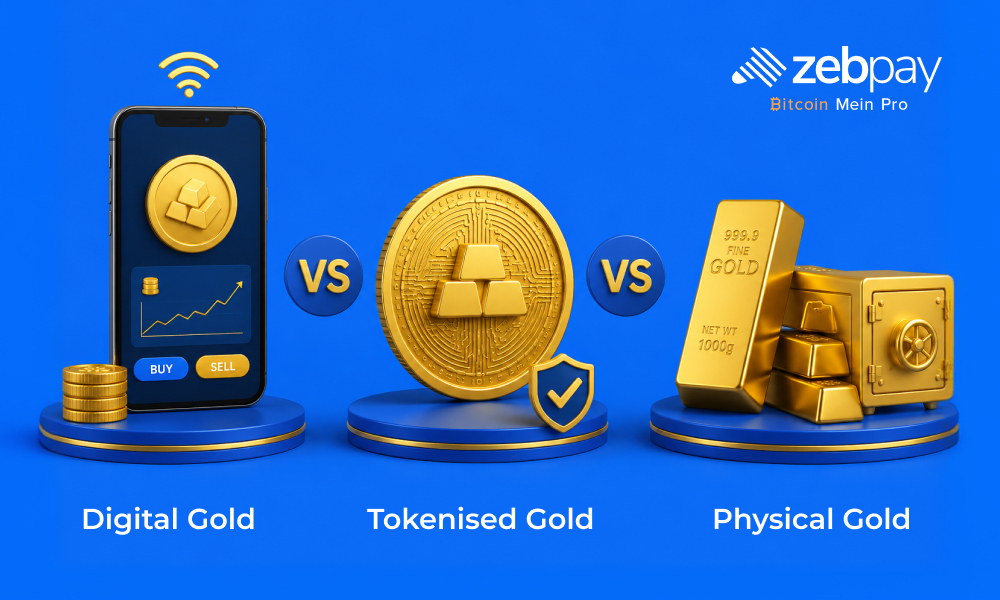


Physical gold is the metal itself, coins, bars, or jewellery you hold. Digital gold is a retail product where a provider buys and stores physical gold on your behalf. Tokenized gold is a blockchain-based token backed one-to-one by vaulted gold. All three track the same underlying metal but differ sharply in custody, liquidity, and accessibility.
Key Takeaways
- Physical gold gives direct ownership but comes with storage, insurance, and making charges.
- Tokenized gold moves gold ownership on-chain, enabling 24/7 trading, fractional ownership, and use as collateral.
- The tokenized gold market crossed $5–6 billion in market cap in 2026, growing far faster than physical gold demand.
- Each format carries different counterparty, custody, and liquidity risk, none is objectively superior for every use case.
What Is Physical Gold?
Physical gold refers to gold you can hold: bars, coins, or jewellery. It has been used as a store of value for centuries and remains the default choice for buyers who want direct, tangible ownership.
Owning physical gold means dealing with storage and insurance costs, making charges on jewellery, and purity verification at the time of resale. Liquidity depends on finding a buyer or a jeweller willing to accept the metal at fair rates. Central banks and institutional investors still trade physical gold in bulk, primarily through the London bullion market and the Shanghai Gold Exchange.
Spot gold has traded above $4,600 per ounce as of late August 2026, near three-month highs, according to live market data. This figure moves constantly, so any published price should be checked against a live source rather than treated as fixed.
What Is Digital Gold?
Digital gold is a service where a provider, typically a fintech app or a bullion company, buys physical gold on your behalf and stores it in an insured vault. You buy in small amounts, sometimes as low as a few dollars’ worth, and your holding is represented as a balance in an app.
At any point, digital gold can usually be redeemed for cash at the prevailing gold price, or in some cases converted into physical delivery of coins or bars, subject to minimum quantities and delivery charges. This structure has become especially popular in India and parts of Southeast Asia, where retail platforms have built dedicated digital gold products around small-ticket, app-based buying.
The core trade-off: digital gold removes storage hassle, but it depends entirely on the provider’s solvency and the accuracy of its vault audits. If the issuer fails or mismanages reserves, the buyer’s recourse is limited compared to holding gold directly.
What Is Tokenized Gold?
Tokenized gold takes the same idea, one unit backed by one unit of physical gold, and issues it as a token on a public blockchain. Each token represents a fixed weight of vaulted gold, and ownership is recorded on-chain rather than in a company’s internal ledger.
The two largest tokenized gold products are Tether Gold (XAUT) and Pax Gold (PAXG). Together they represent roughly 90–97% of the entire tokenized gold market. PAXG is backed by London Good Delivery bars held in Brink’s vaults and is issued by Paxos under a New York State Department of Financial Services trust charter. XAUT is backed by gold held in Swiss vaults and issued by Tether, with strong liquidity on major exchanges.
Because tokenized gold lives on-chain, it settles near-instantly, trades continuously across time zones, and can be used as collateral in decentralized finance protocols, something neither physical gold nor app-based digital gold currently supports at scale. In Q1 2026, tokenized gold’s spot trading volume reached $90.7 billion, already surpassing the total volume recorded across all of 2025.
Digital Gold vs. Bitcoin: Same Name, Different Assets
The phrase “digital gold” causes genuine confusion, because it is used for two unrelated things. One is the gold-backed retail product described above. The other is Bitcoin, which analysts and investors frequently nickname “digital gold” as a comparison, not because Bitcoin contains or represents any physical gold, but because both assets share a fixed or capped supply and a role as a store of value outside traditional currency systems.
Bitcoin has no physical backing. Its value comes from its fixed supply of 21 million coins, its decentralized network, and market demand, not from a vault of bullion. Someone who wants to buy Bitcoin is making a fundamentally different bet than someone buying digital gold or tokenized gold, the volatility profile, custody model, and underlying asset are all different.
Physical Gold vs. Digital Gold vs. Tokenised Gold: Comparison Table
| Feature | Physical Gold | Digital Gold | Tokenized Gold |
| Backing | The metal itself | Vaulted gold held by the provider | Vaulted gold recorded on-chain |
| Custody | Self-storage or bank locker | Provider-managed vault | Third-party custodian and blockchain ledger |
| Minimum purchase | Often high, such as coins or bars | Very low; fractional grams available | Very low; fractional tokens available |
| Trading hours | Limited to dealer hours | App-dependent; often 24/7 for buying and selling | 24/7 and global; traded on-chain |
| Liquidity | Depends on the buyer or jeweller | Redeemable through the app; delivery may be available | High; tradable on exchanges instantly |
| Use as collateral | Rare; usually requires physical pledge | Not typically supported | Supported on some DeFi platforms |
| Regulatory oversight | Established and jurisdiction-specific | Varies by provider and country | Varies; leading tokens may hold formal licences |
| Key risk | Storage, theft, and resale spread | Issuer solvency and audit transparency | Issuer concentration and smart-contract risk |
Liquidity, Storage, and Custody Differences
Liquidity separates these three formats more than anything else. Physical gold requires a willing buyer and often a discount to spot price at resale. Digital gold offers same-day redemption within an app but is bound by that provider’s business hours and terms. Tokenized gold trades continuously on global exchanges, matching the always-on nature of crypto markets.
Storage responsibility shifts accordingly. Physical gold places the burden entirely on the owner. Digital gold and tokenized gold both outsource storage to a custodian, but the trust model differs: digital gold relies on a company’s internal reporting, while tokenized gold relies on third-party attestations and, in some cases, on-chain proof of reserves that anyone can verify.
Regulatory and Custody Risk Across the Three Formats
No format is risk-free. Physical gold carries theft and insurance risk. Digital gold’s main risk is counterparty failure, if the issuing platform collapses or its vault audits prove inaccurate, redemption can be delayed or impaired. Tokenized gold carries issuer concentration risk, since XAUT and PAXG together account for the vast majority of the category, along with smart contract and blockchain-specific risks.
Regulatory treatment also varies by product and jurisdiction. Some tokenized gold issuers, such as Paxos, operate under formal trust charters with regular third-party attestations. Digital gold providers are regulated differently depending on the country and whether they operate as a financial product or a commodity reseller. Readers should verify the specific licensing and audit practices of any provider before purchasing.
How Has Each Format Performed in 2026?
Tokenized gold has grown at a markedly faster pace than physical gold demand in 2026. Its market capitalization moved from roughly $1 billion in early 2025 to a range of $4.8–6 billion through 2026, a pace reported to be about 5.5 times faster than physical gold in the first quarter alone. On-chain deployment of tokenized gold in decentralized finance more than doubled in the same period, and the category added over 44,500 new wallets in Q1 2026, pointing to broadening retail participation rather than existing holders simply adding to positions.
Conclusion
Physical gold, digital gold, and tokenized gold all track the same underlying asset but serve different needs, direct ownership, low-friction app-based buying, or blockchain-native trading and collateral use. Each comes with its own custody structure, liquidity profile, and risk. For those exploring blockchain-based assets, including tokenized gold and Bitcoin.
In the grand scheme of things, ZebPay blogs are here to provide you with crypto wisdom. Get started today and join 6 million+ registered users to explore endless features on ZebPay!
FAQs
Is digital gold the same as tokenized gold?
No. Digital gold is typically held in a company’s internal ledger and vault, while tokenized gold is recorded on a public blockchain and can be traded on crypto exchanges or used in DeFi.
Is tokenized gold backed by real gold?
Leading tokenized gold products such as XAUT and PAXG state that each token is backed by a fixed weight of physical gold held in third-party vaults, verified through periodic attestations.
Is Bitcoin the same as digital gold?
No. Bitcoin is sometimes nicknamed “digital gold” due to its fixed supply and store-of-value narrative, but it has no physical gold backing and is a separate asset class with its own risk profile.
Is physical gold still worth buying compared to digital or tokenized gold?
Each format suits different needs, physical gold for direct ownership, digital gold for low-friction small purchases, and tokenized gold for round-the-clock trading and blockchain use cases. This article does not recommend one over another.