



Key Takeaways
- 62% of new users came from Tier-2 and Tier-3 cities, highlighting their growing role in crypto adoption.
- Tier-3 cities showed the strongest resilience, across user acquisition, trading activity, order sizes, and futures.
- Trading activity varied across city tiers, with users from Metro cities preferring short, frequent trades.
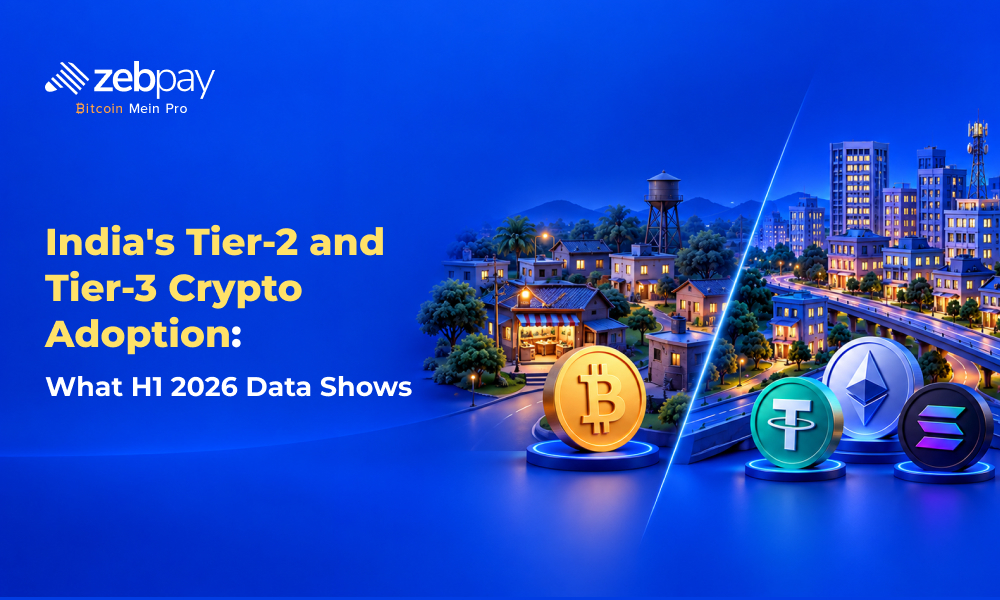
India’s crypto adoption is no longer concentrated in its largest cities. As awareness and access to digital assets continue to expand, users across Tier-1, Tier-2, and Tier-3 cities are becoming an increasingly integral part of the country’s evolving crypto landscape, each bringing different levels of participation and engagement to the market. While Tier-1 cities have traditionally been at the forefront of digital asset adoption, the growing presence of users from Tier-2 and Tier-3 cities points to a broader shift in where crypto interest is emerging across India. In this article, we take a closer look at crypto adoption across Tier-1, Tier-2, and Tier-3 cities, during H1 2026, and examine the growing participation of Tier-2 and Tier-3 users towards digital assets.
Also Read: The State of Crypto in India: H1 2026 Review & H2 2026 Outlook
Tier Classification
| Tier | States Included | Rationale |
| Metro/Tier-1 | Delhi, Maharashtra, Karnataka, Tamil Nadu, Telangana, West Bengal | Home to Mumbai, Bangalore, Chennai, Hyderabad, Kolkata, Delhi NCR |
| Tier-2 | UP, Gujarat, Rajasthan, MP, AP, Punjab, Kerala, Haryana, Chandigarh, Goa | Home to Lucknow, Ahmedabad, Jaipur, Indore, Vizag, Pune suburbs |
| Tier-3 | Bihar, Jharkhand, Odisha, Assam, Chhattisgarh, Uttarakhand, J&K, NE states | Smaller, semi-urban, and rural-adjacent cities |
Also Read: Bitcoin vs. Ethereum in H1 2026: Key Market Trends and Institutional Adoption
5 Observations From H1 2026
- New User Demographics Shifted: The mentioned period witnessed user base becoming increasingly younger and more mobile-led, with this transition evident across users belonging to Northern India’s Tier-1 and Tier-2 cities.
- Emerging Cities Drove the Next Wave of Adoption: 62% of new registered users came jointly from Tier-2 and Tier-3 cities, showing India’s metropolitan centres’ contribution towards crypto participation.
- Tier-3 Markets Showed the Strongest Resilience: Tier-3 cities stood out on 3 fronts:
- Smallest decline in new registrations and spot trading volume.
- Only segment to see a rise in average order size.
- A 7% increase in trading volume of futures activity.
- Metro Users Shifted Towards More Frequent Trades: Tier-1 cities kept spot trading volumes broadly in line with the H1 2025 levels, but recorded a higher number of orders, signifying a shift towards more frequent trades with comparatively smaller order amounts.
- Tier-2 Markets Saw the Sharpest Trading Showdown: Tier-2 cities experienced the most pronounced pullback in spot trading activity, with both active traders and trading volumes falling more than Tier-1 and Tier-3 markets.
Also Read: Top 5 Crypto Assets Traded in India in H1 2026
Final Thoughts
H1 2026 highlights a broader shift in India’s crypto landscape, with adoption and engagement increasingly expanding beyond the boundaries of India’s metropolitan cities. Furthermore, the differences across city tiers show that crypto participation is not developing uniformly, with users in different markets displaying different patterns of engagement and activity. The growing role of smaller cities suggests that the next phase of adoption could be shaped by a wider and more diverse user base. As awareness, accessibility, and familiarity with digital assets continue to expand, Tier-2 and Tier-3 markets are likely to remain important for India’s crypto future.
Note: The insights presented in this report are based on ZebPay’s internal data and reflect user activity observed on the platform, during H1 2026. The data offers a snapshot of user behaviour and trends, related to the timeline, and doesn’t represent the broader Indian crypto market.
FAQs
How is crypto adoption evolving across Indian cities?
1. Crypto participation is expanding beyond traditional metropolitan centres.
2. Tier-1, Tier-2, and Tier-3 cities are showing different patterns of user acquisition and market engagement.
3. Smaller cities are becoming increasingly relevant to India’s broader digital asset landscape.
Why are Tier-2 and Tier-3 cities important for India’s crypto adoption?
1. They represent a growing source of new crypto users.
2. Their participation indicates that digital asset awareness is spreading beyond major financial and technology hubs.
3. Their evolving engagement could play an important role in the next phase of market growth.
How did trading behaviour differ across city tiers?
1. Metro users showed a greater tendency towards frequent, smaller-value trades.
2. Tier-2 markets experienced a comparatively sharper slowdown in spot activity.
3. Tier-3 users displayed stronger resilience across several measures of trading engagement.
What makes Tier-3 cities particularly notable in H1 2026?
1. Tier-3 markets demonstrated greater resilience across both user acquisition and trading activity.
2. Users in these markets also showed stronger average spot order values.
3. Futures participation also developed differently compared with larger city segments.
What does H1 2026 indicate about the future of crypto adoption in India?
1. Crypto adoption is becoming increasingly distributed across different city categories.
2. Emerging markets could become an increasingly important source of new users and activity.
3. The evolving profile of users suggests that India’s crypto ecosystem is broadening in both geographic reach and participation patterns.