

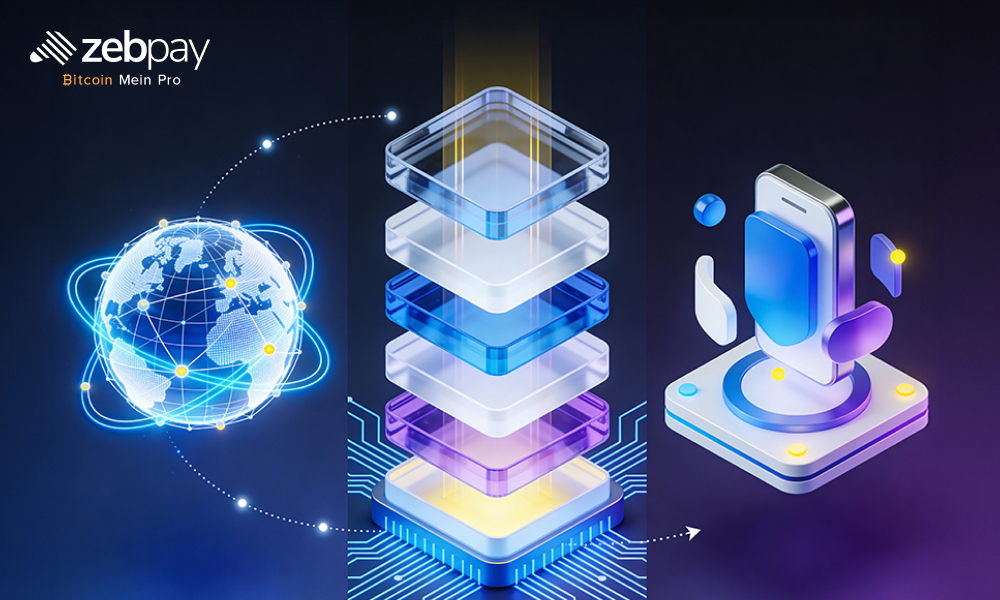


Think of it as a secure messenger that brings real-world information into the isolated world of blockchain smart contracts. Oracle blockchain technology bridges the gap between on-chain code and off-chain data, like weather reports, stock prices, or sports scores, enabling blockchain in oracle systems to power real applications. Without oracles, smart contracts remain blind to external events, limiting their potential.
This guide explains oracle blockchain concepts simply for beginners, covering types, workings, use cases, and challenges, so you understand why what an oracle blockchain is matters for Web3’s future.
Blockchain Oracle
A blockchain oracle acts as middleware connecting blockchains to external systems. Smart contracts execute automatically based on predefined conditions, but blockchains are “closed systems,” and they only verify data already on-chain. Oracle blockchain services fetch, verify, and deliver off-chain data (like API results or sensor readings) to smart contracts securely.
Simple Analogy: Imagine a smart contract as a vending machine that dispenses coffee only if you insert ₹10. It queries the supplier, verifies the price, and tells the contract whether to proceed. What is a blockchain oracle solves the “oracle problem,” making blockchains interact with reality.
Read more: What is Blockchain? All About Blockchain Technology
Why Do Blockchains Need Oracles?
Blockchains prioritize security through determinism, and every node must agree on outcomes. External data introduces uncertainty: What if one API reports different weather than another? Blockchain in Oracle design prevents this by off-chain verification before on-chain submission.
Key Limitations Without Oracles:
- Smart contracts can’t access live prices, weather, or events
- No interaction with traditional systems (banks, IoT devices)
- Limited to on-chain data only, restricting DeFi, gaming, and insurance
Oracles enable hybrid smart contracts combining on-chain logic with off-chain computation, powering $100B+ DeFi markets. They create the “verifiable web,” where data authenticity is cryptographically proven.
Types of Blockchain Oracles
Oracle blockchain networks offer varied designs for different needs. Here’s a breakdown:
| Type | Description | Example Use Case | Pros | Cons |
| Inbound | Feeds external data to the blockchain | Price feeds for DeFi swaps | Enables real-world triggers | Single point of failure risk |
| Outbound | Sends blockchain data to external systems | Trigger API calls when the contract executes | Off-chain automation | Requires trusted recipients |
| Software | Connects to online APIs/databases | Weather data for crop insurance | Fast, cheap | Vulnerable to hacks/outages |
| Hardware | Uses IoT devices/sensors | Supply chain temperature logs | Physical world access | Expensive, device-dependent |
| Inbound Hardware | Sensors → blockchain (e.g., RFID tags) | Real-time asset tracking | Tamper-proof data | High setup costs |
| Decentralized | Multiple node networks (e.g., Chainlink) | Secure price oracles | Fault-tolerant, censorship-resistant | Complex, gas fees |
How Does a Blockchain Oracle Work?
Blockchain oracle operation follows a secure data pipeline:
- Data Request: Smart contract emits event (e.g., “Fetch ETH/USD price”)
- Oracle Node Detection: Network nodes monitor the blockchain for requests
- Off-Chain Fetch: Nodes query external APIs/sources independently
- Verification & Consensus: Nodes aggregate/validate data (majority vote, median)
- On-Chain Delivery: Consensus result submitted via transaction
- Smart Contract Execution: Contract uses verified data to act (pay, liquidate)
Read more: Elevate Your Trading with ZebPay’s API Services
Real-World Use Cases of Blockchain Oracles
Oracle blockchain powers diverse applications:
- DeFi Price Feeds: Chainlink oracles provide tamper-proof prices for lending (Aave), derivatives (Synthetix). Without accurate ETH/USD feeds, $50B+ flash loans fail.
- Insurance: Parametric policies pay automatically, e.g., flight delay oracle triggers a refund. Arbol uses weather oracles for farmer crop insurance.
- Gaming/NFTs: Oracles verify real-world events for play-to-earn (Axie Infinity sports scores) or dynamic NFTs (weather-based art).
- Supply Chain: Hardware oracles track temperature/humidity for pharma (Modum.io ensures cold chain compliance).
- Prediction Markets: Augur uses oracles for event resolution (e.g., “Will BTC hit $100K by 2026?”).
- Cross-Chain Bridges: Oracles verify messages between chains (Polkadot, Cosmos IBC).
- India Example: Agri-insurance dApps use monsoon oracles to auto-pay farmers, bypassing slow claim processes.
Popular Blockchain Oracle Projects
| Project | Key Features | Native Token | TVS Secured |
| Chainlink | Decentralized DON, 10+ chains | LINK | $20B+ |
| Band Protocol | Cosmos SDK, fast finality | BAND | $2B+ |
| DIA | Open-source, community nodes | DIA | $500M+ |
| API3 | First-party oracles (data providers run nodes) | API3 | $1B+ |
| Pyth Network | Solana-focused, 400+ price feeds | PYTH | $10B+ |
Challenges and Risks of Blockchain Oracles
What is a blockchain oracle introduces new attack vectors:
- Oracle Failure: 2016 DAO hack ($50M) exploited, manipulated price data.
- Centralization: Single API reliance = single point failure.
- Economic Attacks: “Flash loan” manipulation (manipulate price briefly, profit).
- Latency: Real-time data delays vs traditional APIs.
- Cost: Gas fees for on-chain submission (mitigated by Layer 2).
- Solutions: Decentralized networks, TWAP (time-weighted averages), insurance pools.
Future of Oracle Blockchain Technology
Oracle blockchain evolves rapidly:
- AI Integration: ML models predict/verify data
- Verifiable Compute: Oracles run off-chain computation, prove on-chain (Chainlink Functions)
- Zero-Knowledge Oracles: Privacy-preserving data feeds
- IoT Expansion: 75B devices by 2025 need blockchain integration
Web3 vision: Blockchain in Oracle creates a tamper-proof global data layer, powering autonomous economies.
Conclusion
Blockchain oracles solve the critical oracle problem, enabling oracle blockchain smart contracts to interact with real-world data securely. From DeFi price feeds to parametric insurance, what is a blockchain oracle powers Web3’s most valuable applications through decentralized verification.
Despite risks like manipulation, mature networks like Chainlink deliver battle-tested reliability. What is an oracle blockchain represents infrastructure essential for blockchain’s trillion-dollar future, bridging isolated ledgers to global reality.
In the grand scheme of things, ZebPay blogs are here to provide you with crypto wisdom. Get started today and join 6 million+ registered users to explore endless features on ZebPay!
FAQs
What is a blockchain oracle?
A blockchain oracle connects smart contracts to external data sources, verifying and delivering off-chain information like prices or weather.
What is an oracle blockchain?
Oracle blockchain refers to networks providing trusted data feeds to blockchains, enabling real-world smart contract execution.
How does a blockchain oracle work?
Oracles fetch external data, achieve node consensus, then submit verified results on-chain for smart contract use.
What are the types of blockchain oracles?
Inbound/outbound, software/hardware, centralized/decentralized, each serves specific data needs.
Name popular Oracle blockchain projects?
Chainlink (LINK), Band Protocol (BAND), and Pyth Network (PYTH) lead with billions in secured value.