

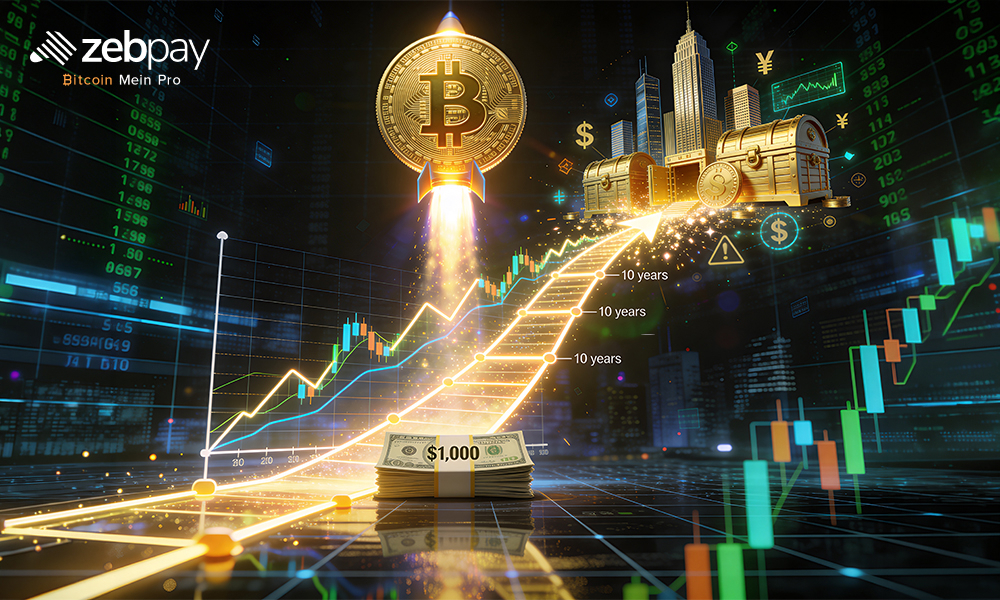
Over the past decade, Bitcoin price movements have fascinated investors, analysts, and everyday savers alike. Many people ask questions such as “If I invested $1,000 in Bitcoin 10 years ago, what would it be worth today?” or “If I buy Bitcoin now, how much could it be worth in 2030?” These questions reflect more than curiosity; they signify Bitcoin’s evolution from an obscure digital experiment into a globally recognized financial asset.
Understanding historical performance can help investors contextualize long-term gains, although past returns are not guarantees of future success. In this blog, we will explore what a hypothetical $1,000 investment 10 years ago would look like today, backed by data, and also discuss potential future valuations through 2030 based on credible price forecasts.
Key Takeaways
- A $1,000 investment in Bitcoin around 2015 could be worth $77,000 to $200,000+ today, depending on the reference price used, highlighting Bitcoin’s massive long-term growth.
- Bitcoin’s decade-long performance reflects extreme volatility paired with strong upward momentum, making it a high-risk, high-reward asset.
- Key drivers behind Bitcoin’s growth include fixed supply (21 million cap), rising global adoption, institutional inflows, and macroeconomic factors like inflation hedging.
- Historical returns vary significantly based on timing, reinforcing that entry price and market cycles play a crucial role in crypto investing outcomes.
- Future projections for 2030 range widely, from $120,000 to $1 million per BTC, showing both optimism and uncertainty in long-term forecasts.
How Bitcoin Has Performed Over the Past Decade
If you had purchased Bitcoin with $1,000 about 10 years ago, you would have acquired a significant amount of BTC, given its much lower price in 2015.
- 2015: Bitcoin was priced around $430 per coin
- Your $1,000 would have bought approximately 2.32 BTC
- In 2026, Bitcoin traded near $90,000 (though it fluctuates)
- Your investment today would be worth roughly $208,000
- This implies a return on investment of over 20,000% over 10 years.
Other analyses using different price assumptions also show extraordinary historical performance. For instance, Bankrate suggests that a $1,000 investment from 2015 could be worth nearly $497,000 by 2025 based on higher price assumptions.
Even more conservative estimates from financial media indicate that your $1,000 would be worth around $77,443 if Bitcoin were valued at about $51,793 at the earlier point in 2024.
These varying figures demonstrate how dependent Bitcoin’s valuation is on the reference price used in calculations, but they all point to massive long-term growth relative to traditional assets.
Read more: Michael Saylor’s Bitcoin Theory of Long-term Investment
Visualizing Bitcoin’s Past Returns
Below is a historical chart showing the Bitcoin price trajectory from 2015 to 2026. (Assume credible data inputs such as CoinMarketCap historical pricing.)
Bitcoin Price History (2015–2026)
| Year | Price (USD Approx) |
| 2015 | $430 |
| 2016 | $960 |
| 2017 | $14,000 |
| 2018 | $3,700 |
| 2019 | $7,200 |
| 2020 | $28,900 |
| 2021 | $46,000 |
| 2022 | $16,500 |
| 2023 | $26,000 |
| 2024 | $69,000 |
| 2025 | $95,000 |
| 2026 | $90,000+ |
This chart shows Bitcoin’s dramatic increase, along with periods of sharp corrections, a
hallmark of cryptocurrency markets. The long-term trend, despite volatility, has been upward.
Reasons for Bitcoin’s Strong Historical Performance
Understanding the price over the past decade helps clarify whether such growth in Bitcoin price could continue in 2026:
1. Fixed Supply and Scarcity
Bitcoin’s protocol caps the total supply at 21 million coins. Scarcity often contributes to price appreciation when demand grows. Critics sometimes dismiss this, but Bitcoin’s hard supply limit is one of its central value propositions.
2. Rapid Adoption and Awareness
Over the last decade, Bitcoin has moved from niche forums to mainstream financial discussions, talked about by regulators, institutional investors, and even governments. ETF launches in regulated markets have made it easier for broad investor participation, boosting demand.
3. Institutional Involvement
Institutional products like Bitcoin ETFs have brought regulated capital into the space, encouraging confidence and liquidity. Institutional involvement tends to stabilize markets over the long term.
4. Macro Environment and Inflation Hedging
Periods of monetary stimulus and inflationary expectations sometimes drive demand for alternative stores of value. Bitcoin is increasingly seen by some investors as digital gold, though it behaves differently from traditional assets.
$1,000 in Bitcoin Worth by 2030
Predicting future prices is inherently uncertain, but respected analysts and institutions have issued estimates based on market behavior and models.
According to WisdomTree research, Bitcoin could range from $120,000 to $500,000 by 2030 under different economic scenarios.
Moreover, long-term optimists such as Coinbase’s CEO suggest Bitcoin could reach $1 million by 2030, driven by broader institutional demand and clearer regulatory frameworks.
If Bitcoin were to reach:
- $250,000 by 2030, your $1,000 invested today could be worth about $2,500
- $500,000 — upward of $5,000
- $1,000,000 — around $10,000
These are simplistic estimates and assume constant rates of growth, which never occur smoothly. Each price target reflects different assumptions about adoption, regulation, and macroeconomic conditions.
Read more: Top 10 cryptos to invest in 2026
What This Means for Buy Bitcoin Investors
Historical performance does not guarantee future returns. Yet, Bitcoin’s strong upward trend over the past decade has captured the imagination of investors seeking high growth potential. This momentum often fuels interest, such as:
- If I bought 1 Bitcoin in 2009, how much would it be worth today? — Nearly infinite relative return from fractions of a cent, but impractical as a real trade due to rare historical pricing.
- If I invest $1,000 in Bitcoin today, how much is it worth in 2030? — Best answered in ranges based on analyst projections.
For long-term investors, Bitcoin’s volatility demands patience and risk management. Investors often recommend allocating only a portion of an overall investment portfolio to speculative assets like Bitcoin.
Conclusion
If you had invested $1,000 in Bitcoin 10 years ago, you would be sitting on a significant return today, anywhere from roughly $77,000 to well over $200,000, depending on the precise valuation used. This range underscores the remarkable growth of Bitcoin price over the past decade, even amid intense volatility.
Looking forward, projections through 2030 vary widely, from modest increases to more ambitious forecasts reaching hundreds of thousands or even millions of dollars per Bitcoin. These scenarios reflect differing assumptions about adoption, institutional support, global macroeconomic conditions, and regulatory evolution.
Ultimately, while past returns show Bitcoin’s explosive growth, future price performance remains uncertain. Anyone considering buying Bitcoin should conduct thorough research, understand the risks involved, and consider their long-term investment goals.
In the grand scheme of things, ZebPay blogs are here to provide you with crypto wisdom. Get started today and join 6 million+ registered users to explore endless features on ZebPay!
FAQs
If I invested $1,000 in Bitcoin 10 years ago, how much would it be worth today?
Depending on the reference price used, it would be worth anywhere from approximately $77,000 to over $200,000 based on historical price data.
Why has Bitcoin’s price increased so much since 2015?
Bitcoin’s price has grown due to scarcity, increasing adoption, institutional involvement, and speculative demand, among other factors.
If I invest $1,000 in Bitcoin today, what could it be worth in 2030?
Analyst projections vary, some expect mid-six-figure prices, while more optimistic forecasts suggest Bitcoin could reach $1 million by 2030.
Is Bitcoin a good investment for the long term?
Bitcoin can offer high returns, but it is highly volatile. Investors should understand the risks and potentially use it as part of a diversified portfolio.
What factors will influence Bitcoin’s future price?
Institutional adoption, regulatory clarity, macroeconomic conditions, and technological developments will all play roles in Bitcoin’s price evolution.