

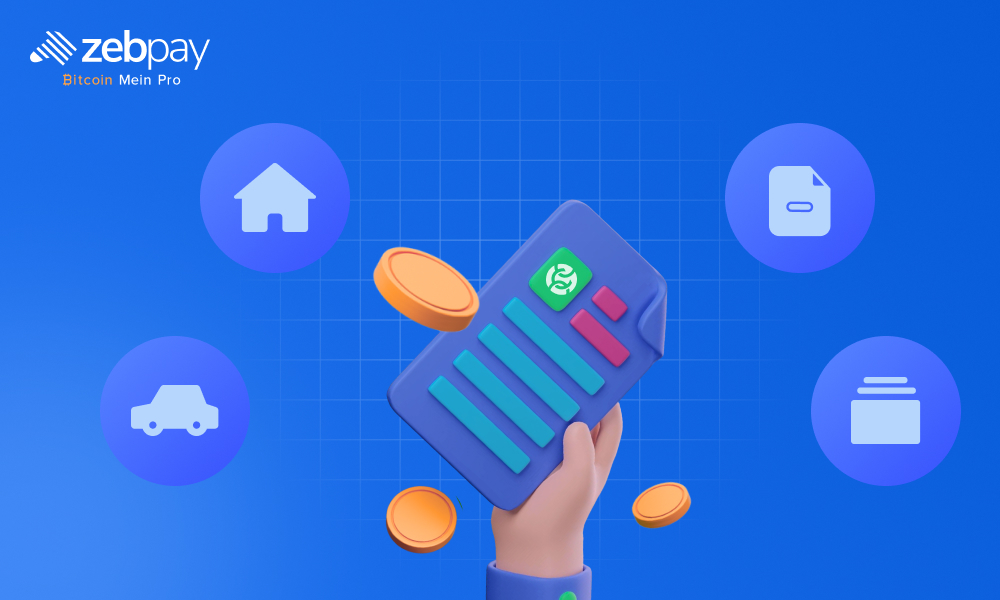


The global financial system is evolving beyond traditional ledgers, paperwork, and intermediaries. As blockchain infrastructure matures, financial institutions, regulators, and asset managers are exploring ways to bring real-world assets onto digital rails. This shift has given rise to Real-World Asset (RWA) tokenization, a model that combines the trust of traditional finance with the efficiency of blockchain technology.
Unlike purely digital cryptos, RWAs represent assets that already exist in the real economy, such as bonds, funds, real estate, or commodities, but are issued, tracked, and settled using blockchain networks. This evolution is not driven by hype. It is driven by the need for better settlement systems, improved transparency, and broader access to financial markets.
What Is RWA Tokenization?
RWA tokenization refers to the process of digitally representing ownership rights or economic claims of real-world assets on a blockchain using cryptographic tokens. Each token corresponds to a specific share, unit, or claim linked to an underlying off-chain asset, supported by legal and regulatory frameworks.
Definition
In traditional finance, asset ownership is recorded across multiple centralized databases, custodians, registrars, clearinghouses, and brokers. Tokenization replaces this fragmented record-keeping with a single, tamper-proof blockchain ledger. Instead of transferring ownership through paperwork and intermediaries, ownership changes are executed through smart contracts and recorded on-chain.
Types of Real-World Assets Being Tokenized
RWA tokenization spans multiple asset classes, each serving different investor and institutional needs.
Financial Instruments
Financial instruments are among the most actively tokenized RWAs today. These include government bonds, treasury bills, corporate debt, and money market funds. Tokenizing these assets allows institutions to automate settlement, reduce counterparty risk, and enable near-instant transfers. For investors, it provides easier access to traditionally complex instruments with greater transparency.
Physical Assets
Physical assets such as real estate, gold, and commodities are also being tokenized. In these cases, tokens represent ownership rights or economic exposure to a physical asset that is securely stored and audited off-chain. Tokenization enables fractional ownership, allowing investors to gain exposure without purchasing the entire asset, while also improving liquidity in traditionally illiquid markets.
Private Market Assets
Private market assets, including private credit, invoices, receivables, and fund units, are increasingly moving on-chain. These assets have historically been difficult to access due to high minimum investments and limited transparency. Tokenization simplifies issuance, enhances reporting, and opens new channels for institutional and accredited investors.
Why Traditional Assets Are Moving On-Chain?
Traditional financial infrastructure is reliable but operationally heavy. Tokenization addresses long-standing inefficiencies by redesigning how assets are issued and settled.
- Faster and More Efficient Settlement
In traditional markets, asset settlement often takes one to three business days, creating delays and exposure to counterparty risk. Tokenized assets can settle in minutes or seconds through smart contracts, significantly improving capital efficiency and reducing settlement risk for institutions and investors alike.
- Reduced Dependence on Intermediaries
Traditional asset transfers require multiple intermediaries to verify, clear, and settle transactions. Tokenization automates many of these functions, reducing reliance on manual processes and lowering operational costs. Smart contracts can handle ownership transfers, interest payments, and corporate actions automatically.
- Improved Transparency and Auditability
Blockchain ledgers provide a single, immutable source of truth. Every transaction is recorded transparently and can be audited in real time. This reduces reconciliation errors, enhances trust among participants, and improves reporting for regulators and investors.
- Programmable Compliance
Tokenized assets can embed compliance rules directly into smart contracts. Restrictions related to jurisdiction, investor eligibility, holding periods, or transfer limits can be enforced automatically. This makes compliance more efficient and scalable compared to traditional monitoring systems.
- Global Accessibility
Blockchain-based assets can be accessed digitally across borders, subject to regulatory permissions. This allows issuers to reach a broader investor base while maintaining regulatory oversight, enabling global participation without the complexity of cross-border settlement systems.
Read more: Tokenization Market to Reach USD18.8 billion by 2032
Benefits of Real-World Asset Tokenization
Fraction Ownership
One of the most significant advantages of RWA tokenization is fractional ownership. High-value assets such as real estate or bonds can be divided into smaller units, enabling investors to participate with lower capital requirements. This democratizes access to assets that were previously restricted to large institutions or high-net-worth individuals.
Liquidity
Tokenization also improves liquidity. Assets that traditionally trade infrequently can be transferred more easily on secondary markets, improving price discovery and market efficiency. This is particularly valuable for private market assets and long-term instruments.
Market Access
Tokenized assets are not limited by traditional market hours, allowing transfers and settlements to occur around the clock. This enhances flexibility for global investors operating across time zones.
Operations
Tokenization significantly reduces costs by automating processes such as reconciliation, settlement, and compliance checks. Over time, these efficiencies can lower fees and improve returns for investors.
DeFi Integration
Tokenized RWAs can integrate seamlessly with decentralized finance (DeFi) platforms, enabling new use cases such as on-chain collateral, yield generation, and programmable financial products backed by real economic value.
Major RWA Tokenization Projects Across Regions
RWA tokenization is gaining momentum globally, with different regions adopting approaches aligned with their regulatory and financial frameworks.
India: Institutional Innovation Through GIFT City
In India, RWA tokenization efforts are primarily centered around GIFT City, an international financial services hub regulated by the International Financial Services Centres Authority (IFSCA). GIFT City provides a controlled environment where banks, fintech firms, and financial institutions can experiment with tokenized bonds, fund units, and other financial instruments.
Several pilot projects have focused on digitizing fund issuance and settlement processes, allowing institutions to explore blockchain efficiencies while remaining compliant with regulatory requirements. GIFT City’s approach reflects India’s focus on innovation within a structured and supervised framework.
Europe: Regulation-Led Tokenization
Europe has emerged as a leader in compliant tokenization initiatives. Institutions such as Siemens and Société Générale have issued tokenized bonds under regulated frameworks. European banks are also exploring tokenized fund distribution and on-chain settlement infrastructure.
The European Union’s DLT Pilot Regime enables regulated entities to test tokenized securities markets under supervision, balancing innovation with investor protection. This has positioned Europe as a hub for institution-grade RWA tokenization.
United States: Large-Scale Institutional Adoption
In the United States, RWA tokenization is being driven by major asset managers and financial institutions. BlackRock’s tokenized money market fund and Franklin Templeton’s on-chain government fund illustrate how blockchain is being integrated into existing capital markets rather than replacing them.
JPMorgan’s Onyx platform further demonstrates how tokenized collateral and settlements can operate at scale. These initiatives highlight the U.S. focus on institutional-grade infrastructure and market depth.
Read more: JP Morgan Launches Kinexys to Accelerate Tokenization
Regulatory Bodies Governing RWA Tokenization
Regulation plays a critical role in the adoption of tokenized RWAs, as these assets intersect with securities, commodities, and financial market laws.
Markets in Crypto-Assets Regulation (MiCA)- European Union
In the European Union, MiCA (Markets in Crypto-Assets Regulation) provides a comprehensive framework governing issuance, custody, disclosure, and investor protection. While MiCA primarily addresses crypto-assets, it creates clarity for tokenized instruments operating within the EU.
Financial Conduct Authority (FCA)- United Kingdom
The Financial Conduct Authority (FCA) in the United Kingdom supports tokenization through regulatory sandboxes and market infrastructure pilots. The FCA’s approach encourages innovation while maintaining strong oversight of financial markets.
Securities and Exchange Commission (SEC)- United States
In the United States, regulatory oversight is shared between the Securities and Exchange Commission (SEC) and the Commodity Futures Trading Commission (CFTC). The SEC regulates tokenized securities, while the CFTC oversees digital assets classified as commodities. Together, they shape the compliance environment for tokenized RWAs.
International Financial Services Centres Authority (IFSCA)- India
In India, the IFSCA regulates tokenization initiatives within GIFT City. Its framework allows controlled experimentation, enabling institutions to explore blockchain-based financial products while ensuring regulatory compliance and investor safeguards.
RWA Tokenization in DeFi
RWA tokenization is increasingly influencing decentralized finance by introducing assets backed by real economic value. Traditionally, DeFi relied heavily on crypto-native assets, which are often volatile. Tokenized RWAs provide more stable and predictable returns, making DeFi protocols more resilient.
Tokenized government bonds, treasury bills, and credit instruments are now being used as on-chain collateral, enabling lending, borrowing, and yield generation backed by real-world cash flows. This integration bridges the gap between traditional finance and decentralized systems, creating hybrid financial models that combine efficiency with stability.
As DeFi matures, RWAs are expected to play a central role in expanding its use beyond speculative activity toward sustainable financial applications.
Conclusion
RWA tokenization represents a fundamental shift in how assets are issued, managed, and transferred. By bringing real-world assets onto blockchain infrastructure, it enhances efficiency, transparency, and accessibility while remaining anchored in regulatory frameworks.
From India’s GIFT City initiatives to Europe’s compliance-driven pilots and large-scale institutional adoption in the United States, tokenized RWAs are steadily becoming part of mainstream financial infrastructure. As regulation evolves and technology matures, RWA tokenization is poised to redefine asset ownership in the digital age.
In the grand scheme of things, ZebPay blogs are here to provide you with crypto wisdom. Get started today and join 6 million+ registered users to explore endless features on ZebPay!
FAQs
What are real-world assets in crypto?
Real-world assets, such as tangible or financial assets like bonds or real estate, are represented on blockchain through tokens.
Is RWA tokenization regulated?
Yes, most RWA tokenization initiatives operate under regulatory oversight, especially for institutional-grade assets.
Can retail investors invest in tokenized RWAs?
Access depends on jurisdiction and asset type. Many offerings are currently limited to institutional or accredited investors.
How do RWAs benefit DeFi?
They introduce stable, real-yield assets that reduce volatility and improve sustainability in DeFi ecosystems.