



Agentic payments are transactions that an AI agent initiates, authorizes, and completes on a person’s behalf, without a human clicking “buy” at the point of sale. The agent works within spending limits set in advance. Instead of a person choosing and paying, the agent plans, decides, and pays.
This shift matters because payment systems were built around a person making each decision. When software makes that decision instead, banks, card networks, and crypto platforms all need new ways to verify who authorized the payment and enforce limits automatically.
Key Takeaways
- Agentic payments let AI agents shop, subscribe, or pay for services on a user’s behalf, inside limits the user sets.
- They differ from autopay or saved cards because the agent decides what to buy, not just when to pay.
- Visa, Mastercard, and Google have each launched protocols (Trusted Agent Protocol, Agent Pay, and AP2) to authorize these transactions.
- In crypto, stablecoins are emerging as the preferred settlement currency because they support instant, low-cost micropayments between machines.
What Are Agentic Payments, Exactly?
Automation in payments is not new. Autopay, subscriptions, and recurring billing have existed for years. Agentic payments go further. An AI agent does not just repeat an instruction; it makes a judgment call.
For example, a user might tell an agent to “book a flight to Singapore under $600, departing next Friday.” The agent searches options, compares prices, picks a flight, and pays, all without further approval. That decision-making step is what separates agentic payments from ordinary automation.
Also Read: What Are AI Coins? A Complete Guide to AI Crypto
How Does an Agentic Payment Actually Work?
Most agentic payment systems follow a similar sequence, whether the rail is a card network or a blockchain.
First, the user sets rules with the agent, such as a spending cap, approved merchants, or a monthly budget. Second, the agent identifies something to buy and checks it against those rules. Third, the agent signs a payment request using a credential tied to both its own identity and the user’s authorization. Fourth, the payment network or blockchain verifies that signature and settles the transaction. Finally, the merchant delivers the product or service, and the user sees the transaction on their statement or wallet.
This structure exists so that a payment can be traced back to a specific person’s consent, even though no human clicked “confirm” in real time.
Also Read: Top 5 AI Crypto Coins of August 2026
What Are Some Agentic Payments Examples?
A few use cases are already live or in active pilots. AI shopping assistants inside chat interfaces, such as ChatGPT Shopping, can complete a purchase once a user approves a budget. Subscription and travel booking agents compare providers and lock in the best deal automatically. On the business side, procurement agents place recurring supplier orders without a manual approval chain for every purchase.
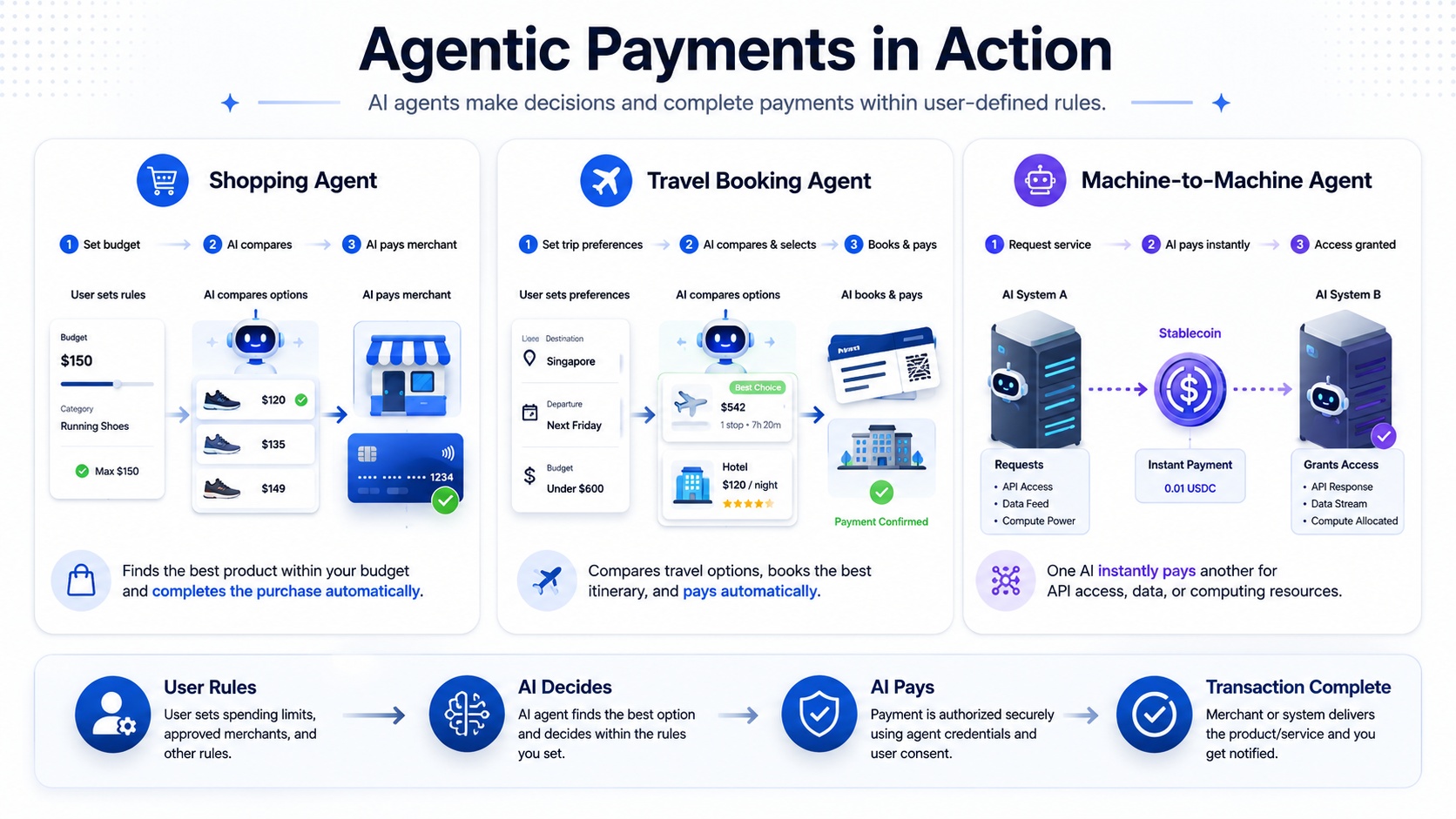
A newer category is machine-to-machine payments, where one AI system pays another for something like a data feed, an API call, or a compute cycle. These payments are often worth only a few cents, which is where crypto rails start to matter.
Also Read: How to Choose AI for Crypto Trading?
Agentic Payments in Crypto: Why Stablecoins Fit This Model
Card networks charge fees and processing time that make sense for a $50 purchase but not for a $0.01 API call. Stablecoins solve that problem because they settle almost instantly and cost very little to move, which makes micropayments between machines practical for the first time.
Coinbase’s x402 protocol is the best-known example. It works by reviving an old, unused piece of the internet’s technical standard, the HTTP “402 Payment Required” status code. When an AI agent requests something like a data feed, the server responds asking for payment. The agent sends a stablecoin payment, usually in USDC, and the server delivers the resource once payment is confirmed.
x402 has drawn backing from a wide coalition that includes Google, Visa, Mastercard, AWS, and Circle, and reporting from March 2026 put its cumulative transaction count above 150 million across multiple blockchains. At the same time, other reporting from around the same period found actual daily payment volume to be far smaller than the protocol’s ecosystem valuation would suggest, with much of the recorded activity attributed to testing rather than genuine commerce. Both figures are worth checking closer to publication, since this space is moving fast.
Who Is Building the Rails for Agentic Payments?
A handful of major players are shaping how these payments get authorized. Mastercard launched Agent Pay, which issues a tokenized card credential scoped to a specific AI agent and merchant. Visa followed with what has since become its Intelligent Commerce program, including a Trusted Agent Protocol that verifies an agent’s identity before a transaction clears.
Google took a different approach with AP2, an open protocol rather than a card network product. AP2 uses signed digital records called mandates to capture what a user wants, what the agent selected, and what was actually charged. It is designed to work across both card payments and stablecoins, which is why Coinbase, Mastercard, and PayPal all joined as launch partners.
What Risks Come With Agentic Payments?
Agentic payments raise questions that current rules were not built to answer. Regulations like Europe’s Strong Customer Authentication requirements assume a human authorizes each payment, which does not map cleanly onto an AI agent acting independently. Regulators are now discussing a shift from verifying a customer’s identity to verifying an agent’s identity, sometimes called “Know Your Agent.”
Liability is another open question. If an agent overspends, buys the wrong item, or gets manipulated into an unauthorized purchase, it is not yet fully settled who bears that cost: the user, the platform, or the payment network. These are the kinds of gaps that are likely to shape how quickly agentic payments scale.
The Road Ahead
Agentic payments are still early. Adoption forecasts vary widely, and the gap between projected market size and current real-world usage is one to watch rather than assume away. What is clear is that major payment networks, crypto platforms, and AI companies are all building toward the same outcome: a world where software can transact on a person’s behalf, inside rules that person sets.
In the grand scheme of things, ZebPay blogs are here to provide you with crypto wisdom. Get started today and join 6 million+ registered users to explore endless features on ZebPay!
FAQs
Is it safe to let an AI agent make payments for me?
Most current systems use spending limits, approved merchant lists, and cryptographic authorization records to reduce risk, though the technology and regulation around it are still maturing.
What are agentic payments in simple terms?
They are payments an AI agent makes on your behalf, based on rules you set in advance, without you approving each transaction.
Can I set a spending limit for an AI agent?
Yes. Systems like Google’s AP2 and Mastercard’s Agent Pay are built around user-defined limits, such as a maximum amount per transaction or per month.
What happens if an AI agent makes a wrong purchase?
This is still an unresolved area. Liability rules for agent errors are being actively discussed by regulators and payment networks, and clear standards are not yet in place everywhere.