

India’s digital asset market has expanded significantly, giving users access to a growing range of platforms for buying, selling and managing crypto assets. As the number of crypto exchanges in India continues to grow, factors such as security, regulatory compliance, INR access, trading options, fees and overall user experience have become increasingly important. This guide covers 10 crypto exchanges in India in 2026, offering an overview of each platform, its key offerings and the services available to users across the country.
The 10 Exchanges
| Exchange | FIU-Registered | Key Strength |
| ZebPay | ✅ Yes | Security & Trust |
| CoinDCX | ✅ Yes | Advanced Trading |
| Mudrex | ✅ Yes | Beginner-Friendly |
| Coinbase | ✅ Global | Institutional Focus |
| Binance | ✅ Global | Trading Variety |
| Delta Exchange | ✅ Yes | Derivatives Focus |
| KuCoin | ✅ Global | Global Market Access |
| Unocoin | ✅ Yes | Longevity |
| Bitbns | ✅ Yes | Coin Diversity |
| CoinSwitch | ✅ Yes | User Accessibility |
Note: This article is intended solely for informational purposes and provides a general overview of crypto exchanges functional in India; the order of exchanges does not represent a ranking or indicate any preference by ZebPay. Users should independently verify the latest information about each platform.
ZebPay
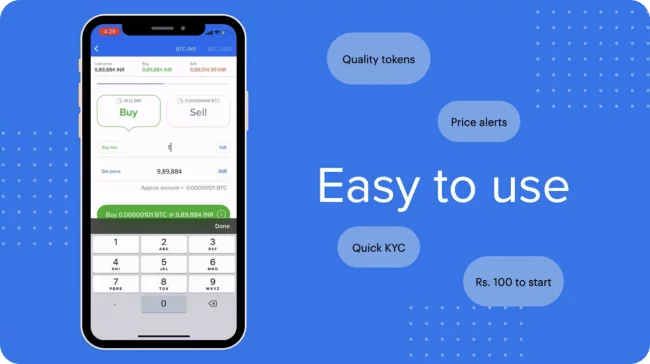
ZebPay has established its reputation as India’s most secure crypto exchange and one of the best platforms for crypto trading since its launch in 2014. With millions of users, it prioritizes cold wallet storage for the majority of funds and maintains a perfect security record with no major breaches. The platform offers a wide selection of crypto assets, including major coins and emerging tokens, supported by smooth INR deposit options through popular banking methods. ZebPay offers an intuitive mobile app featuring advanced charting tools, real-time price alerts, and portfolio tracking capabilities. Its customer support team offers assistance in multiple Indian languages around the clock.
Trading Features
- Quick Trade: Buy/sell crypto in INR and USDT
- Perpetual Futures: Leverage up to 75x
- CryptoPacks: Invest in expert-curated crypto portfolios with just one click
- SIP: Make systematic, recurring crypto investments
- OTC: Personalized services for HNIs and institutions
Key Products
- Portfolio: Track profit and loss
- Earn: Passive crypto returns up to 10%
- Affiliate Program: Partner with ZebPay and earn up to 30% revenue share
- API Services: API services for both Perpetual Futures and spot trading
- Pricing: Enjoy minimum fees on crypto withdrawals and deposits
- TDS: Automatically deducted
- Support: 24/7 support system
Also Read: Top 10 Cryptos to Invest in 2026
CoinDCX
CoinDCX caters to both retail and advanced traders. The platform offers spot trading, futures and margin trading, with access to hundreds of crypto assets and markets. It is registered with FIU-IND and states that it follows Indian anti-money laundering requirements, while also holding ISO/IEC 27001:2022 certification. CoinDCX also provides educational resources through DCX Learn, covering topics such as crypto trading, derivatives and technical analysis. Its platform includes both a simplified investing experience and CoinDCX Pro for advanced trading.
Mudrex
Mudrex offers crypto investment and trading services, with Coin Sets providing curated baskets of crypto assets based on different themes and market segments. These baskets are designed to provide exposure to multiple assets while reducing the need to manage each token individually, with the allocations rebalanced automatically according to predefined rules. Mudrex also provides educational content through its Learn platform, covering crypto assets, investing and related market concepts. Its platform includes spot trading, futures, SIPs and other investment options, along with INR-based access for Indian users.
Coinbase
Coinbase is a global crypto exchange that entered the Indian retail market with direct INR deposits and withdrawals in 2026. The platform offers spot trading and perpetual futures, along with Coinbase Advanced for users seeking more advanced trading functionality. Its security measures include encryption, two-factor authentication, security-key support and cold storage for customer assets. Coinbase also provides educational resources through Coinbase Learn, covering crypto assets and related concepts. In India, the exchange is registered with FIU-IND and operates within the applicable Indian compliance framework.
Also Read: Top 10 Layer-2 Blockchain Cryptos in 2026
Binance
Binance is a global crypto exchange, and provides Indian users with access to a broad range of crypto markets and services. The platform offers Spot, Margin and Futures markets, along with other products across its wider ecosystem. Its P2P marketplace supports INR transactions, with users able to trade with verified merchants. Binance also provides tools such as trading bots and copy trading, alongside services for discovering and accessing new crypto projects. The platform caters to different levels of trading experience, with options ranging from straightforward crypto purchases to more advanced trading tools.
Delta Exchange
Delta Exchange focuses primarily on crypto derivatives, offering futures and options on assets such as Bitcoin and Ether. Users can trade these contracts without directly holding the underlying crypto assets, with INR deposits and withdrawals available through the platform. Its derivatives markets support leverage, with maximum levels varying by contract, while features such as Strategy Builder, basket orders and TradingView integration provide additional tools for derivatives trading. Delta Exchange is operated by Excelium Technologies Private Limited, which is registered with FIU-IND.
Also Read: Top 10 Layer-1 Blockchain Cryptos in 2026
KuCoin
KuCoin is a global crypto exchange operating in the Indian market and was among the early international exchanges to register with FIU-IND. It offers access to a wide selection of crypto assets and markets, with services including spot, futures, margin and P2P trading. For Indian users, the platform supports P2P transactions and has implemented measures related to local tax and compliance requirements, including TDS deductions where applicable. KuCoin has also announced plans to develop localised payment options and strengthen its India-focused operations through a dedicated local team.
Unocoin
Founded in July 2013, Unocoin was among the earliest crypto platforms to enter India’s digital asset market and has been serving Indian users for more than a decade. The platform provides access to Bitcoin and other crypto assets through INR-based buying and selling, along with exchange and trading services. Unocoin also offers its Systematic Buying Plan (SBP), which enables users to schedule recurring purchases of Bitcoin and Ether. Its long operating history and focus on the Indian market have made it a longstanding participant in the country’s crypto ecosystem.
Bitbns
Bitbns is an Indian crypto exchange offering access to digital assets, including established crypto assets and a range of other tokens. The platform provides users with access to multiple crypto markets through its trading services, along with options such as automated buying and selling and systematic investment plans through Bitdroplet. Bitbns is operated by Buyhatke Internet Private Limited, which is registered with FIU-India as a Virtual Digital Asset Service Provider.
Also Read: 10 Cryptos to Buy Under $1 in 2026
CoinSwitch
CoinSwitch is an India-focused crypto trading platform that provides users with a simple way to buy, sell and manage digital assets. The platform allows users to start investing with as little as ₹100 and supports INR deposits through UPI and bank transfers. It offers access to a broad range of crypto assets, including Bitcoin, Ethereum and other digital assets, through its mobile app and web platform. CoinSwitch is registered with FIU-India and also holds ISO/IEC 27001:2022 certification for information security.
What to Consider When Choosing an Exchange
When choosing a crypto exchange, consider factors that affect security, accessibility, trading experience and regulatory compliance. For users comparing crypto exchanges in India, FIU-IND registration is an important consideration, along with security measures such as cold storage and multi-factor authentication.
INR deposit and withdrawal options should be convenient and compatible with widely used banking methods. It is also worth assessing the range of supported crypto assets based on your investment needs, as well as the functionality of the mobile app. Finally, reliable customer support can be particularly valuable when markets are moving rapidly and timely assistance is required.
The right exchange ultimately depends on your individual requirements, preferences, and priorities. Before choosing a platform, one should conduct their own research and review factors such as its regulatory status, available services, fees, security practices, and terms to determine whether they align with their needs.
Also Read: CLARITY Act Fails to Advance in U.S. Senate
Conclusion
India’s crypto exchange landscape has become increasingly diverse, with platforms catering to different trading preferences, experience levels and investment requirements. While some exchanges focus on advanced trading tools and broader asset selection, others place greater emphasis on security, education, accessibility or ease of use.
As the market continues to develop, regulatory compliance, technology, security and user experience are likely to remain central to how crypto exchanges in India evolve. For users, comparing these factors alongside INR access, available features, and individual requirements can help identify a platform that aligns with their approach to digital asset investing and trading.
In the grand scheme of things, ZebPay blogs are here to provide you with crypto wisdom. Get started today and join 6 million+ registered users to explore endless features on ZebPay!
FAQs
How do FIU regulations impact crypto exchanges in India?
FIU (Financial Intelligence Unit) regulations require crypto exchanges operating in India to follow strict anti-money laundering (AML) and compliance measures. Registered exchanges must conduct KYC verification, monitor suspicious transactions, maintain transaction records, and report specific activities to authorities when required. These regulations aim to improve transparency, strengthen investor protection, and reduce the misuse of digital assets for illegal activities. As a result, many users today prefer trading on top crypto exchanges that are FIU-registered and compliant with Indian regulatory requirements.
What is the difference between spot trading and futures trading on crypto exchanges?
Spot trading involves the direct buying and selling of crypto assets at the current market price, where users own the actual asset after the transaction. Futures trading, on the other hand, allows traders to speculate on the future price of crypto assets without necessarily owning the underlying asset. Futures markets also often include leverage, which can amplify both profits and losses. Many top crypto exchanges offer both spot and futures trading to cater to different trading strategies and risk appetites.
How do crypto exchanges store user funds securely?
Crypto exchanges typically use a combination of hot wallets and cold wallets to secure user funds. Cold wallets, which are stored offline, are commonly used for holding the majority of customer assets to reduce hacking risks, while hot wallets support daily transaction activity. In addition, top crypto exchanges implement multiple security measures such as two-factor authentication (2FA), encryption protocols, withdrawal whitelisting, and regular security audits to enhance platform safety.
What role does liquidity play when choosing a crypto exchange?
Liquidity refers to how easily crypto assets can be bought or sold on an exchange without significantly impacting the asset’s price. High liquidity generally leads to faster trade execution, tighter bid-ask spreads, and lower chances of price slippage during transactions. This is particularly important for active traders and institutional participants. Top crypto exchanges often attract larger trading volumes, which helps maintain stronger liquidity across multiple trading pairs.
How do crypto exchanges handle compliance and KYC verification in India?
Crypto exchanges in India typically follow KYC (Know Your Customer) and AML (Anti-Money Laundering) guidelines to comply with regulatory expectations. Users are generally required to submit documents such as PAN cards, Aadhaar cards, and proof of address for identity verification before accessing trading services. Many top crypto exchanges also use automated verification systems, transaction monitoring tools, and risk assessment frameworks to strengthen compliance and improve platform security.
What are the risks of using unregulated crypto exchanges?
Using unregulated crypto exchanges can expose users to several risks, including weak security measures, lack of customer protection, poor transparency, and limited legal recourse in case of disputes or fund losses. Such platforms may also operate without proper compliance standards, increasing the risks of fraud, market manipulation, or sudden operational shutdowns. This is why many users prefer top crypto exchanges that follow regulatory guidelines, maintain transparent operations, and implement stronger security and compliance practices.