

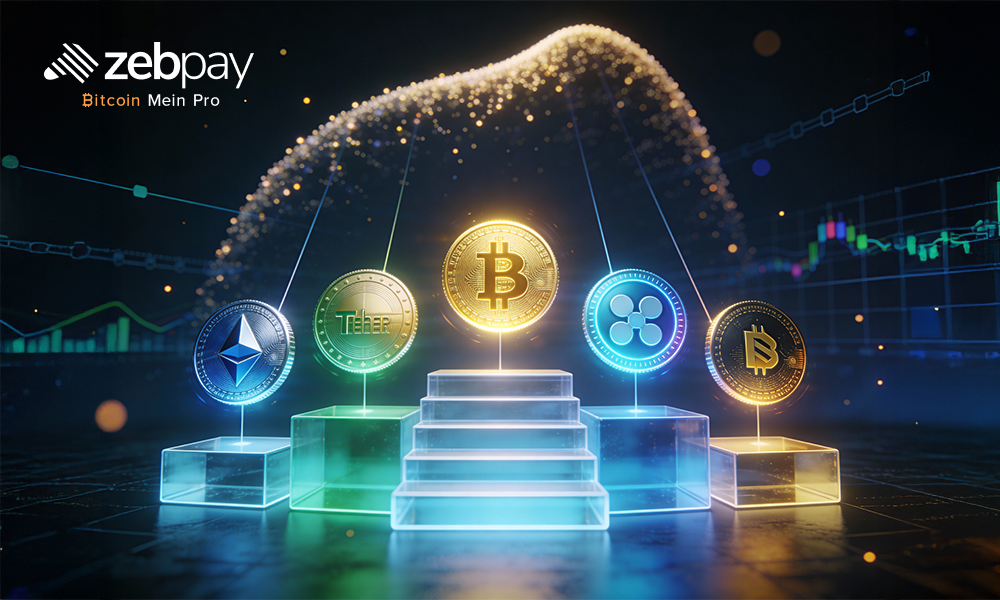


The crypto market has evolved from a niche experiment into a multi-trillion-dollar financial ecosystem. While thousands of digital assets exist today, only a handful dominate the market in terms of adoption, liquidity, and influence. These assets collectively shape the total crypto market capitalization, often acting as bellwethers for broader market trends.
Understanding the top 5 cryptos by market cap is not just about rankings; it’s about grasping which blockchain networks, financial instruments, and payment protocols are driving real-world use cases, institutional interest, and long-term value creation.
This article explores the five largest crypto coins by market capitalization, explaining their market size, core use cases, and why market insiders continue to track them closely.
Read more: Top 10 crypto to invest in 2026
Bitcoin (BTC): The Benchmark of the Crypto Market
Bitcoin remains the undisputed leader of the crypto market and continues to set the tone for the entire industry.
As of recent market data, the bitcoin coin market cap stands well above $1 trillion, making BTC not only the largest crypto but also one of the most valuable financial assets globally. The BTC market cap alone accounts for a significant portion of the total crypto market capitalization, highlighting Bitcoin’s outsized influence.
Bitcoin was created as a decentralized alternative to traditional money, with a fixed supply of 21 million coins. This scarcity-driven design has positioned Bitcoin as a digital store of value, often compared to gold.
From a market insider’s perspective, Bitcoin is widely viewed as the entry point for institutional capital into crypto. Exchange-traded products, corporate treasury allocations, and long-term holding strategies are predominantly Bitcoin-focused, reinforcing its role as the market’s anchor asset.
Why Bitcoin continues to dominate:
- Bitcoin’s fixed supply creates scarcity-driven demand over time.
- Its decentralized and censorship-resistant design appeals during macroeconomic uncertainty.
- Institutional adoption has made BTC the most liquid and trusted crypto asset.
- Bitcoin often dictates broader market cycles, earning it the title of “crypto’s reserve asset.”
Ethereum (ETH): The Backbone of Smart Contracts
Ethereum is the second-largest crypto asset and the most influential blockchain platform beyond Bitcoin.
The Ethereum market cap consistently ranks just behind BTC, typically exceeding $400–500 billion, depending on market conditions. Unlike Bitcoin, Ethereum is not just a digital asset; it is an entire programmable blockchain ecosystem.
Ethereum introduced smart contracts, enabling developers to build decentralized applications (dApps), decentralized finance (DeFi) protocols, NFTs, and tokenized assets. This versatility has made Ethereum the foundation layer for much of the crypto economy.
Market insiders often describe Ethereum as the operating system of Web3. The network’s transition to proof-of-stake significantly reduced its energy consumption, strengthening its long-term sustainability narrative.
Why Ethereum remains critical to crypto markets:
- Ethereum powers DeFi, NFTs, and tokenized financial products.
- ETH is used as “fuel” to execute transactions and smart contracts.
- Proof-of-stake has improved network efficiency and scalability.
- Institutional interest is growing due to real-world asset tokenization use cases.
Tether (USDT): The Liquidity Engine of Crypto Markets
Tether occupies a unique position among the top 5 crypto assets by market cap because it is not designed to appreciate.
With a tether market cap exceeding $100 billion, USDT is the largest stablecoin and one of the most heavily traded crypto assets globally. It is pegged to the US dollar, meaning 1 USDT is intended to maintain a value of $1.
Tether’s primary role is to provide liquidity and price stability within crypto markets. Traders and institutions use USDT to move funds quickly between exchanges, hedge against volatility, and settle transactions without relying on traditional banking rails.
From a market insider’s lens, Tether functions as the financial plumbing of crypto markets. During periods of high volatility, stablecoin flows often signal risk-on or risk-off sentiment across the ecosystem.
Why Tether is central to crypto trading:
- USDT enables fast, borderless value transfers.
- It acts as a bridge between fiat currencies and crypto assets.
- Stablecoin liquidity supports efficient price discovery.
- High trading volume makes USDT essential for market stability.
Binance Coin (BNB): Utility Meets Exchange Economics
Binance Coin (BNB) represents a different category within large-cap crypto, exchange-linked utility tokens.
The market cap of BNB typically places it among the top five cryptocurrencies globally, reflecting its deep integration within the Binance ecosystem. BNB is used to pay transaction fees, access token launches, and interact with applications built on the BNB Chain.
Unlike Bitcoin or Ethereum, BNB’s value is closely tied to the activity and growth of its underlying ecosystem. Token burns, which periodically reduce supply, have historically supported BNB’s valuation.
Market insiders often view BNB as a proxy for centralized exchange activity, blending elements of utility, governance, and ecosystem participation.
Why BNB remains a top crypto asset:
- BNB offers fee discounts and platform-specific benefits.
- Its deflationary token-burning mechanism reduces the circulating supply.
- The BNB Chain supports DeFi, gaming, and NFT projects.
- Strong ecosystem usage drives consistent demand for the token.
XRP (Ripple): Payments at Institutional Scale
XRP is one of the longest-standing crypto assets and remains among the top 5 crypto assets by market cap despite regulatory challenges.
The XRP market cap typically ranges in the tens of billions of dollars, reflecting its continued relevance in cross-border payment infrastructure. XRP is designed to facilitate fast, low-cost international transactions, particularly for financial institutions.
Ripple’s payment network aims to replace or complement legacy systems like SWIFT by enabling near-instant settlement across borders. XRP acts as a bridge currency, reducing the need for pre-funded nostro accounts.
From a market insider’s perspective, XRP’s value proposition lies in enterprise adoption, not retail speculation. Its future is closely tied to regulatory clarity and institutional partnerships.
Why XRP still commands market attention:
- XRP enables near-instant global payments.
- Low transaction costs make it suitable for high-volume transfers.
- Financial institutions test XRP for cross-border settlements.
- Regulatory developments significantly influence its market outlook.
Why Market Capitalization Still Matters?
Market capitalization remains one of the most useful metrics for evaluating cryptocurrencies because it reflects adoption, liquidity, and investor confidence.
The top 5 crypto by market cap, Bitcoin, Ethereum, Tether, Binance Coin, and XRP, each serve distinct roles within the crypto ecosystem. Together, they account for a substantial share of the total crypto market capitalization, shaping market sentiment and capital flows.
For investors and learners alike, understanding these assets provides a clearer picture of how the crypto market functions beyond short-term price movements.
In the grand scheme of things, ZebPay blogs are here to provide you with crypto wisdom. Get started today and join 6 million+ registered users to explore endless features on ZebPay!
FAQs
What does market capitalization mean in crypto?
Market capitalization is calculated by multiplying a cryptocurrency’s current price by its circulating supply, indicating its overall market value.
Why is Bitcoin the largest crypto by market cap?
Bitcoin’s fixed supply, strong security, and widespread adoption have made it the most trusted and valuable crypto asset.
Is Ethereum more useful than Bitcoin?
Ethereum focuses on smart contracts and applications, while Bitcoin primarily serves as a store of value. Their use cases are different, not competitive.
Why is Tether among the top crypto?
Tether provides price stability and liquidity, making it essential for trading and fund transfers across crypto markets.
Does a higher market cap mean lower risk?
Generally, higher market-cap cryptocurrencies are considered more stable, but they are still subject to market volatility and risk.