

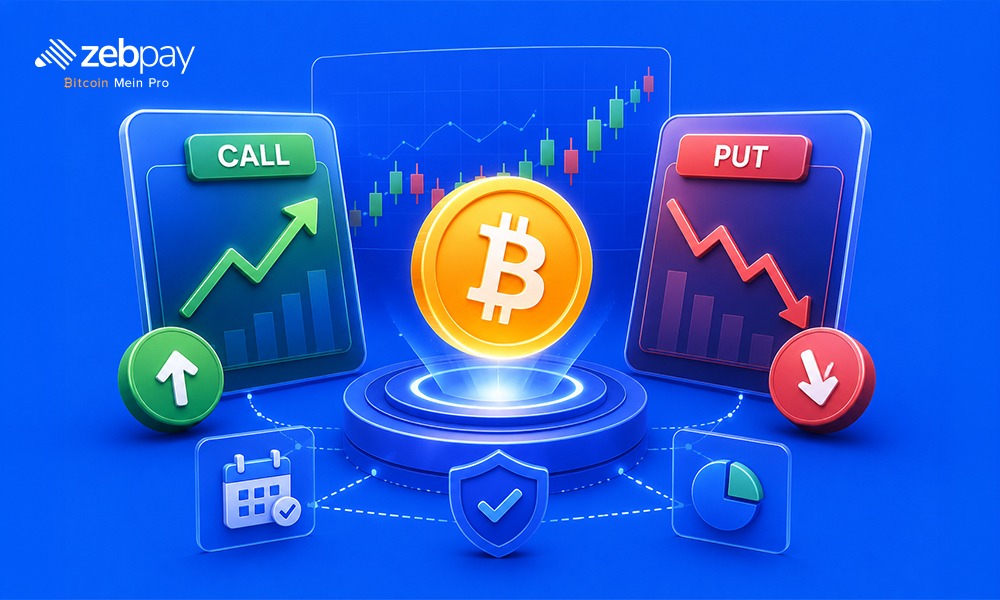


Bitcoin option trading means buying or selling contracts tied to Bitcoin’s price, without owning the coin itself. A Bitcoin option gives you the right, but not the obligation, to buy or sell BTC at a fixed price before a set expiry date. Traders use crypto options to hedge existing positions or speculate on price movements, risking only the premium rather than the full trade value.
That single feature, limited risk for the buyer, is what separates option trading from futures or spot trading. It also explains why more traders are exploring crypto options as the derivatives market matures. This guide breaks down how Bitcoin options work, the terms you need to know, and how to actually trade options with a clear head.
Key Takeaways
- A Bitcoin option gives the right, not the obligation, to buy or sell BTC at a fixed price.
- Call options profit when Bitcoin rises; put options profit when it falls.
- The premium paid upfront is the maximum loss for an option buyer.
- Strike price, expiry date, and implied volatility together determine an option’s value.
- Deribit, Binance, OKX, and Bybit currently handle most global Bitcoin options volume.
- Options suit traders who already understand spot and futures trading, not first-time beginners.
Also Read: What Are Crypto Options? A Complete Guide!
How Bitcoin Options Work
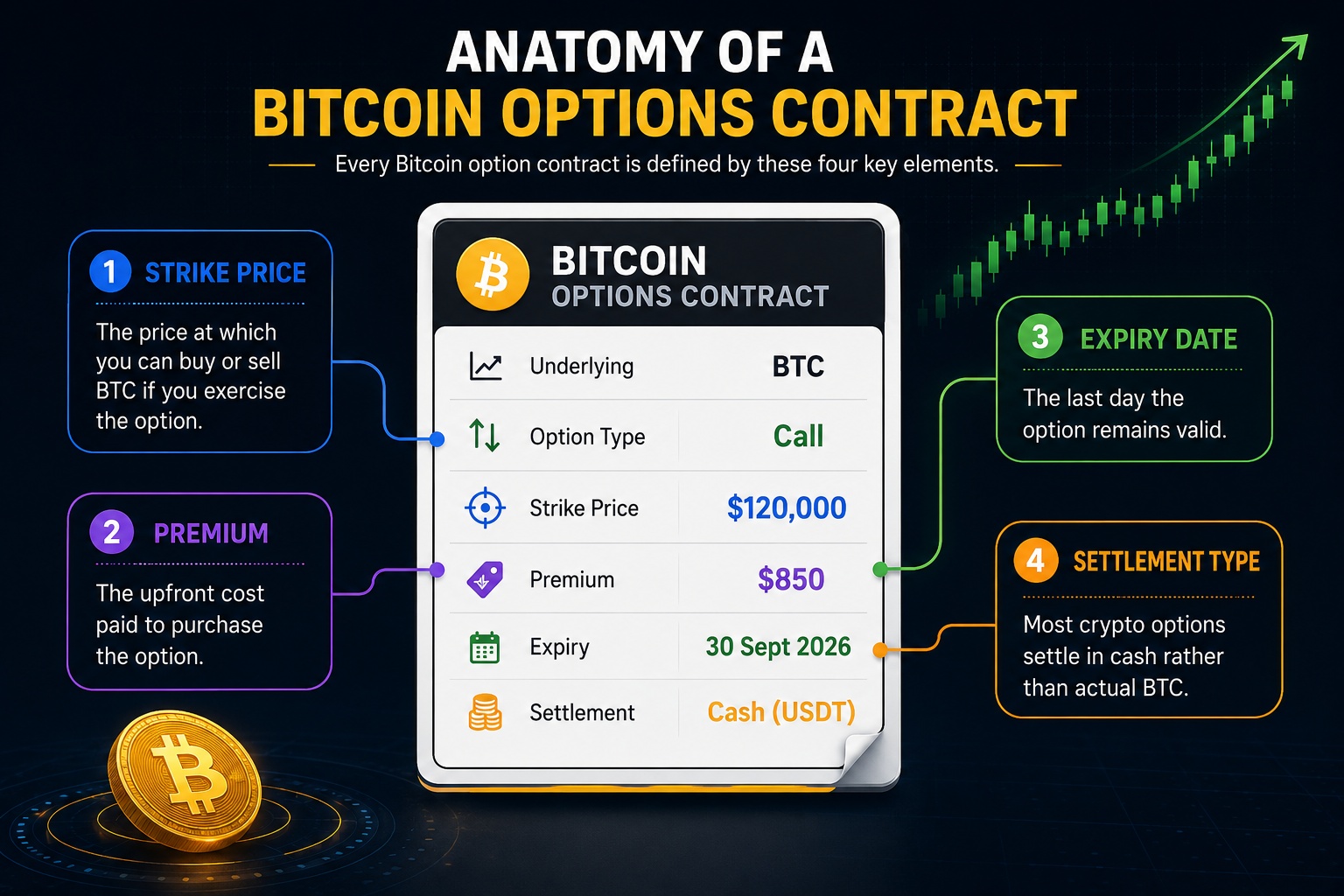
A Bitcoin option is a derivative contract. Its value comes from Bitcoin’s market price, not from holding the coin. Every contract has four moving parts: a strike price, a premium, an expiry date, and a settlement method.
The strike price is the level at which you can buy or sell Bitcoin if you exercise the option. The premium is what you pay upfront to hold that right. As expiry nears, the option’s price shifts faster because less time remains for Bitcoin to move in your favour.
Most crypto options settle in cash rather than the actual coin. That means profits or losses get credited in USDT or USD value, not in BTC. This makes Bitcoin options easier to manage than physically settled contracts.
Call Options vs. Put Options
Bitcoin options split into two types, and picking the right one depends entirely on your market view.
Call options give you the right to buy Bitcoin at the strike price. Traders buy calls when they expect prices to rise. If Bitcoin climbs well above the strike, the call gains value fast.
Put options give you the right to sell Bitcoin at the strike price. Traders buy puts when they expect prices to fall, or when they want to protect an existing BTC holding from a downturn.
In both cases, if the market moves against you, you simply let the option expire. Your loss stays capped at the premium you paid, which is the core appeal of option trading over futures.
Key Terms Every Trader Should Know
Before you trade options, a handful of terms will keep showing up. Understanding them upfront saves confusion later.
- Strike price: The fixed price at which the option can be exercised.
- Premium: The cost of the contract, paid by the buyer to the seller.
- Expiry date: The last date the option remains valid.
- Implied volatility (IV): The market’s expectation of future price swings. Higher IV usually means a higher premium.
- In-the-money (ITM): An option that would be profitable if exercised right now.
- Out-of-the-money (OTM): An option that would not be profitable if exercised right now.
- Open interest: The total number of active, unsettled option contracts, often used as a gauge of market interest at a given strike.
Also Read: How to Keep Your Crypto Safe with Cold Wallets?
Common Bitcoin Options Trading Strategies
Once the basics click, traders combine calls and puts into structured strategies. Each one fits a specific market outlook.
- Long call: Buy a call when you expect Bitcoin to rise. Loss is capped at the premium; upside is theoretically unlimited.
- Long put: Buy a put when you expect Bitcoin to fall, or to insure an existing holding against a drop.
- Covered call: Hold Bitcoin while selling a call against it. This generates premium income but caps your upside if BTC rallies hard.
- Protective put: Hold Bitcoin while buying a put as insurance. It softens the impact of a sharp price drop.
- Straddle: Buy a call and a put at the same strike and expiry. This works when you expect a big move but aren’t sure of the direction, such as around a major macro event.
- Calendar spread: Use two options at the same strike but different expiry dates, aiming to profit from the difference in time decay. This is an advanced strategy best left until you’re comfortable with the basics.
How to Trade Bitcoin Options?

Step 1: Learn spot and futures trading first
Options behave differently, and that foundation makes premiums and expiry easier to interpret.
Step 2: Set a clear goal
Decide whether you’re hedging an existing position or taking a fresh directional bet.
Step 3: Pick call or put
This depends entirely on whether you expect Bitcoin to rise or fall before expiry.
Step 4: Choose a strike price
Strikes closer to the current market price cost more but need a smaller move to profit.
Step 5: Check the premium
A high IV environment inflates premiums, even if Bitcoin’s price stays flat.
Step 6: Confirm the expiry
Shorter expiries decay faster; most crypto options settle in cash.
Step 7: Place the trade and size it small
Options can move quickly, so position sizing matters more here than in spot trading.
Step 8: Track the position and plan your exit
Decide in advance whether you’ll exit early, hold to expiry, or roll the position.
Risks to Weigh Before You Trade Options
Options limit the buyer’s loss to the premium, but that doesn’t make them low risk. Premiums can expire worthless entirely, and that happens more often than new traders expect.
Sellers of options, unlike buyers, can face losses far larger than any premium collected. Implied volatility can also swing sharply around news events, inflating or collapsing premiums within hours.
Liquidity varies by strike and expiry too. Thinly traded contracts can be hard to exit at a fair price, especially during high-volatility periods. Treat Bitcoin options as an advanced instrument, not an entry point into crypto trading.
Conclusion
Bitcoin options give traders a structured way to manage risk or express a market view, without committing to the full cost of owning BTC. They reward preparation: understanding strike price, premium, and expiry before placing a single trade.
ZebPay is building out Crypto Options for BTC and ETH, designed for traders who already understand how derivatives work. In the grand scheme of things, ZebPay blogs are here to provide you with crypto wisdom. Get started today and join 6 million+ registered users to explore endless features on ZebPay!
FAQs
What is crypto options trading, in simple terms?
Crypto options trading means buying contracts that give you the right to buy or sell a cryptocurrency at a set price later. You pay a premium upfront, and your maximum loss as a buyer is limited to that amount.
Can I lose more than my premium when I trade options?
As a buyer, no. Your loss is capped at the premium paid. As a seller, yes, losses can exceed the premium collected if the market moves sharply against your position.
Is Bitcoin options trading suitable for beginners?
Not usually. Options involve concepts such as implied volatility and time decay that are easier to grasp once you first understand spot and futures trading.
How much money do I need to start trading Bitcoin options?
There’s no fixed minimum. Costs depend on the premium of the contract you choose, which varies with strike price, expiry, and volatility.
Are Bitcoin options the same as Bitcoin futures?
No. Futures obligate both parties to complete the trade at expiry. Options only give the buyer a right, which they can choose not to exercise.