

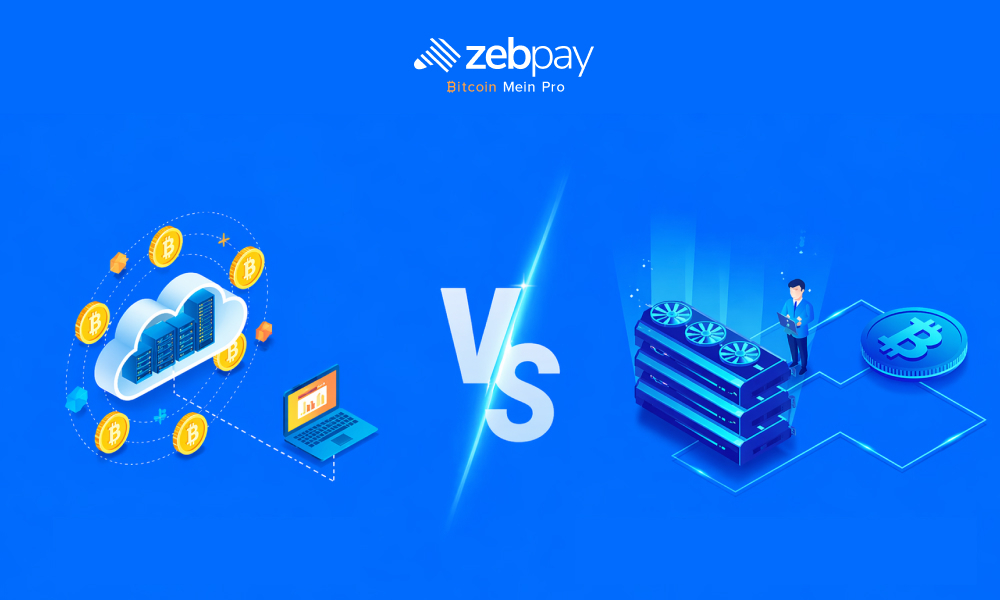
Crypto mining remains one of the most talked-about ways to earn digital assets like Bitcoin. But in 2026, miners face the question, “Should you invest in hardware or opt for cloud mining?” Both approaches promise passive income, yet their profitability, risks, and entry barriers differ significantly.
This guide breaks down cloud mining vs traditional Bitcoin mining, helping you understand which option is more profitable based on costs, scalability, and market conditions.
What is Crypto Mining?
At its core, crypto mining is the process of validating transactions on a blockchain network and earning rewards in return. In the case of Bitcoin, miners use computational power to solve complex mathematical problems and secure the network.
The faster and more efficiently you solve these problems, the higher your chances of earning mining rewards.
What is Traditional Crypto Mining?
Traditional crypto mining, also known as hardware mining, involves setting up physical mining equipment such as ASIC (Application-Specific Integrated Circuit) machines or GPUs.
How it works
You buy mining hardware, install software, and run it continuously to solve cryptographic puzzles. The process consumes significant electricity and requires cooling systems to prevent overheating.
Key characteristics
- High upfront investment (hardware + setup)
- Requires technical knowledge
- Ongoing electricity and maintenance costs
- Full control over mining operations
Example
A Bitcoin miner may invest in ASIC rigs like Antminer devices and run them 24/7 to earn BTC rewards.
What is Crypto Cloud Mining?
Crypto cloud mining allows users to mine cryptocurrencies without owning or managing physical hardware. Instead, you rent computing power from a remote data center.
How it works
You sign up with a cloud mining provider, choose a contract (hash rate + duration), and pay upfront or via subscription. The provider handles everything, from hardware to maintenance.
Key characteristics
- No hardware ownership
- Lower technical barrier
- Fixed contract-based returns
- Less operational control
Cloud Mining vs Traditional Mining: Key Differences
Let’s break down hardware mining vs cloud mining across important parameters:
| Factor | Traditional Mining | Cloud Mining |
| Initial Cost | High | Low to moderate |
| Technical Skills | Required | Not required |
| Control | Full control | Limited |
| Maintenance | User-managed | Provider-managed |
| Risk | Hardware failure, power cost | Platform risk, scams |
| Scalability | Limited by hardware | Easily scalable |
| Profit Stability | Variable | More predictable (contract-based) |
Profitability Comparison: Which Makes More Money?
When it comes to cloud mining vs traditional mining profitability, there’s no one-size-fits-all answer. It depends on multiple variables.
1. Initial Investment vs Returns
Traditional mining requires a large upfront investment. However, if managed efficiently, it can generate higher long-term returns.
Cloud mining, on the other hand, has lower entry costs but often includes service fees, reducing overall profit margins.
Insight:
- Hardware mining → Higher ROI potential
- Cloud mining → Lower risk but capped returns
2. Electricity and Operational Costs
Electricity is the biggest expense in traditional mining. In regions with high power costs, profits can shrink significantly. Cloud mining includes these costs in the contract, making it easier to predict earnings.
Example Insight:
- High electricity cost regions (like India) → Cloud mining may be more viable
- Low-cost regions → Traditional mining gains advantage
3. Market Volatility Impact
Crypto prices fluctuate heavily. During bull markets, both methods can be profitable, but traditional mining benefits more because you own the hardware and can continue mining indefinitely.
Cloud mining contracts are time-bound, meaning profits stop when the contract ends, even if the market is bullish.
4. Difficulty and Halving Events
Bitcoin mining difficulty increases over time, and events like halving reduce rewards.
- Traditional miners can upgrade hardware to stay competitive
- Cloud mining users depend on provider upgrades
This creates a long-term edge for hardware mining, especially for experienced miners.
Also Read: What Is Bitcoin Mining | ZebPay India
Risks Involved in Both Models
In traditional crypto mining, the primary risk comes from high upfront costs and ongoing operational expenses. Mining hardware like ASIC machines can become obsolete quickly, especially as mining difficulty increases and newer, more efficient devices enter the market.
Another major concern with traditional mining is the operational complexity. Running mining rigs requires technical knowledge, proper cooling systems, and continuous monitoring to avoid downtime or hardware failures. Any disruption, whether due to overheating, maintenance issues, or power outages, can directly impact mining output and earnings, making it a resource-intensive process.
In contrast, crypto cloud mining shifts these challenges to third-party providers but introduces risks around trust and transparency. Users rely entirely on the platform’s credibility, and the industry has seen cases of hidden fees.
Conclusion
If your goal is maximum long-term profitability, traditional mining generally has the edge, provided you manage costs effectively and stay updated with hardware.
However, if your goal is ease, convenience, and lower risk, cloud mining is a more accessible option, especially for beginners.
In the grand scheme of things, ZebPay blogs are here to provide you with crypto wisdom. Get started today and join 6 million+ registered users to explore endless features on ZebPay!
FAQs
What is crypto cloud mining?
Crypto cloud mining is a process where users rent computing power from remote data centers to mine cryptocurrencies without owning hardware.
Is cloud mining profitable in 2026?
Yes, but profitability is generally lower than traditional mining due to service fees and contract limitations. It is more suitable for beginners.
What is traditional crypto mining?
Traditional crypto mining involves using physical hardware like ASICs or GPUs to mine cryptocurrencies by solving cryptographic problems.
Which is safer: cloud mining or hardware mining?
Hardware mining is safer in terms of ownership and transparency, while cloud mining carries platform-related risks such as scams.
Can I start mining Bitcoin without hardware?
Yes, cloud mining allows you to mine Bitcoin without owning hardware by renting hash power.
How long does it take to become profitable in mining?
It depends on your investment, electricity cost, and market conditions. Traditional mining may take 1–2 years to break even, while cloud mining depends on contract terms.