


Artificial intelligence (AI) is transforming how businesses operate, how people access information, and how digital services are developed. However, as AI adoption grows, questions around data ownership, infrastructure, transparency, and control are being increasingly important. These concerns have brought two approaches into focus: centralised AI and decentralised AI.
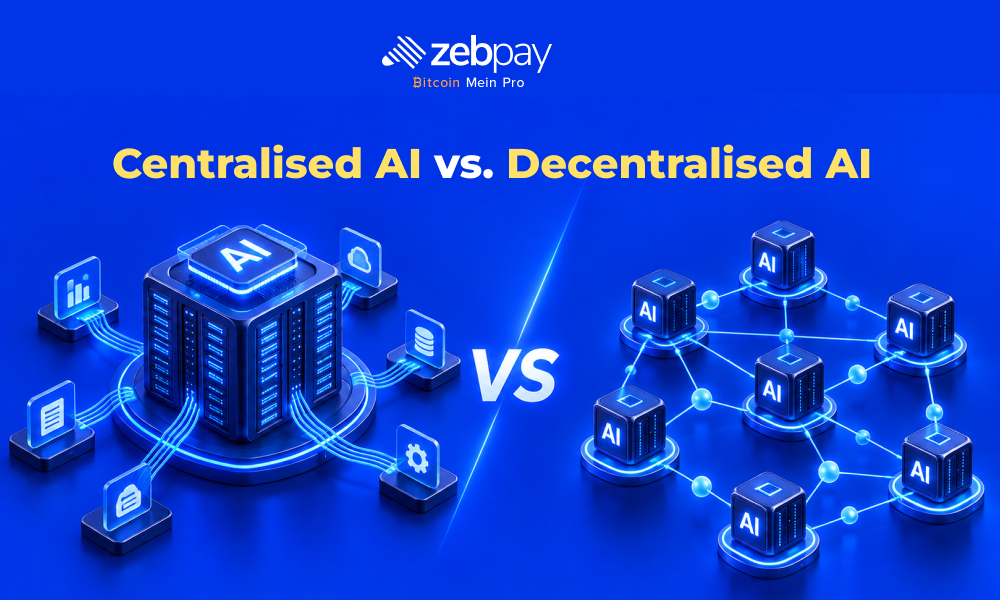
Centralised AI relies on infrastructure and models managed by a single organisation or provider, while decentralised AI distributes certain functions, such as computing, model development, or governance, across multiple participants. Both approaches offer distinct characteristics, influencing how AI systems are developed, accessed, and managed. Understanding the differences between them is essential to evaluating their potential applications and the role each could play in the future of AI.
Understanding the Different Forms of AI
Centralised AI
Centralised AI refers to AI systems in which the development, deployment, and management of models and infrastructure are controlled by a single organisation or a limited number of providers. Typically, these providers oversee computing resources, model access, data processing, and system updates, allowing them to maintain consistent performance and governance.
Popular AI services such as ChatGPT and Google Gemini illustrate this approach, with their respective companies managing categories to their models and services. While centralised AI can benefit from large-scale infrastructure and coordinated development, it can also concentrate control over technology, resources, and use cases.
Decentralised AI
Decentralised AI refers to artificial intelligence systems in which computing resources, model development, data processing, or governance are distributed across multiple independent participants rather than controlled entirely by a single entity. This approach can enable developers, businesses, and individuals to contribute computing power, build AI models, or access services through distributed networks.
Blockchain technology can support certain decentralised AI networks by enabling transparent transaction records, smart contracts, and mechanisms for coordinating participants. Some networks also use crypto tokens to facilitate payments for computing resources, reward contributions, or support governance. By distributing control and participation, decentralised AI aims to offer alternatives to reliance on individual providers.
Also Read: How to Choose AI for Crypto Trading?
Key Characteristics
Centralised AI
- Centralised Control: A single organisation or a limited number of providers oversee model development, deployment, and management.
- Managed Infrastructure: Relies on provider-controlled servers, cloud platforms, and computing resources.
- Coordinated Updates: Models, features, and security measures can be updated through a centrally managed process.
- Defined Access: Usage, permissions, and customisation depend on the provider’s policies and service offerings.
- Consistent Standards: Centralised oversight can help maintain uniform operational standards and model management practices.
- Provider Dependence: Users may rely on a specific provider for continued access, pricing, service availability, and model improvements.
Decentralised AI
- Distributed Participation: Multiple independent participants can contribute to computing, model development, data processing, or governance.
- Shared Resources: Computing power and other resources can be sourced from different providers or network participants.
- Flexible Governance: Decision-making may be shared among participants rather than controlled by a single organisation.
- Collaborative Development: Developers and organisations can contribute to shared models, tools, and AI infrastructure.
- Potential for Greater Data Control: Approaches such as federated learning allow models to be trained collaboratively without necessarily centralising raw data.
- Blockchain Integration: Some networks use blockchain and smart contracts for coordination, transaction records, and incentives.
Applications
Centralised AI
- Healthcare: Supports medical imaging analysis, clinical decision support, drug discovery, and patient data analysis through centrally managed AI systems.
- Finance and Banking: Enables fraud detection, credit risk assessment, customer support, and transaction monitoring using models managed by financial institutions or technology providers.
- Customer Service: Powers chatbots, virtual assistants, and automated support systems that handle customer queries through centralised platforms.
- Business Automation: Helps organisations automate repetitive tasks, analyse business data, generate reports, and improve operational efficiency.
- Content Creation: Enables the generation of text, images, videos, and other digital content through AI platforms managed by individual providers.
- Retail and E-commerce: Supports personalised recommendations, demand forecasting, inventory management, and customer behaviour analysis.
- Cybersecurity: Helps detect suspicious activities, identify potential threats, and monitor networks through centrally managed security systems.
Decentralised AI
- Distributed Computing: Connects independent computing providers to supply GPU resources for AI training, inference, and other computationally intensive workloads.
- Federated Learning: Enables multiple organisations or devices to collaboratively train AI models while keeping raw data in their respective environments, subject to appropriate privacy safeguards.
- Decentralised Data Marketplaces: Facilitates the sharing or monetisation of data and data-related services across participants, potentially using blockchain-based mechanisms to coordinate transactions.
- Autonomous AI Agents: Supports networks in which AI agents discover services, coordinate tasks, and interact with other agents. Blockchain can facilitate transactions between participants where required.
- Blockchain-based AI Services: Uses smart contracts and distributed ledgers to coordinate access, record transactions, and potentially reward participants contributing computing resources or AI services.
- Edge AI and IoT: Enables AI processing on devices such as smartphones, sensors, and industrial equipment, reducing reliance on remote servers. However, edge AI is not inherently decentralised.
- Collaborative AI Development: Allows independent developers and organisations to contribute to open models, distributed training initiatives, or shared AI infrastructure.
Also Read: How AI Agents Coins are Shaping the Future of Blockchain
6 Core Differences
| Factor | Centralised AI | Decentralised AI |
| Control and Governance | Managed by a single organisation or a limited number or providers. | Control and governance can be distributed across multiple independent participants. |
| Infrastructure | Relies primarily on provider-managed servers and cloud platforms. | Can use computing resources distributed across independent providers. |
| Data Processing | Typically processes data within provider-managed systems. | Can distribute data processing or keep data local through approaches such as federated learning. |
| Transparent and Access | Access and transparency depend on the provider’s policies and disclosures. | May support open participation, shared governance, and publicly verifiable records. |
| Blockchain and Crypto Integration | Doesn’t generally require blockchain technology or crypto tokens. | Can use blockchain for coordination and verification, with tokens supporting payments, incentives, or governance. |
Can Centralised and Decentralised AI Work Together?
Centralised and decentralised AI are not necessarily competing approaches. Hybrid models can combine the computational capabilities of centralised systems with the distributed resources of decentralised networks. For instance, an organisation could use a centrally managed AI model while relying on distributed computing resources or federated learning to process data across multiple locations. Such approaches can help balance performance, privacy, and resource efficiency.
The Role of Blockchain in Combining Centralised and Decentralised AI
Blockchain can help connect centralised AI services with decentralised networks by enabling transparent transaction records, coordinating interactions between participants, and facilitating incentive mechanisms. Smart contracts can automate payments to contributors who provide computing resources or other services. Crypto tokens may also support participation and governance in certain AI networks. However, blockchain is not essential to every hybrid AI system, and its relevance depends on the specific use case.
Final Thoughts
The evolution of artificial intelligence will depend not only on technological progress but also on how effectively these systems address real-world needs. For businesses, developers, and users, understanding the trade-offs between different AI architectures can help inform decisions about adoption, investment, and long-term strategy. As the field matures, factors such as accountability, accessibility, cost efficiency, and the quality of AI-generated outcomes will remain central to its development. Rather than viewing centralised and decentralised AI as mutually exclusive choices, it is worth evaluating each approach based on its intended purpose, practical constraints, and potential to deliver meaningful value.
In the grand scheme of things, ZebPay blogs are here to provide you with crypto wisdom. Get started today and join 6 million+ registered users to explore endless features on ZebPay!
FAQs
What is the difference between centralised AI and decentralised AI?
Centralised AI is managed by a single organisation or a limited number of providers, while decentralised AI distributes functions such as computing, model development, or governance across multiple participants.
What are the common applications of centralised AI?
Centralised AI is commonly used in healthcare, finance, customer service, business automation, content creation, retail, and cybersecurity.
How does blockchain support decentralised AI?
Blockchain can facilitate transparent transaction records, smart contract execution, and coordination between participants. Crypto tokens may also support payments, incentives, and governance in certain networks.
Can centralised and decentralised AI work together?
Yes. Hybrid systems can combine centrally managed AI models with distributed computing resources or federated learning to meet specific performance, privacy, and resource requirements.
Is decentralised AI always more secure than centralised AI?
No. Security depends on the system’s design, data handling practices, access controls, and safeguards. Both approaches have distinct risks that need to be managed.


