

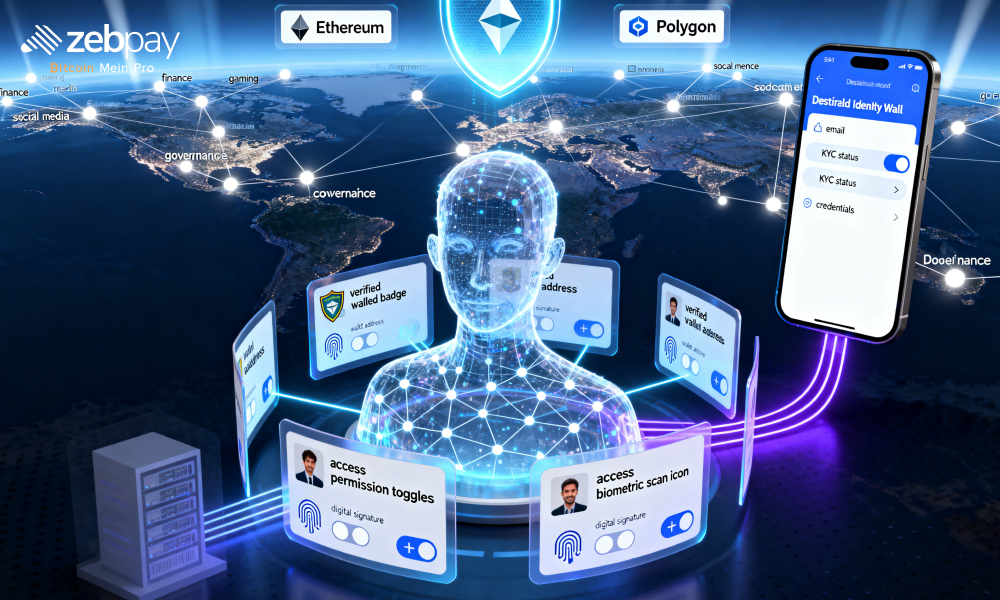
Have you ever wondered how many corporations currently hold a piece of your digital soul? Every time you click “Sign in with Google” or “Login with Facebook,” you aren’t just saving time; you are handing over the keys to your digital kingdom to a central authority. But what if you could prove who you are without a middleman watching your every move? What if your identity belonged to you, and only you, stored in a digital wallet rather than a corporate database?
The digital landscape is currently undergoing a seismic shift. We are moving away from centralized “silos” of data toward a Self-Sovereign Identity (SSI) model, powered by a breakthrough technology known as Decentralized Identifiers (DIDs). This isn’t just a technical upgrade; it is a fundamental reclamation of digital autonomy.
In this blog, we will get to know how the Decentralized Identifier model works with real-world use cases.
What is Decentralized Identity?
At its core, Decentralized Identity is a methodology that enables individuals to create, own, and manage their digital identifiers without relying on a central authority, such as a government or a tech giant.
In the traditional world, if your identity provider (e.g., a social media platform) decides to delete your account, your digital identity, and all the services linked to it, vanish. In a decentralized world, you are the “root of trust”. You hold your credentials in a digital wallet, and you decide exactly what information to share, with whom, and for how long.
Decoding the Tech: What are Decentralized Identifiers (DIDs)?
The engine driving this shift is the Decentralized Identifier (DID). Think of a DID as a permanent, globally unique “digital fingerprint” that doesn’t require a central registry to exist.
Unlike an email address or a username, which is owned by a service provider, a DID is generated and controlled entirely by you. According to the W3C standards, a DID is a simple text string (e.g., did:example:123456789abcdefghi) that points to a DID Document. This document contains the public keys and service endpoints needed to verify that you are indeed the controller of that identity, all without revealing a single shred of personal data.
The Three Pillars of Self-Sovereign Identity (SSI)
To understand how this ecosystem functions in 2026, we must look at the three critical roles that make up the “Trust Triangle”:
- The Issuer: A trusted entity (like a university or government) that signs a Verifiable Credential (VC), a digital version of a diploma or passport.
- The Holder: That’s you. You store these VCs in your digital wallet and generate DIDs to interact with services.
- The Verifier: The entity that needs to confirm a fact about you (like an employer checking your degree). They verify the cryptographic signature of the issuer without ever needing to contact them directly.
Read More: Decentralised Exchanges: How Far Have They Come?
Why Now? The Benefits of Decentralized Identity
The urgency for this shift is backed by alarming data. In 2024 alone, consumer losses due to fraud exceeded $12.5 billion, a 25% increase from the previous year. Centralized databases have become “honeypots” for hackers; when one is breached, millions of identities are compromised.
Key benefits include:
- Privacy & Selective Disclosure: You can prove you are over 21 without revealing your exact date of birth or home address.
- Elimination of Identity Silos: Credentials are issued once and reused everywhere, removing the need for 50 different passwords for 50 different sites.
- Enhanced Security: By using blockchain or distributed ledgers, there is no single point of failure. Your data isn’t sitting on a server waiting to be hacked; it’s encrypted and held by you.
- Faster Onboarding: Businesses can verify your identity instantly through cryptographic proofs, reducing KYC (Know Your Customer) costs and friction.
Real-World Decentralized Identity Use Cases (2024-2026)
This isn’t theoretical. Global leaders and industries are already integrating DIDs:
- Finance: In 2024, Japan’s largest banks (MUFG, SMBC, Mizuho) partnered to develop digital identity solutions to streamline cross-border transactions and reduce fraud.
- Healthcare: Patients can now hold their own medical records via DIDs, sharing them securely with different providers while ensuring their sensitive health data remains private and tamper-proof.
- Government: In January 2025, Malaysia launched the “MyDigital ID Superapp,” a blockchain-based platform designed to fight online fraud and provide citizens with a secure digital identity.
- Education: Universities are increasingly issuing digital diplomas as Verifiable Credentials, allowing graduates to instantly share authenticated achievements with recruiters.
The Road Ahead: Market Growth and Challenges
The market for decentralized identity is exploding. Estimates suggest it will grow from $2.56 billion in 2025 to over $4.62 billion in 2026, with a staggering compound annual growth rate (CAGR) of approximately 80%.
However, the shift isn’t without hurdles. Experts point to “technical complexity” and “user education” as the primary barriers. Most people are comfortable with the simplicity of centralized logins, even if they are less secure. For SSI to become the global standard, digital wallets must become as intuitive as physical ones, and regulatory frameworks like GDPR must continue to evolve to support decentralized data.
Conclusion
The shift toward self-owned digital identity represents a turning point in human-computer interaction. By moving the “root of trust” from corporations back to the individual, Decentralized Identifiers offer a path toward a safer, more private, and more efficient internet.
As we move further into 2026, the question isn’t if you will adopt a decentralized identity, but when you will decide to take back control of your digital self.
In the grand scheme of things, ZebPay blogs are here to provide you with crypto wisdom. Get started today and join 6 million+ registered users to explore endless features on ZebPay!
FAQs
Is Decentralized Identity (SSI) a replacement for my physical ID?
Not necessarily. While it offers a digital alternative that is more secure and portable, physical IDs will likely continue to exist for legal and regulatory purposes for the foreseeable future.
What happens if I lose my digital wallet?
This is one of the main challenges. Because you are in control, losing your recovery keys can make your identity irrecoverable. However, modern wallets are developing social recovery and biometric backup methods to mitigate this risk.
Does Decentralized Identity use Bitcoin?
While many DIDs are “anchored” on blockchains like Bitcoin or Ethereum for security and immutability, the identity itself is not a cryptocurrency. Some systems, like MicroStrategy Orange, specifically use the Bitcoin network to manage DIDs.
How does this help with privacy?
It utilizes “Zero-Knowledge Proofs” (ZKPs), which allow you to prove a statement is true (e.g., “I am a licensed driver”) without revealing the underlying data used to prove it.
Can companies still track me?
Decentralized identity makes tracking significantly harder because you can use different DIDs for different services, preventing companies from correlating your activity across the web.