



In 2026, there is no longer a need to ask whether decentralized finance is an option, but how its underlying design is fundamentally transforming the definition of capital. When one defi protocol has the capacity to operate billions of dollars without a central headquarters or even a CEO, what does that imply about the future of trust?
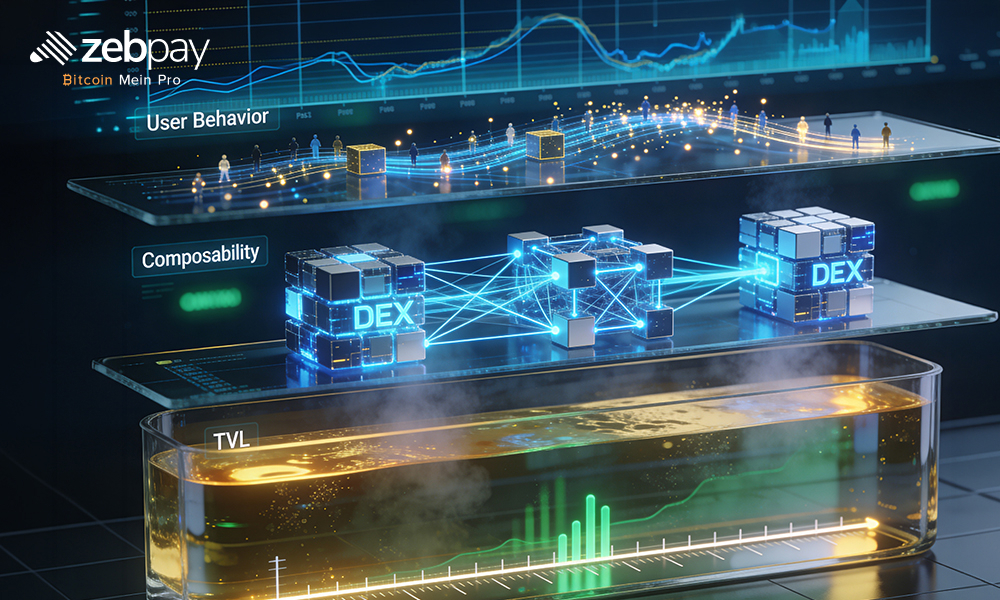
The crypto industry lived on speculation and “hype cycles ” for years. A more grown-up ecosystem arose, however, as the dust of 2025 settled, one characterized by hard data, institutionally graded security, and a zero-tolerance attitude towards utility. On a deeper level to comprehend this change, we have to move past price charts and consider the metrics that actually mean something: Total Value Locked (TVL), the complexity of the development of defi through composability, and the changing nature of user behaviour.
The Gold Standard: Total Value Locked (TVL)
TVL is called the North Star of adoption in the world of decentralized finance (DeFi). But what is it actually? The fundamental concept of TVL is to quantify the total worth of all deposited or locked crypto assets on smart contracts within a given DeFi protocol. These are assets that provide the liquidity required in lending, borrowing, and trade.
The 2026 Snapshot: By the Numbers
By early 2026, the world DeFi TVL is roughly balanced between the 130-140 billion range, demonstrating a strong recovery from the downward trends in the market. This expansion is not only due to the rising prices of assets, but the actual amount of money being invested in the ecosystem has also increased.
The formula for calculating TVL is straightforward yet revealing:
$$TVL = \sum_{i=1}^{n} (Quantity_i \times Price_i)$$
Where $Quantity_i$ represents the amount of a specific asset $i$ locked in the protocol, and $Price_i$ is its current market value.
Leading the Charge
The concentration of TVL reveals which platforms have earned the most trust. As of early 2026:
- Lido: The undisputed leader in liquid staking, commanding approximately $27.5 billion in TVL.
- Aave: The premier lending and borrowing protocol, holding nearly $27 billion.
- EigenLayer: A dominant force in the restaking market with $13 billion.
While high TVL indicates confidence, experts warn against using it as the only metric. A protocol’s “stickiness,” how long users keep their funds locked, is often more indicative of long-term health than a sudden spike in deposits driven by temporary incentives.
“Money Legos”: The Power of DeFi Composability
Composability is one of the most potent defi development aspects. It is also known as the Money Legos, which is the capability of various protocols to communicate with each other and construct themselves without the approval of a central authority.
Why Composability is a Game Changer
With traditional finance (TradFi), when you need to borrow an asset with your savings to invest in a third asset, you will likely have to wait weeks of paperwork and high interest rates. This is achieved in a few seconds in decentralized finance using interoperable smart contracts.
Composability Impact Metrics in 2026
- Speed of Innovation: The Teams develop 85% faster using existing modules.
- Network Effect: The success rate of integration between protocols is 82.
- Cost Efficiency: The efficiency is increased by 76 per cent because of the ability to bypass the intermediaries.
The Stacked Strategy
Think of the experience of a user on a highly composable market:
- Staking: A user places a bet on Lido and gets stETH (a liquid staking token).
- Lending: They place that stETH on Aave as security.
- Borrowing: They borrow against their stETH a stablecoin such as USDC.
- Yield Farming: They offer that USDC as collateral on a decentralized exchange (DEX) such as Uniswap to receive trading fees.
Such piling up of the protocols would be the web of value wherein breaking one of the bricks would possibly impact the whole structure, which is referred to as the interdependence.
Shifting User Behaviour: From “Degens” to Institutions
Who is actually using Defi today? The demographics have shifted significantly over the last five years.
The Institutional Turn
By 2026, the era of the “retail-only” DeFi market will have passed. Institutional participation has become the primary driver of TVL. Global leaders are no longer just watching from the sidelines; they are embedding blockchain into their core operations.
- BlackRock: Its BUIDL fund (Institutional Digital Liquidity Fund) crossed $550 million in assets on the Solana network alone by early 2026.
- J.P. Morgan & Citi: These giants have integrated tokenized deposit and clearing services, blurring the lines between TradFi and decentralized finance defi.
Real-World Asset (RWA) Integration
One of the most significant shifts in user behaviour is the move toward Real-World Assets. Instead of just trading speculative tokens, users are now interacting with tokenized U.S. Treasuries, real estate, and supply chain invoices.
- Tokenized RWA value reached over $30 billion by late 2025, a 5x increase from 2022.
- Users are seeking “stable yields” rather than the volatile “fireworks APYs” of the early yield farming days.
AI-Driven Decision Making
In 2026, human-managed lending strategies are being supplemented by AI “solvers.” These agents scan multiple chains and protocols in real-time to move capital automatically based on pre-set risk limits. This has reduced human error and improved risk assessment, making the ecosystem more accessible to conservative investors.
Regional Spotlight: The Case of India
As global defi development accelerates, regional regulations play a crucial role in shaping user behaviour. India’s approach in 2025-2026 serves as a fascinating case study in balancing innovation with oversight.
While decentralized finance remains legally accessible in India through registered platforms, it is not considered “legal tender.” The regulatory framework is defined by:
- Taxation: A flat 30% tax on crypto gains and a 1% TDS on transactions above ₹10,000.
- Oversight: Multiple authorities, including the FIU-IND and RBI, monitor transactions to prevent AML (Anti-Money Laundering) violations.
- Strategy: India is exploring a regulatory sandbox for DeFi and NFTs as part of its National Blockchain Strategy, aiming to become a global Web3 player.
This clear, albeit strict, regulatory stance has provided the “certainty” needed for Indian users to engage with digital assets responsibly, contributing to the Asia-Pacific region’s status as the fastest-growing DeFi market globally.
Read more: Is Crypto Legal in India?
Looking Ahead: The Road to 2030
The trajectory for decentralized finance is one of exponential growth. Projections suggest the market will grow from its current state to a staggering $256.4 billion by 2030, representing a CAGR of approximately 43.3%.
What will drive this?
- Layer-2 Scalability: Networks like Arbitrum, Optimism, and Base already hold over $15 billion in combined TVL, offering lower fees and higher speeds.
- Cross-Chain Interoperability: Chain abstraction is making it so users don’t have to care which blockchain they are using; they just care about the service.
- Bitcoin DeFi (BTCFi): Native Bitcoin lending is waking up, with BTC-backed stablecoins and yield products gaining traction without the need for risky “wrappers.”
Conclusion
DeFi is no longer an experiment; it is the burgeoning infrastructure of a global, programmable economy. By monitoring metrics like TVL, understanding the modular power of composability, and tracking the shift toward institutional and RWA-based behaviour, we can see the blueprint of future finance.
Whether you are a developer building the next big defi protocol or an investor looking for sustainable yield, the data is clear: the decentralized world is maturing. It is becoming quiet, efficient, and, in the best possible way, slightly “boring” as it integrates into the fabric of our daily lives.
In the grand scheme of things, ZebPay blogs are here to provide you with crypto wisdom. Get started today and join 6 million+ registered users to explore endless features on ZebPay!
FAQs
What is the most important metric for a DeFi protocol?
While TVL (Total Value Locked) is the standard benchmark for comparing platforms, user retention and the volume of “real-world” assets (RWAs) are increasingly important for long-term health.
Is DeFi legal in India?
Yes, you can legally trade and engage in DeFi activities in India on registered platforms. However, there are strict tax obligations (30% on gains), and digital assets are not legal tender.
What are “Money Legos”?
“Money Legos” refers to composability, the ability to combine different DeFi protocols (like a lending app and a DEX) to create complex financial products without needing central permission.
How does AI help in DeFi?
AI is used to detect smart contract vulnerabilities, optimize trading through automated bots, and manage risk by moving capital across protocols based on real-time data.
How many Bitcoins will ever exist?
The Bitcoin protocol caps the total supply at 21 million BTC. This scarcity is a fundamental reason why it is often used as collateral in decentralized finance.