




The consensus meaning in everyday language is collective approval or shared agreement on a particular decision. However, in blockchain systems, consensus goes far beyond agreement; it becomes the backbone of security, decentralization, and trust.
A blockchain network operates without a central authority. There is no bank, company, or regulator verifying transactions. Instead, thousands of computers across the world must agree on which transactions are valid and which are not. This agreement is achieved through a consensus mechanism in blockchain.
Without consensus, blockchain cannot function. It is the invisible infrastructure that allows decentralized networks to remain secure, transparent, and tamper-resistant.
What Is Consensus in Blockchain?
To understand consensus in blockchain, imagine a shared digital ledger that is publicly distributed across many computers. Every time a transaction occurs, the network must verify whether it is legitimate before adding it to the ledger.
In traditional financial systems, this verification is done by a central institution. In blockchain, there is no central verifier. Instead, independent nodes validate transactions based on predefined rules.
Therefore, consensus in blockchain refers to the process through which distributed participants agree on the validity of transactions and maintain a single, synchronized version of the ledger.
This mechanism ensures:
- All participants see the same transaction history.
- Fraudulent transactions are rejected.
- The blockchain remains immutable and secure.
In essence, blockchain replaces institutional trust with algorithmic trust.
Read more: Centralized vs Decentralized Networks
Why Is Consensus Important?
Consensus is not just a technical feature. It is the structural foundation of decentralized systems.
Security and Fraud Prevention
One of the biggest challenges in digital systems is preventing fraud, particularly double-spending. Without consensus, malicious actors could manipulate transaction records.
Consensus mechanisms create economic or computational barriers that make attacks extremely expensive and impractical.
Decentralization Without Chaos
Decentralization means no single authority controls the network. However, decentralization without rules would result in disorder. Consensus introduces a structured agreement, ensuring the system operates smoothly despite being distributed.
Trust Without Intermediaries
The core promise of blockchain is to eliminate middlemen. Consensus mechanisms enforce network rules automatically, enabling participants to transact without trusting each other personally.
Data Integrity and Immutability
Once consensus confirms a block, altering it becomes nearly impossible. This guarantees the integrity and permanence of recorded data.
How Does a Consensus Mechanism Work?
Although different mechanisms operate differently, the overall process generally follows structured steps.
First, a user initiates a transaction. The transaction is then broadcast to the blockchain network. Validators or miners verify whether the transaction meets predefined criteria, such as sufficient balance and valid digital signatures.
Once validated, transactions are grouped into blocks. The network applies consensus rules to determine which participant has the authority to add the block to the chain. After approval, the block becomes a permanent part of the ledger.
The updated ledger is then distributed across all nodes, ensuring synchronization.
Major Types of Consensus Mechanisms
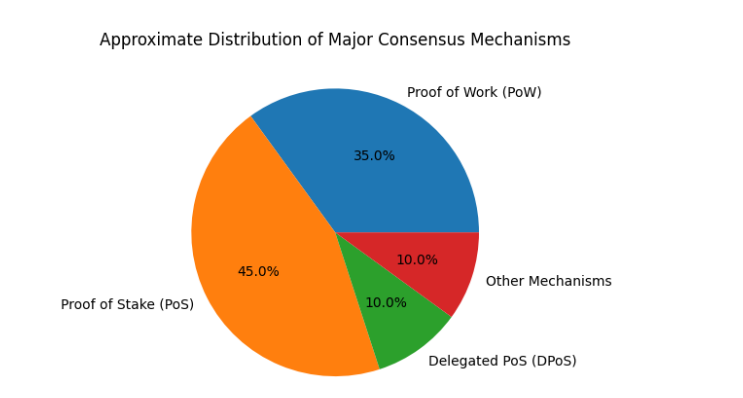
Different blockchain networks use different models depending on their goals. Some prioritize security, others focus on scalability or energy efficiency.
Proof of Work (PoW)
Proof of Work was the first widely adopted consensus mechanism. It requires miners to solve complex mathematical puzzles to validate transactions and create new blocks.
This process demands substantial computational power. The difficulty of solving these puzzles secures the network by making attacks extremely costly.
However, the high energy consumption of PoW has raised environmental concerns.
Proof of Work emphasizes security and decentralization but sacrifices energy efficiency.
Proof of Stake (PoS)
Proof of Stake introduces a more energy-efficient approach. Instead of competing through computational power, validators lock up cryptocurrency as collateral.
The network selects validators based on the size of their stake and other algorithmic factors. If validators act dishonestly, they risk losing their staked funds.
Proof of Stake significantly reduces energy usage while maintaining strong security incentives.
Read more: Proof of Work vs Proof of Stake (POW vs POS)
Delegated Proof of Stake (DPoS)
Delegated Proof of Stake builds upon PoS by introducing voting. Token holders elect a limited number of delegates who validate transactions on their behalf.
This system increases speed and scalability but may introduce partial centralization since only selected validators produce blocks.
Read more: Comparing Proof-of-Stake vs Delegated Proof-of-Stake
Other Consensus Models
Blockchain innovation continues to evolve. Other mechanisms include:
- Proof of Authority, which relies on approved validators.
- Practical Byzantine Fault Tolerance is often used in enterprise networks.
- Hybrid models combining multiple approaches.
Each mechanism attempts to balance security, scalability, and decentralization, commonly known as the blockchain trilemma.
Comparing Consensus Mechanisms
Understanding consensus requires recognizing trade-offs.
Proof of Work offers exceptional security but demands high energy consumption. Proof of Stake improves efficiency and scalability but may concentrate power among large stakeholders. Delegated systems enhance speed but reduce decentralization to some extent.
The chosen consensus model directly influences:
- Transaction throughput
- Network fees
- Validator incentives
- Governance structures
- Environmental impact
Therefore, when evaluating a blockchain project, analyzing its consensus mechanism provides deep insight into its long-term sustainability.
Challenges of Consensus Mechanisms
Despite their importance, consensus mechanisms face practical challenges.
Energy-intensive systems raise sustainability concerns. Wealth concentration in stakeholder-based models may reduce decentralization. Scalability limitations restrict high-volume transaction processing. Security trade-offs must be carefully balanced.
The future of blockchain depends on continuous improvement in consensus design.
The Future of Consensus in Blockchain
As blockchain adoption increases globally, consensus innovation becomes more critical.
Emerging consensus models aim to:
- Reduce environmental impact
- Improve transaction speed
- Strengthen economic incentives
- Enhance governance transparency
Future blockchain ecosystems will likely rely on optimized consensus protocols that can support millions of users without compromising decentralization or security.
Consensus is not static. It evolves with technological advancement and regulatory frameworks.
Conclusion
The concept of consensus represents agreement, but in blockchain systems, it represents far more than collective approval. The definition for consensus in blockchain describes a structured, algorithm-driven process that enables decentralized participants to agree on a single source of truth.
The consensus meaning in blockchain transforms traditional ideas of trust. Instead of trusting institutions, users trust cryptographic rules and economic incentives. Whether through Proof of Work, Proof of Stake, or hybrid models, blockchain consensus ensures transaction validity, prevents fraud, and maintains network integrity.
Understanding consensus mechanisms is essential for anyone exploring blockchain technology. It explains how decentralized systems operate securely without central authorities and why blockchain continues to redefine digital trust in the modern economy.
In the grand scheme of things, ZebPay blogs are here to provide you with crypto wisdom. Get started today and join 6 million+ registered users to explore endless features on ZebPay!
FAQs
What is the definition of consensus in blockchain?
Consensus in blockchain refers to the process through which distributed network participants agree on the validity of transactions and maintain a shared ledger.
What is the consensus meaning in simple terms?
Consensus means general agreement among participants. In blockchain, it refers to an algorithmic agreement on transaction records.
Why is consensus important in blockchain?
Consensus ensures security, prevents double-spending, maintains decentralization, and eliminates the need for central authorities.
What are the main types of consensus mechanisms?
The most common types are Proof of Work, Proof of Stake, and Delegated Proof of Stake.
Can blockchain work without consensus?
No. Without consensus, decentralized networks cannot securely validate transactions or maintain data integrity.