





Bitcoin has fallen sharply since early October, erasing billions of dollars in paper wealth and significantly impacting investor confidence. At the center of that drawdown is the October 10 sell-off, when a cascading liquidation event wiped out over $19 billion in leveraged crypto positions within a single day, one of the largest wipeouts of its kind on record.
Since then, Bitcoin has fallen more than 30% from its October peak above 126,000 dollars, which many now term the “crypto crash of 2025.”
In this blog, we unpack the reasons behind the crypto crash and take a look at what crypto enthusiasts and investors should watch as 2026 approaches.
What Caused the Bitcoin Crash?
On October 10, a chain reaction turned what had been a routine market correction into the historic liquidation of digital assets. In less than 24 hours, more than 1.6 million traders were seeing positions liquidated, with total liquidations well over $19 billion.
Just Bitcoin alone lost about $340 billion in market capitalization and fell nearly 10% in a single session, with major altcoins selling off even harder.
Five trigger points that caused a massive crypto shock in the world:
- A software/Oracle glitch on a major exchange briefly sent a key synthetic “dollar” token down to about 0.65 dollars.
- Increasing macro uncertainty in the US is related to apprehensions over budget gridlock, tariffs, and the direction of interest rates.
- A liquidity crunch for spot Bitcoin ETFs with record daily and monthly outflows.
- Growing concerns about the AI-driven equity bubble, particularly with names such as NVIDIA, are spilling over into risk assets.
- Bearish on-chain signals, as whales and long-term holders moved large amounts of BTC to exchanges to lock in gains.
Individually, each of these alone would not necessarily create a structural bear market. But together, they flipped market psychology from greed to fear within days.
Emotional Warfare: From Greed to Fear
Crypto markets are structurally more leveraged and sentiment-driven compared to traditional markets. When prices increase, traders mostly pile into leveraged long positions, with expectations of volatility continuing to work to their advantage. However, quarter 3 showed the opposite.
- Greed at the top: With Bitcoin near its all‑time high above 126,000 dollars, funding rates were elevated, and open interest in futures was close to records.
- Fear after the shock: Once the liquidation cascade started, each forced sell moved prices lower, which in turn triggered more margin calls and liquidations in a self‑reinforcing spiral.
This is why questions like “why is Bitcoin dropping?” or “why is Bitcoin down today?” usually have more than one answer. Price action is not purely about fundamentals; it is also about positioning and emotion. When sentiment flips, even long‑term holders feel pressure, which leads to accelerated selling and deeper drawdowns than many expect.
Bitcoin’s Performance Over the Last 3 Months
Recent data show two distinct phases during the last three months:
Phase 1: 1 September – 31 October
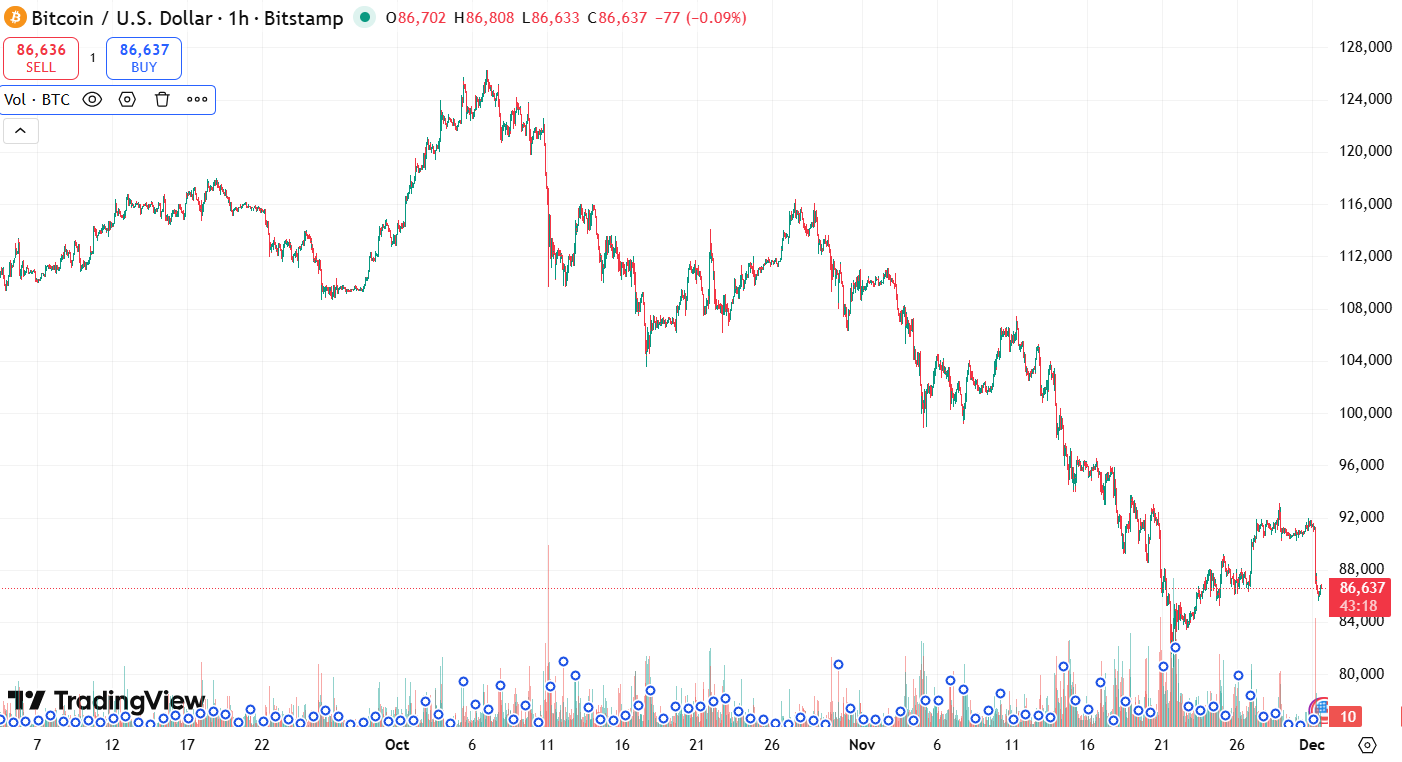
Image Source: TradingView
From early September up until 31 October, Bitcoin was on a broad uptrend, cooling since then from the approximate low‑hundred thousand dollar range to repeatedly testing above 115,000 dollars and setting an all‑time high above 126,000 dollars in early October. Over 31 October to 20 November, this correction gained momentum, and Bitcoin slid from around $108,000–110,000 to the low‑90,000s.
Phase 2: 01 – 30 November
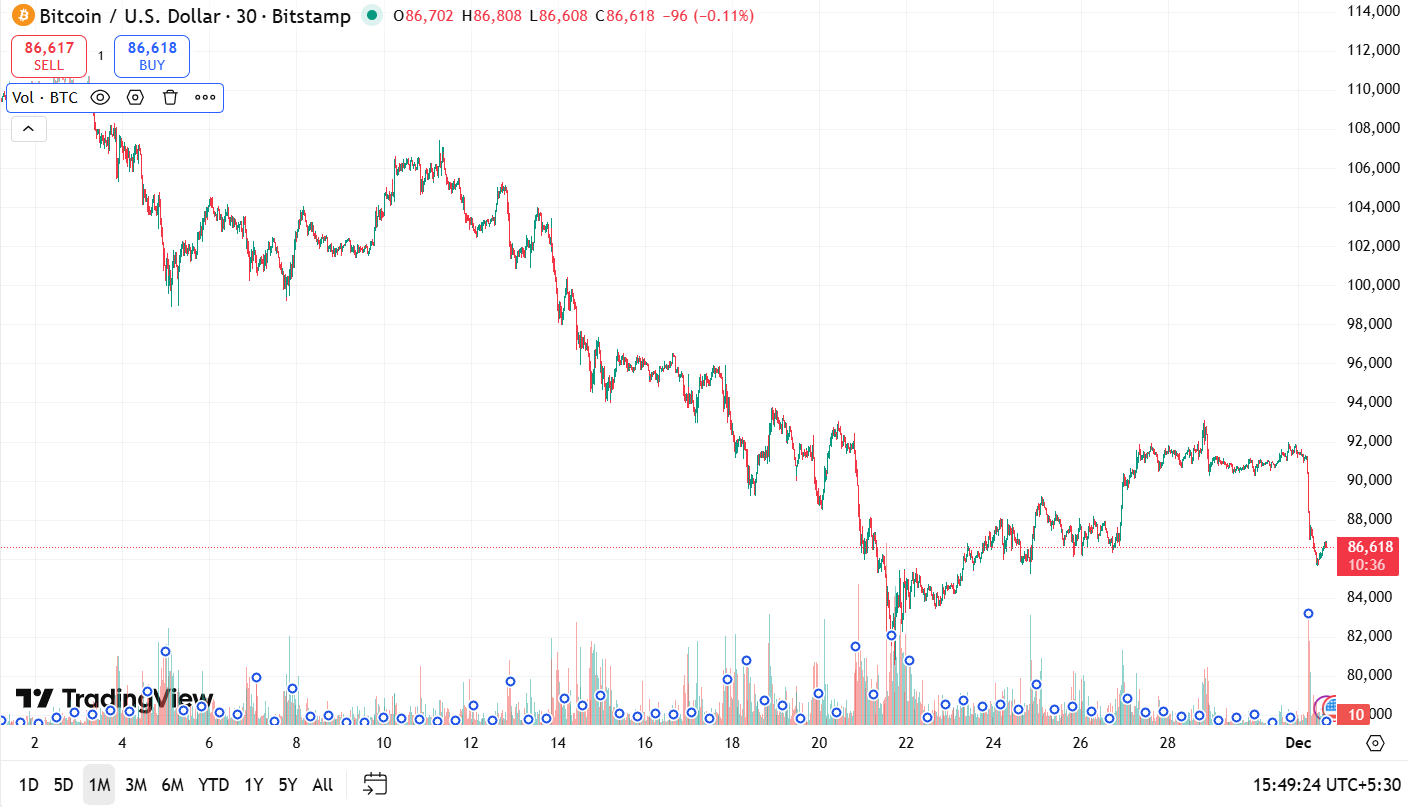
Image Source: Trading View
During 01–30 November, Bitcoin traded within a tighter range, around the high‑80,000s and low‑90,000s. The selling momentum slowed, and price action entered choppy consolidation, reflecting signs that the market may be searching for a near-term floor following the heavy sell‑off from October to mid‑November.
On the weeklies, the move is starting to look like a series of lower highs and lower lows, classic for a corrective phase after an overextended rally. For long‑term holders, this is painful but not unprecedented; similar drawdowns occurred after the 2013, 2017, and 2021 peaks.
Read more: Standard Chartered Forecasts Bitcoin Rally Soon
Five Key Reasons Behind the Bitcoin Drop
Before diving into each factor, it’s useful to frame them together: this sharp crypto drop is not about a single failure, but about market structure under stress.
- Chaos Caused by a Software/Oracle Bug
One of them was a pricing glitch related to Ethena’s USDe, a synthetic “dollar” token, on a major exchange: internally, the exchange showed for some time that USDe traded close to 0.65 dollars when in fact it traded close to 1 dollar on other venues and on‑chain markets.
Since the platform used that flawed price for margin and collateral calculations, many leveraged positions with USDe were liquidated all of a sudden. Those forced sales spilled over into other trading pairs and added extra sell pressure across the market.
The exchange later acknowledged problems in its unified margin system. It established a compensation program. Still, by then, the traders had already seen how a single bug could trigger a huge liquidation wave and shake confidence.
- U.S. Government Tensions, Tariffs, and Fed Uncertainty
Against this background, global macro news also turned more negative. Markets were hit by the unexpected 100% tariff announcement on key Chinese imports from the U.S. side. That headline re-ignited concerns about trade tensions and a possible slowdown in global growth.
These debates added to ongoing ones about government spending, budget risks, and whether the U.S. Federal Reserve would cut interest rates in any significant fashion.
Many investors still regard Bitcoin as a high‑risk asset and not just “digital gold.” When uncertainty rises, then, they typically cut exposure across all risky assets, crypto included, adding to the selling pressure.
- Liquidity Crunch from Exchanges and ETFs
Another big contributor was a liquidity squeeze related to exchanges and spot Bitcoin ETFs. In November, US spot Bitcoin ETFs saw record net outflows. On one of the worst days, nearly US$1 billion exited these products within 24 hours.
BlackRock’s iShares Bitcoin Trust has become one of the largest spot Bitcoin funds and also witnessed US$2 billion in redemptions over the month, including a record single‑day outflow of US$523 billion.
When investors redeem ETF shares, the fund generally has to sell spot BTC to meet those redemptions; in other words, real coins hit the market. Added to already-thin order books and ongoing liquidations, this created a “liquidity vacuum” where even moderate sell orders could easily push prices down quickly.
- Sentiment about Overvaluation of Artificial Intelligence and Risk
The Bitcoin drop also occurred when investors were questioning whether parts of the AI trade had become a bubble. Some analysts argued big AI‑linked stocks looked expensive relative to their earnings and realistic growth expectations.
Whenever investors begin to question crowded trades in one high‑beta market segment, they often reduce risk in other speculative markets as well.
Crypto is not directly tied to AI revenues, but the same portfolios that hold the AI names often hold altcoins. This means when money rotates out of high‑risk tech, crypto can be among the first assets to be trimmed.
- On‑Chain Signals: Whales and Exchange Reserves
On-chain data indicates that large, experienced holders used the rally to lock in profits. Analytics firms tracked billions of dollars’ worth of BTC moving from long-term “hodler” wallets and big whale addresses to exchanges. That pattern usually signals “distribution at the top,” where early or patient investors gradually sell into strength.
Bitcoin reserves across exchanges, which had been declining for much of the year, saw brief upticks as more coins streamed onto trading platforms. This explains the intensity of the move, which is when leveraged traders are getting liquidated, and whales are also selling into the weakness; it will affect prices as well.
History shows that Bitcoin’s major rallies are often followed by sharp corrections, then periods of consolidation before the next cycle moves higher. After the 2017 peak, BTC fell more than 80% over the following year; after the 2021 run‑up, it saw multiple 50%+ drawdowns before eventually making new highs.
What Investors Should Watch in 2026?
For 2026, a realistic, not overly optimistic, lens should focus on:
- Macro backdrop: If global growth stabilizes and rate expectations become clearer, risk markets, including crypto, may find firmer footing.
- Institutional flows into stablecoins and tokenized products: Large financial players are experimenting more with stablecoins, tokenization, and digital asset infrastructure, which can support deeper liquidity over time.
- Regulatory clarity: Continued progress on regulatory frameworks in major economies (U.S., EU, Asia) can improve confidence and reduce “headline risk” that often triggers panic selling.
The key is to recognize that crashes are part of Bitcoin’s long‑term story. Volatility cuts both ways, and while the recent crypto crash felt severe, it occurred after a strong multi‑month rally and amid heavy leverage.
Read more: Top 10 Cryptos to Invest in December 2025
Final Thoughts
The question “why is Bitcoin dropping?” rarely has a simple answer. The October 10 event and subsequent crypto crash were caused by market structure fragility meeting macro shock, a software glitch on a major exchange, unexpected tariffs and policy uncertainty, record ETF outflows, overextended risk appetite in related sectors like AI, and on‑chain profit‑taking by whales, all converged within weeks.
For 2026, it will be more about watching policy developments, institutional adoption, and on‑chain behavior than headlines alone. Volatility is likely to remain a feature, not a bug, of Bitcoin’s journey.
In the grand scheme of things, ZebPay blogs are here to provide you with crypto wisdom. Get started today and join 6 million+ registered users to explore endless features on ZebPay!
FAQs
1. Why is Bitcoin dropping right now?
The price decline in Bitcoin was thereby caused by a confluence of factors: a record $19 billion liquidation event on October 10, macroeconomic shocks in the form of new tariffs and rate uncertainty, record outflows from spot Bitcoin ETFs, concerns over valuations in other risk assets, and profit-taking by substantial holders. Put together, these factors contributed to a sharp, multifactor correction.
2. Which particular events on the 10th of October caused the crypto downturn?
High leverage combined with an exchange-level pricing failure related to a synthetic dollar token on October 10 fueled the biggest ever single-day liquidation in cryptocurrency, which saw over $19 billion of positions wiped out and Bitcoin lose nearly 10% in just hours.
3. Did a stablecoin or synthetic dollar fail?
Ethena’s USDe briefly traded down to around $0.65 on Binance due to an internal pricing/oracle issue and limited liquidity. Nevertheless, on-chain activity and other trading venues remained near $1, indicating that the problem was exchange-specific rather than a protocol-wide failure.
4. How did Bitcoin ETFs contribute to the drop?
In November, U.S. spot Bitcoin ETFs saw a record month of outflows at about $3.79 billion, with nearly $900 million in one day and more than $2 billion from BlackRock’s IBIT. Such outflows required selling pressure on BTC, adding to the market fragility.
5. Are large holders, whales, selling Bitcoin?
On-chain analytics show that big holders and long-term wallets distributed substantial BTC to exchanges during and right after the October peak. This has been a trademark of distribution and profit-taking post-strong rallies, further adding to the selling pressure.
6. Is this the beginning of a long bear market?
At this point, it is premature to call the current movement a full-cycle bear market. The drawdown so far, around 25–30% from the top, is significant but has been in line with previous mid-cycle corrections.