



The crypto market in 2025 was marked by volatility and consolidation. After periods of optimism driven by institutional participation, ETFs, and macro liquidity expectations, markets struggled to sustain momentum. Major assets like Bitcoin and Ethereum spent much of the year moving within defined ranges, reflecting uncertainty among investors. Liquidity rotated toward selective narratives rather than broad market rallies, and overall participation remained cautious.
Heading into 2026, market sentiment is mixed. According to the Crypto Fear & Greed Index, the market is currently in “extreme fear,” a phase that historically appears during periods of uncertainty, reduced risk appetite, and price consolidation. While fear reflects caution in the short term, such conditions have often preceded longer-term accumulation phases. Looking ahead, 2026 will likely be shaped by global liquidity trends, regulatory clarity, and renewed institutional interest. If macro conditions turn supportive, crypto assets may see a gradual recovery, with opportunities emerging for long-term participants as confidence rebuilds.
Bitcoin (BTC) opened 2026 at $87,500 as markets prepared for the first Wall Street trading session of the year. The asset continues to trade within a range of $86,400 to $90,600, reflecting a temporary balance between supply and demand. Since November, Bitcoin has underperformed compared to other asset classes such as gold and the S&P 500. However, analysts suggest this divergence could present an opportunity for crypto to play catch-up, particularly as broader market conditions evolve. Some market observers believe Bitcoin could benefit from rising global liquidity in 2026, which has historically supported risk assets.
Notably, Bitcoin ended 2025 lower than where it began—marking the first decline in a post-halving year. Bitcoin halvings occur every four years, reducing mining rewards and limiting new supply. Historically, these events have been followed by a period of accumulation, a strong bull run, and then a correction. This pattern was observed after the 2012, 2016, and 2020 halvings, each of which led to new all-time highs in the following cycle. This time, however, the pattern appears to be diverging. Aggregate Bitcoin options open interest rose to $49 billion in December 2025, up from $39 billion in December 2024, bringing increased attention to the widespread use of covered call strategies. Critics argue that by effectively “renting out” upside for yield, large investors may have created a price ceiling, potentially limiting Bitcoin’s ability to enter its next parabolic phase.
Ether (ETH) has traded within a tight 4% range over the past week, raising questions about whether the $2,900 support level can hold. Repeated failures to break above $3,000 have coincided with lower Ethereum network fees and subdued demand for Ether ETFs. This lack of momentum is also reflected in derivatives markets. ETH monthly futures are trading at a 3% annualized premium to spot prices, indicating very weak demand for leveraged long positions. Under normal market conditions, futures premiums typically exceed 5% to compensate for longer settlement periods. However, ETH’s premium has stayed below this level for several weeks.
Meanwhile, network fees dropped 26%, even as transaction counts rose 10%, suggesting that activity remains stable but monetization has weakened. While Ethereum usage has not declined, price recovery will likely depend on stronger demand for blockchain processing and fee generation, which remain key drivers of ETH’s long-term valuation.
Technical Outlook
BTC
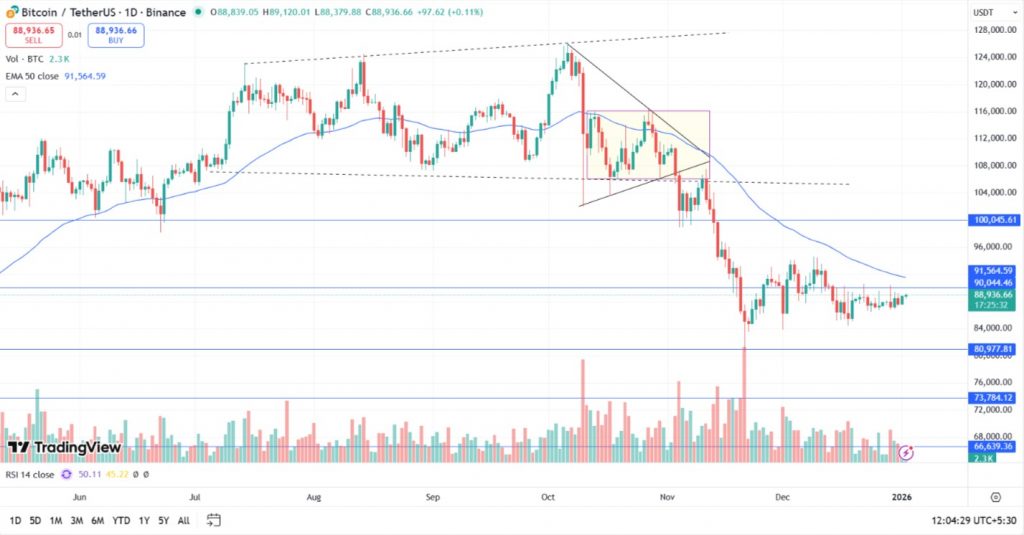
BTC, after making a new all-time high of $126,199, witnessed a sharp fall, with the price plunging nearly 20% to $102,000. Following this move, the asset traded within a range of $116,000 to $107,000, forming a symmetrical triangle pattern. BTC later broke down below this range and plunged another 25%, marking a low of $80,600. After this move, BTC staged a relief rally of nearly 17%. The asset is currently consolidating and trading sideways within a range of $84,000 to $94,000, accompanied by declining volumes. Breakouts on either side of the range, supported by strong volumes, will likely determine the next trend.
ETH
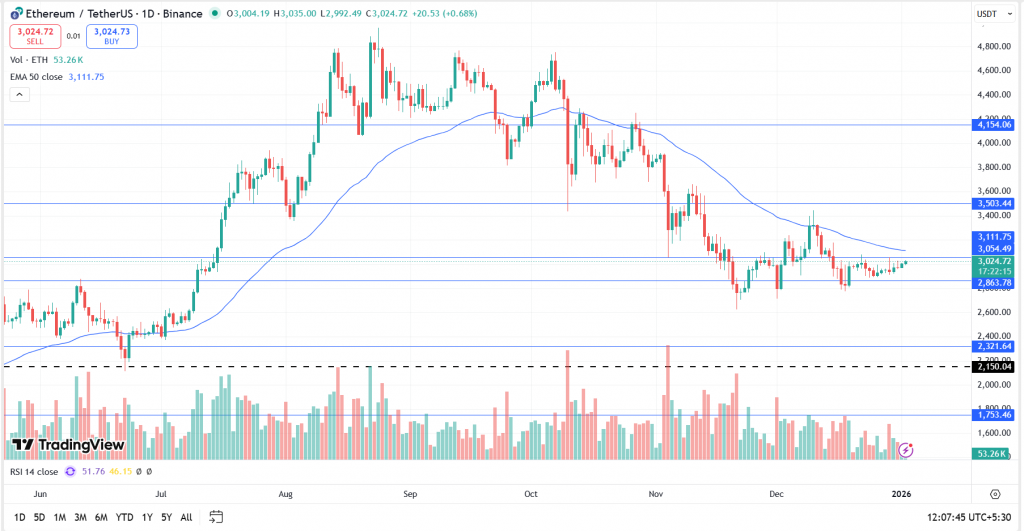
ETH, after reaching a new all-time high of $4,956, experienced a sharp decline of nearly 39%, dropping to $3,054. The asset attempted to hold support at the psychological $3,000 level and entered a consolidation phase. ETH eventually broke down below this range, marking a recent low of $2,623. However, it did not close below the key support level of $2,725 (the 61.8% Fibonacci retracement level) and rallied to $3,447. The asset failed to break the $3,500 resistance and corrected again. Currently, ETH is consolidating and trading within a range of $2,750 to $3,100. Breakouts on either side of this range, supported by strong volumes, will determine the future trend.
BAT
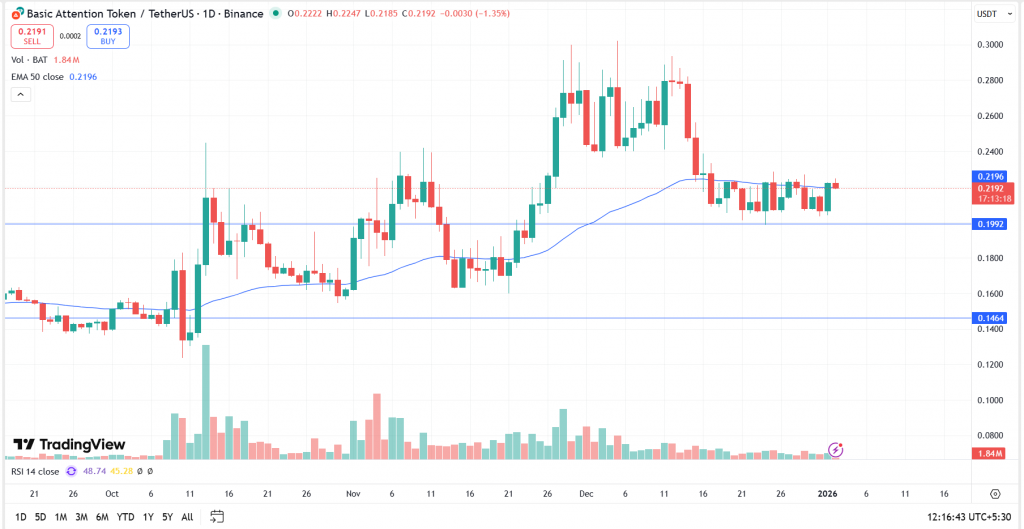
BAT formed a double-bottom pattern at $0.1078, with a neckline at $0.175. The asset broke out above the neckline and witnessed a sharp rally to $0.3023. However, it failed to close above the long-held resistance at $0.30 and saw profit booking at those levels. The price corrected by nearly 33% to $0.20. Currently, BAT is consolidating and trading within a range of $0.20 to $0.23 with low volumes. Breakouts on either side of the range, supported by strong volumes, will determine the next trend. For BAT to rally further, it needs to break, close, and sustain above the key resistance level of $0.30.
Weekly Snapshot
| USD ($) | 25 Dec. 25 | 01 Jan. 26 | Previous Week | Current Week | |||
| Close | Close | % Change | High | Low | High | Low | |
| BTC | $88,732 | $87,235 | -1.69% | $90,501.93 | $85,107.66 | $90,299.16 | $86,628.14 |
| ETH | $2,904 | $3,000 | 3.32% | $3,073.35 | $2,811.39 | $3,051.94 | $2,894.15 |
| BAT | $0.207 | $0.221 | 6.96% | $0.227 | $0.199 | $0.225 | $0.204 |
| Crypto Asset | 1w – % Vol. Change (Global) |
|---|---|
| Bitcoin (BTC) | -0.23% |
| Ethereum (ETH) | -6.66% |
| Basic Attention Token (BAT) | -18.05% |
| Resistance 2 | $100,000 | $3,350 | $0.30 | $1,025 |
| Resistance 1 | $93,500 | $3,150 | $0.25 | $953 |
| USD | BTC | ETH | BAT | BNB |
| Support 1 | $87,000 | $2,750 | $0.20 | $775 |
| Support 2 | $80,000 | $2,550 | $0.175 | $700 |
Market Updates
- Crypto investors across 48 countries will begin having their crypto wallet transaction data recorded for tax purposes this year, as the long-awaited Crypto-Asset Reporting Framework (CARF) rolls out globally. Developed by the OECD, CARF officially goes into effect in 2027.
- A key policymaker who oversaw the launch of regulated Bitcoin futures in the US has returned as chief of staff at the Commodities Futures Trading Commission after a six-year hiatus. In an announcement on Wednesday, the CFTC welcomed back Amir Zaidi, with Chairman Michael Selig emphasizing the experience Zaidi brings.
- The Reserve Bank of India has urged countries to prioritize central bank digital currencies over privately issued stablecoins, citing concerns around financial stability. In its December Financial Stability Report, the RBI stated that CBDCs preserve the “singleness of money and the integrity of the financial system,” and should remain the “ultimate settlement asset” and the “anchor for trust in money.”
Unravel everything that you need for your crypto journey via ZebPay blogs. Get started today and join 6 million+ registered users on ZebPay!