

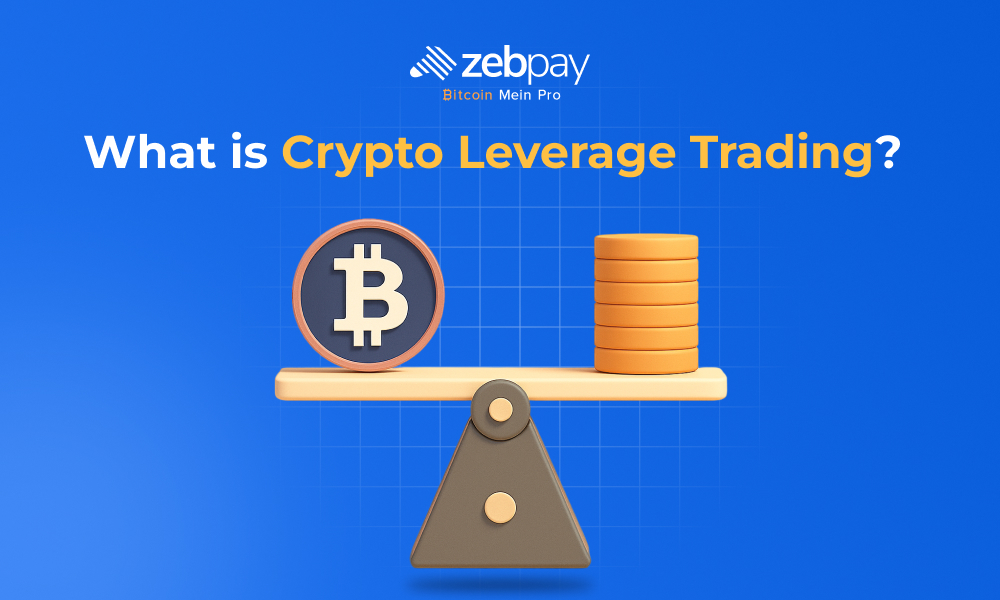
Crypto leverage is a trading feature that allows users to open positions by borrowing funds on top of their existing capital. This is also known as leverage trading, where traders can control a much larger position size than their actual investment. In leverage trading crypto, profits and losses are calculated as multiples of the collateral used, meaning even small price movements can have a significant impact. When you trade crypto with leverage, you essentially increase your market exposure without needing to invest the full amount upfront.
While crypto leverage can dramatically enhance profit potential, it also comes with equally high risk. Leverage trading crypto exposes traders to higher volatility, and unfavorable price movements can quickly lead to large losses or even liquidation of the entire position. Because of this, leverage trading is best suited for experienced traders who clearly understand risk management, stop-loss strategies, and market behavior before choosing to trade crypto with leverage.
The crypto industry is booming at a rapid pace. With this rapid boom, the number of investors and traders in the industry have also risen exponentially. Not just that, the number of financial instruments to facilitate innovative ways of making money have also populated the crypto industry. If you are one such trader or investor, you should know about crypto derivatives that come in the form of futures, options, perpetual and swaps. In addition to that, there is another type of financial instrument called crypto leverage that you should know about. Let’s dive into it to expand on the mystery.
Understanding Leverage Trading in Crypto
Crypto leverage is a trading instrument that allows traders to borrow funds against a set amount of collateral and use that borrowed capital to place bigger trades. This process is commonly known as leverage trading, where you gain exposure to a larger position than your actual balance would normally allow. In leverage trading crypto, traders can take sizable market positions without fully owning the required funds. In simple terms, when you trade crypto with leverage, your purchasing power increases based on the leverage multiple you choose.
Because leveraged positions are backed by collateral, crypto leverage carries significant risk. A small unfavorable price movement can lead to rapid losses or even liquidation of the entire position. At the same time, favorable price movements can generate amplified profits. This dual nature of higher risk and higher reward makes leverage trading highly speculative. Many traders also use leverage trading crypto for hedging purposes, especially to manage risks during high market volatility. The added flexibility of entering both long and short positions is another reason traders choose to trade crypto with leverage.
To understand how a crypto leverage trade works in practice, consider this example: if you use 3x crypto leverage on $100, you can control a $300 position in the market. This means you are trading three times your actual capital. If the asset’s price rises by 1%, your profit is calculated on the full $300 exposure, giving you a 3% return on your original $100 (before fees). The same multiplier applies to losses as well. This is a simple way to explain how leverage trading crypto amplifies outcomes, regardless of the size of the original investment.
Key Concepts Behind Crypto Leverage
Crypto leverage allows traders to increase their market exposure by borrowing funds against their existing capital. In leverage trading, the trader puts up a margin (collateral), while the exchange provides additional funds to amplify the position size. The leverage ratio, such as 2x, 5x, or 10x, determines how much larger the trade becomes compared to the trader’s original investment. In leverage trading crypto, both profits and losses are multiplied according to the selected leverage.
Another important concept in crypto leverage is liquidation. If the market moves against your position and your losses approach your collateral value, the position can be automatically closed to prevent further losses. This is why risk management tools like stop-loss orders are essential when you trade crypto with leverage. Maintenance margin, funding fees, and margin calls are also key elements that directly impact the outcome of leveraged trades.
How Does Crypto Leverage Trading Work?
Leverage trading crypto works by allowing traders to deposit a portion of the total trade value as margin and borrow the remaining amount from the exchange. For example, if you use 5x crypto leverage with $100, you can open a $500 position. This means you are controlling a much larger trade than your actual capital would normally allow. When you trade crypto with leverage, any price movement—up or down—is calculated on the full $500 exposure, not just your original $100.
As the market moves, your profit or loss is continuously adjusted based on the total leveraged position. If the trade moves in your favor, your gains increase rapidly. However, if the price moves against you, losses can also escalate quickly and may lead to liquidation if your margin is exhausted. Because of this, leverage trading is widely used for short-term speculation and hedging but requires strict risk management to avoid substantial losses.
Also Read: What is Ethereum Name Service?
How to Calculate Leverage in Crypto Trading
Understanding how to calculate leverage is one of the first practical skills any trader needs before putting real money on the line. The math itself is not complicated, but the implications of getting it wrong can be severe. Knowing exactly how much you are risking at any given moment is what separates disciplined traders from those who learn expensive lessons.
Understanding Margin, Position Size, and Liquidation Price
Three concepts sit at the foundation of every leveraged trade: margin, position size, and liquidation price.
Margin is the amount of your own capital you put up to open a leveraged position. Think of it as a security deposit. If you want to open a $1,000 position with 10x leverage, your margin requirement is $100. The remaining $900 is effectively borrowed from the exchange.
Position size is the total value of your trade, including the borrowed portion. It is calculated simply as your margin multiplied by your leverage ratio. So $100 at 10x gives you a position size of $1,000.
Liquidation price is the price level at which your position is automatically closed by the exchange because your losses have eaten through your margin. The higher your leverage, the closer your liquidation price is to your entry point, leaving very little room for the market to move against you before your position is wiped out.
The formula to estimate your liquidation price on a long position is broadly as follows: subtract the result of your entry price divided by your leverage ratio from your entry price. For a short position, the logic is reversed. Most exchanges calculate this automatically, but understanding the mechanics gives you far greater control over your risk.
Leverage Ratio Examples: 5x, 10x, and 100x Explained
To make this concrete, consider a trader who has $200 and wants to trade crypto with leverage across three different ratios.
At 5x leverage, their position size is $1,000. A 10% move in their favour returns $100, doubling their effective gain on their margin. A 10% move against them loses $100, wiping out half their margin.
At 10x leverage, the same $200 controls a $2,000 position. A 10% favourable move now returns $200, effectively doubling the entire margin. But a 10% adverse move wipes out the margin entirely and triggers liquidation.
At 100x leverage, the $200 controls a $20,000 position. The potential gains are dramatic, but a move of just 1% against the trader is enough to liquidate the entire position. This is the level of leverage where even a momentary price wick can end a trade instantly.
How a 10x Leverage Trade Works in Practice
Suppose a trader believes Bitcoin is about to rise and decides to open a long position. They have $500 in their account and choose 10x leverage, giving them a position size of $5,000. Bitcoin is priced at $50,000 at the time of entry, so they are effectively buying 0.1 BTC.
If Bitcoin rises to $55,000, a 10% increase, their position is now worth $5,500. After returning the borrowed $4,500, they are left with $1,000, doubling their original $500 margin. Had they traded without leverage, the same 10% move would have returned just $50 on a $500 position.
Now consider the downside. If Bitcoin drops to $45,000, a 10% decline, their position is worth $4,500. After accounting for the borrowed funds, their margin is completely gone and the position is liquidated. The same 10% drop without leverage would have simply reduced their $500 to $450, a loss they could recover from comfortably.
Types of Crypto Leverage Trading
There are several ways traders can use crypto leverage depending on their trading strategy and risk appetite. Each method of leverage trading crypto works differently but shares the same core idea—amplifying market exposure using borrowed funds. Whether you trade crypto with leverage through margin trading, futures, or options, each method carries unique benefits, risks, and use cases. Understanding these types is essential before participating in leverage trading.
Margin Trading
Margin trading is one of the most common forms of leverage trading in crypto. In this method, traders borrow funds from an exchange by depositing collateral, also known as margin. Based on the selected leverage ratio, traders can open positions much larger than their actual capital. For example, with 5x crypto leverage, a trader can control a position five times the size of their investment.
Margin trading allows both long and short positions, giving traders the flexibility to profit from rising and falling markets. However, if the market moves against the position, losses are also amplified and can lead to liquidation if the margin is insufficient. This makes margin-based leverage trading crypto suitable mainly for traders who understand position sizing and risk management.
Crypto Futures
Crypto futures are derivative contracts where traders agree to buy or sell a cryptocurrency at a predetermined price on a future date. Futures trading is one of the most widely used ways to trade crypto with leverage, as it allows for high leverage, easy short-selling, and exposure without owning the actual asset.
In leverage trading crypto through futures, traders only need to deposit a fraction of the contract value as margin. Profits and losses are calculated on the full contract size, making futures highly attractive—but also highly risky. Because of their volatility and liquidation risk, crypto futures are mainly used for short-term speculation and hedging strategies.
Crypto Options
Crypto options give traders the right, but not the obligation, to buy or sell a cryptocurrency at a specific price before a certain expiry date. While options are more complex than margin or futures, they still offer a form of crypto leverage by providing large market exposure with relatively smaller capital.
In leverage trading using options, traders can design strategies for speculation, income generation, or risk hedging. Losses are typically limited to the premium paid for the option, while profit potential can be significant depending on the strategy used. However, due to their complexity, crypto options are generally better suited for experienced traders who deeply understand market behavior and volatility dynamics.
Also Read: India’s Parliament Calls ZebPay, WazirX & Binance to Discuss Crypto’s Future
Crypto Leverage Trading Strategies
Knowing how leverage works in crypto is one thing. Knowing how to deploy it strategically is another. The traders who consistently manage leveraged positions well are not necessarily the ones who take the biggest risks. They are the ones who use leverage as a precision tool rather than a shortcut to outsized gains.
Long vs. Short Positions With Leverage
Going long means you are betting that the price of an asset will rise. With leverage, your gains are amplified if the price moves in your favour, but so are your losses if it falls. Long positions are most effective in clearly bullish market conditions, supported by strong technical or fundamental signals.
Going short means you are betting that the price will fall. You borrow the asset, sell it at the current price, and aim to buy it back at a lower price, pocketing the difference. Leveraged short positions can be highly profitable during bear markets or sharp corrections, but they carry unique risks since, in theory, an asset’s price can rise indefinitely while it can only fall to zero.
Both directions can be traded with leverage, and many experienced traders use a combination of long and short positions to navigate different market conditions with greater flexibility.
Hedging With Leveraged Positions
Hedging is a strategy used to reduce the risk of an existing position by opening a counterbalancing trade. In the context of crypto leverage trading, a trader who holds a large spot position in Bitcoin might open a short leveraged position to protect against a potential price decline. If Bitcoin drops, the gains from the short position offset the losses on the spot holding.
It is a more advanced approach and not without its own costs, including funding rates and the complexity of managing multiple positions simultaneously. But for traders with significant exposure to a single asset, hedging with leveraged positions can be an effective way to manage downside risk without fully exiting a position.
Why Traders Use Crypto Leverage
Traders use crypto leverage to increase their market exposure without needing to invest a large upfront capital. Through leverage trading, they can control bigger positions using a relatively smaller amount of funds as collateral. This makes leverage trading crypto attractive for traders who want to maximize opportunities in fast-moving markets. When traders trade crypto with leverage, they gain access to higher profit potential, short-selling opportunities, and advanced trading strategies that are not possible in regular spot trading.
At the same time, crypto leverage is often used for speculative trading and hedging. Traders can profit from both rising and falling markets, and hedge existing positions against price volatility. However, because leverage trading magnifies both gains and losses, it requires discipline, risk management, and a strong understanding of market behavior.
Benefits of Using Crypto Leverage
One of the biggest advantages of crypto leverage is the ability to amplify profits using a relatively small investment. In leverage trading crypto, traders can multiply returns even from minor price movements. This makes it especially useful in short-term trading strategies such as scalping and intraday trading.
Another key benefit is flexibility. When you trade crypto with leverage, you can take both long and short positions, allowing you to profit in bullish as well as bearish markets. Crypto leverage also helps traders optimize capital efficiency by freeing up funds for multiple trades rather than locking all capital into a single position.
Also Read: CLARITY Act Advances in U.S. Senate: A Major Step for Crypto Regulation
When Should You Trade Crypto With Leverage?
Traders should consider using crypto leverage only when they have a clear trading plan, proper risk management rules, and a strong understanding of market trends. Leverage trading crypto is most effective in markets with strong momentum, high liquidity, and clear technical setups supported by indicators.
It is also useful when traders want to hedge an existing spot position or take advantage of short-term price movements. However, beginners should avoid using leverage trading during periods of extreme volatility or major news events, as sudden price swings can trigger rapid liquidations.
How Does Liquidation Work in Crypto Leverage Trading?
Liquidation is one of the most important concepts to understand when you trade crypto with leverage. It is the mechanism by which an exchange forcibly closes your position when your losses approach the value of your margin, ensuring that borrowed funds are protected. For traders, it represents the worst-case outcome of a leveraged position going the wrong way.
What Triggers a Liquidation?
A liquidation is triggered when your margin balance falls to or below the exchange’s maintenance margin threshold. This is the minimum amount of collateral required to keep a position open. When the market moves against your position far enough to breach this level, the exchange closes your trade automatically, and your margin is used to cover the losses.
Different exchanges set different maintenance margin requirements, and the speed at which liquidation occurs depends on your leverage ratio. At higher leverage levels, even a small adverse price movement can be enough to trigger the process. Some exchanges issue a margin call before liquidation, alerting you to add more collateral, but in fast-moving crypto markets, prices can move so quickly that there is little time to react.
How to Avoid Getting Liquidated
Avoiding liquidation is not just about picking the right trade. It is about managing your position intelligently from the moment you open it.
Using Stop-Loss Orders Effectively
A stop-loss order is one of the most valuable tools available to any leveraged trader. It allows you to define in advance the price at which your position will be closed if the market moves against you, capping your losses before they reach your liquidation price.
The key is placement. Setting a stop-loss too close to your entry point means you risk being stopped out by normal market volatility. Setting it too far reduces its protective value. A well-placed stop-loss sits at a level that is technically significant, such as below a key support level, and is calculated with your liquidation price clearly in mind.
Maintaining a Healthy Margin Ratio
Your margin ratio reflects how close your position is to liquidation at any given moment. Keeping it healthy means either reducing your position size, lowering your leverage, or adding collateral to your margin balance when the market moves against you.
A practical rule of thumb is to never let your margin be fully consumed by a single position. Experienced traders typically risk only a small percentage of their total capital on any one trade, ensuring that a liquidation, while painful, does not end their participation in the market entirely.
Common Mistakes Traders Make With Crypto Leverage
A common mistake in leverage trading crypto is using excessive leverage without understanding the risks. High leverage increases liquidation chances and can wipe out capital quickly. Another mistake is entering trades without proper stop-loss placement, which exposes traders to uncontrolled losses.
Many traders also trade crypto with leverage emotionally—chasing losses, overtrading, or ignoring proper position sizing. Relying only on leverage without technical confirmation, poor margin management, and trading during highly unpredictable market conditions are also frequent errors.
Is Crypto Leverage Trading Safe?
Crypto leverage trading is not inherently unsafe, but it carries significantly higher risk compared to spot trading. The safety of leverage trading largely depends on how well the trader manages risk, position size, and market exposure. Without proper risk controls, even small market movements can result in heavy losses.
However, when used responsibly with proper stop-loss levels, limited leverage, and strong technical confirmation, leverage trading crypto can be a controlled and strategic trading method. The key lies in discipline, education, and realistic expectations rather than aggressive profit chasing.
Also Read: What is Bitcoin Mining?
How to Start Crypto Leverage Trading as a Beginner
Beginners should start with a strong foundation in spot trading before moving into crypto leverage. Understanding market trends, technical indicators, liquidity, and volatility is essential before engaging in leverage trading. It is always advisable to begin with the lowest leverage possible to minimize risk exposure.
New traders should also practice using demo accounts, apply strict stop-loss rules, and only trade with funds they can afford to lose. When you trade crypto with leverage, continuous learning, emotional discipline, and proper capital management are critical to surviving and growing in leveraged markets.
In the grand scheme of things, ZebPay blogs are here to provide you with crypto wisdom. Get started today and join 6 million+ registered users to explore endless features on ZebPay!
FAQs
What is leverage in crypto trading in simple terms?
Leverage in crypto trading allows you to control a larger position than your actual capital would normally allow by borrowing funds from the exchange. If you have $100 and use 10x leverage, you can open a $1,000 position. Your profits and losses are both calculated on the full $1,000, meaning leverage amplifies both the upside and the downside of any trade.
How does leverage work in crypto trading?
When you open a leveraged position, the exchange lends you the difference between your margin and your total position size. As the trade moves in your favour, your profits are calculated on the entire position, not just your margin. If the trade moves against you, losses accumulate just as quickly. If those losses reach your margin amount, the exchange liquidates your position to recover the borrowed funds.
Can beginners use leverage in crypto trading?
Technically yes, but it requires serious caution. Beginners who are still developing their understanding of market dynamics, risk management, and position sizing are particularly vulnerable to rapid liquidations. If you are new to crypto trading with leverage, starting with the lowest available ratios, using stop-loss orders consistently, and risking only a small portion of your capital on any single trade is strongly advisable before scaling up.
What is the difference between leverage trading and regular crypto trading?
In regular spot trading, you buy or sell an asset using only your own capital. Your maximum loss is limited to what you invested. In leverage trading, you control a position larger than your capital by borrowing from the exchange. This amplifies both potential gains and potential losses, and introduces the risk of liquidation, where your entire margin can be lost even if the underlying asset only moves a small percentage against your position.
How do I avoid liquidation in crypto leverage trading?
The most effective ways to avoid liquidation are using stop-loss orders to exit positions before losses reach your margin, keeping your leverage ratio low, monitoring your margin ratio actively, and never allocating more capital to a single leveraged trade than you can afford to lose entirely. Staying aware of upcoming market events, such as economic announcements or major on-chain developments, that could trigger sudden volatility also helps you manage open positions more proactively.