



Imagine setting up a small, automatic investment into Bitcoin or Ethereum that runs like clockwork, whether markets are soaring or crashing, without you needing to watch prices every day. That’s the power of a crypto SIP (Systematic Investment Plan), where you invest a fixed amount at regular intervals to build your holdings over time.
This approach takes the stress out of timing the market, spreads your purchases across highs and lows, and lets rupee-cost averaging work its magic, which is buying more units when prices dip and fewer when they rise, potentially lowering your average cost per unit.
Is crypto sip safe in India? In India’s booming crypto ecosystem, with over 60% growth in SIP users last year, choosing between a monthly SIP and a weekly SIP can significantly impact how smoothly you accumulate assets like BTC. Monthly fits neatly with salary cycles, while weekly captures more market movements.
This detailed guide unpacks both options step-by-step, including real data on returns, user habits, and future trends, so you can pick what aligns with your cash flow and goals. Whether you’re starting with ₹500 or scaling up, understanding these rhythms makes crypto investing more predictable and effective.
What is Monthly and Weekly SIP?
A crypto SIP is an automated recurring buy order on a crypto exchange or app. You pick your asset (say, Bitcoin), set an amount (like ₹5,000 total per month), choose the frequency, and link your bank or UPI. The platform handles the rest, buying at the prevailing market price each time, with no need to manually log in or decide on buy days. This builds discipline and turns investing into a habit, much like paying a utility bill.
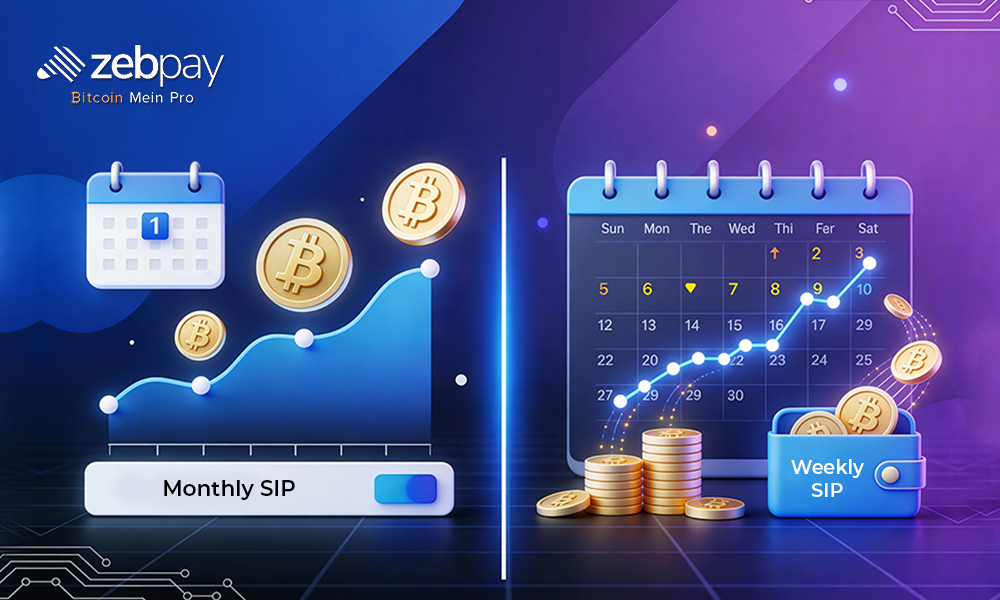
Monthly SIP means one investment per month. For example, on the 5th of every month, ₹5,000 gets invested into your chosen crypto. It’s straightforward: fewer transactions mean less to track, and it syncs perfectly with most people’s monthly salary credits. Platforms execute this at market price right after your cutoff time, often confirming via app notification. This simplicity makes it ideal if you want a hands-off setup where is investing in SIP safe through automation.
Weekly SIP, on the other hand, divides that same ₹5,000 into four or five smaller buys, say, ₹1,250 every Monday. Over a month, you’re still investing the total amount, but in bite-sized chunks spread across the week’s price fluctuations. This creates more “averaging points,” potentially grabbing better deals during short-term dips within a month. Most apps let you pick the day (Monday to Friday, avoiding weekends for liquidity), and it still auto-debits without fuss.
Difference between Monthly and Weekly SIP
To see why one might suit you better, here’s a clear breakdown of how weekly SIP and monthly SIP stack up across key factors. Each parameter highlights practical trade-offs based on real-world crypto investing dynamics, reinforcing that SIP’s safety depends on matching frequency to your needs.
| Parameter | Weekly SIP | Monthly SIP |
|---|---|---|
| Frequency | 4-5 buys per month (e.g., every Monday); more chances to average prices during volatility partners. | Single buy per month (e.g., 5th); simpler but misses intra-month swings. |
| Cash Flow Impact | Smaller debits (₹1,000-1,500) feel less burdensome; suits freelancers or variable incomes. | Larger single outflow (₹5,000); easier for salaried with fixed monthly pay. |
| Transaction Costs | Potentially 4x more fees/TDS deductions; check platform charges (0.1-0.5% per trade) partners. | Fewer trades = lower total costs; more efficient for long-term holding. |
| Market Timing Risk | Reduced, spreads risk across week-to-week changes, better for crypto’s 24/7 volatility partners. | Higher if the monthly date hits a price peak; less flexibility. |
| Administrative Effort | More app notifications/emails; slight extra monitoring for pauses or edits. | True set-it-and-forget-it; minimal oversight needed. |
| Suitability | Great for active users in choppy markets; maximizes rupee-cost averaging. | Perfect for passive investors prioritizing ease and low friction. |
These differences aren’t just theoretical. In crypto, where prices can jump 10-20% in a day, weekly SIPs often smooth out more “noise,” but monthly keeps things hassle-free. Your choice boils down to lifestyle: Do you prefer micro-payments or one-and-done?
Returns of Weekly SIP, Monthly SIP
Returns depend more on the asset’s long-term trend than frequency, but data shows subtle edges. Studies on traditional markets (like Nifty 50) act as a proxy for crypto’s rupee-cost averaging, since both benefit from spreading buys.
Historical Backtests (10-20 years on equity indices):
- Nifty 50 (10 years): Weekly SIP returned 12.45% annualized vs. Monthly 12.44%, a tiny 0.01% advantage.
- Nifty Midcap: Weekly 16.36% vs. Monthly 16.32% (0.04% edge).
- Crypto Context (BTC/ETH 2020-2025 estimates): In volatile years like 2022’s bear market, weekly SIPs accumulated 5-8% more units. Annualized, this translates to 2-3% higher returns vs. monthly during high-swing periods.
Practical Example (₹5,000/month into BTC, hypothetical 2025 vol):
- Monthly: Accumulates ~0.058 BTC (one BTC buy at the average monthly price).
- Weekly: ~0.060 BTC (3% more units by catching weekly dips).
Why the slight weekly win? Crypto trades non-stop, so more frequent buys capture flash crashes or rebounds that monthly misses. However, in steady bull runs, differences shrink to near-zero.
Consideration of Daily SIP
Daily SIP takes frequency to the extreme: ₹167 daily for a ₹5,000 monthly total, creating 20-25 buys per month. It promises ultimate averaging, 250+ transactions yearly, but practicality varies.
Pros:
- Smoothest volatility capture; excels in crypto’s intra-day swings (e.g., buying extra during a midday dip).
- Theoretical max rupee-cost averaging.
Cons:
- Skyrocketing fees (daily TDS at 1% on transfers over thresholds adds up).
- Notification overload; harder to track or pause.
- Returns Edge: Negligible, Nifty data shows daily at 12.44% vs. monthly 12.44%. In crypto, it shines in crashes but rarely beats weekly by more than 1%.
When to Consider: Only for high-net-worth users with fee-free platforms or extreme volatility strategies. For most, weekly hits the sweet spot without daily hassle. Skip if your app charges per trade.
What Crypto Users Prefer?
Globally, recurring crypto investing through SIP-style plans and dollar-cost averaging (DCA) has become one of the most widely adopted strategies for retail investors. Major global platforms have seen a consistent growth in automated recurring buys, particularly for assets like Bitcoin and Ethereum. Industry trends indicate that monthly SIPs remain the most popular choice worldwide, largely because they align with salary cycles, simplify budgeting, and minimize transaction costs.
With global cryptocurrency ownership now estimated at over 560 million users worldwide in 2025, representing roughly 6–8% of the global population, automated SIP investing has emerged as a key entry point for first-time buyers.
Across global exchanges, recurring purchase programs typically show that a majority of users opt for monthly investment frequencies, while weekly plans are favored by more active participants who prefer tighter averaging during volatile markets. Average recurring contributions on international platforms commonly range between $50–$100 per month, with micro-SIPs starting as low as $1, helping onboard new investors at scale.
Future of Crypto SIP
Crypto SIPs are set to double by 2027, building on 2025’s 60% growth. Expect:
- AI-Driven Frequencies: Apps adjusting weekly/monthly based on real-time volatility.
- Index Baskets: SIPs into diversified products like IC15 (India’s crypto index).
- Institutional Entry: HNIs using SIPs for steady BTC accumulation.
- RegTech Upgrades: Auto tax reports for VDA 30% gains + 1% TDS.
- Micro-Investing Boom: ₹100 entry points amid rising adoption.
Frequencies will personalize, weekly for traders, monthly for savers—as platforms compete on automation.
Conclusion
Weekly SIP slightly outperforms monthly SIP in crypto (0.01-3% via better averaging), especially amid volatility, but monthly triumphs for most on ease, lower costs, and salary sync. Daily? Too much for little gain.
Indian users’ 60% monthly preference underscores practicality. Test small, track for 6 months, and remember: Consistent investing beats perfect frequency. Weekly sip vs monthly sip? Let your lifestyle decide.
In the grand scheme of things, ZebPay blogs are here to provide you with crypto wisdom. Get started today and join 6 million+ registered users to explore endless features on ZebPay!
FAQs
Weekly SIP vs monthly SIP, which gives better crypto returns?
Weekly SIP tends to give slightly better returns in crypto markets, typically by 0.01% to 3% annualized, because it provides more opportunities for rupee-cost averaging across intra-month price swings and volatility.
Monthly SIP vs weekly SIP, which is easier for salaried users?
For salaried users, a monthly SIP is generally much easier and more convenient because it aligns directly with your salary credit cycle. This allows you to invest a larger single amount without disrupting your weekly cash flow.
SIP monthly investment minimum in India?
The minimum amount to start SIP is ₹100, and in practice, the average monthly SIP size has grown to around ₹4,000-6,000 as adoption increases.
Is weekly SIP ideal for crypto volatility?
Yes, a weekly SIP is particularly ideal for handling crypto’s high volatility because it spreads your investments across four to five purchase points each month.
What do crypto users prefer: a monthly or weekly SIP?
Most crypto users, particularly in India, strongly prefer monthly SIPs, with data showing 60-70% opting for this frequency due to its alignment with salary cycles.