

Bitcoin is often described as “peer‑to‑peer electronic cash” because it lets two people transact directly, using software and cryptography instead of trusted intermediaries. Every Bitcoin transaction is recorded on a public ledger called the blockchain, which anyone can view, but no single person or institution controls.
There will be only 21 million bitcoins, which makes it a scarce digital asset and an asset for a long‑term store of value similar to gold. The Bitcoin meaning is simple:
- Digital cash that you can send like an email
- A payment network that never sleeps and works 24/7 globally
- A rare asset with clear rules that no single central authority can easily change.
How the Bitcoin Journey Started?
History of Bitcoin
Bitcoin’s story begins in the aftermath of the 2008 global financial crisis. In October 2008, a person (or group) using the name Satoshi Nakamoto published a nine‑page document titled Bitcoin: A Peer‑to‑Peer Electronic Cash System on a cryptography mailing list. This white paper laid out the idea of a new kind of money that would run on a decentralised network. This moment formally marks when Bitcoin started from theory to a working network.
First Block
On 3 January 2009, Satoshi Nakamoto mined the genesis block, the first block of the Bitcoin blockchain. Hidden within that block is a secret message referencing a current newspaper headline related to government bank bailouts. It indicates that Bitcoin is a response to the centralized traditional financial system. The mining reward for this first block was 50 BTC, which was the standard reward for newly mined blocks during the early days of Bitcoin.
Denominations
The block reward is set to gradually decrease over time by periodic reductions, roughly every four years, in events labeled as “halvings.” The reward has consecutively fallen from 50 BTC to 25, then 12.5, then 6.25, and, after the halving event of 2024, to 3.125 BTC per block.
It is this programmed, predictable reduction of new supply that provides a principal rationale for calling Bitcoin a deflationary asset, and not an inflationary one. Bitcoin is also highly divisible. A single bitcoin can be divided into 100 million units, which are called satoshis, or “sats.” This, therefore, carries the corollary implication that:
- 1 BTC = 100,000,000 sats
This divisibility allows people to buy or spend tiny fractions of a bitcoin, so you don’t need to own a “whole” BTC to participate.
Pizza Narrative
A key moment in the history of Bitcoin is the Bitcoin pizza transaction. On 22 May 2010, developer Laszlo Hanyecz sent 10,000 BTC in return for two pizzas, presumably the first valid real-world purchase using Bitcoin.
At that moment, the value corresponded to approximately $40; with contemporary valuation, this quantity would represent a great fortune.
Bitcoin White Paper: Core Principles
The Bitcoin white paper serves as the foundational blueprint for the system. Within this nine-page document, Satoshi Nakamoto laid out a roadmap to build a digital currency that did not depend on central authorities. The main issues dealt with are:
- Double-spending: How does one ensure that a particular digital coin is never spent more than once?
- Trust: How can you avoid dependency on the third party (like banks) to maintain balances and process payments?
Addressing the above issues, this whitepaper introduces the following foundational components:
- A peer‑to‑peer network: Instead of one central server, many independent computers (nodes) run the Bitcoin software. Each node checks new transactions and keeps a copy of the ledger.
- A public blockchain: Transactions are grouped into blocks. Each block references the one before it, forming a chain. This chain is shared publicly so everyone can verify the same history.
- Proof of Work: Adding a new block requires the miners to solve a complex mathematical puzzle, which requires energy and computing power. Hence, cheating is expensive. In case of trying to alter old transactions, a miner would have to redo that “work” for that block and all the blocks that came after it-a task practically impossible at scale.
- Incentives: A miner is incentivized with newly created bitcoin, the block reward, in addition to transaction fees. This economic incentive encourages honest behavior and secures the network.
What is Blockchain Technology and How Does It Work?
Understanding blockchain helps answer both what Bitcoin is and how Bitcoin works. The blockchain is the backbone of Bitcoin. It is a special type of database that is:
- Many computers keep an identical copy.
- You can add new data, that is, blocks, but you cannot modify or delete old data easily.
- Anyone can read and verify transactions in it.
Here is a simple way to visualize it:
- Imagine a public notebook where every Bitcoin transaction is written down in order.
- Every few minutes, recent transactions are bundled into a “page” in this notebook; that page is a block.
- Each new block contains a reference (a hash) to the previous block, linking them together like a chain.
- Because everyone has a copy of this notebook, and blocks are linked, it is extremely hard to change past entries without everyone noticing.
Miners are the ones who add new pages (blocks). They compete to solve a puzzle first; the winner adds the block and gets rewarded. Other nodes check that the block follows the rules. If it does, they accept it, and the chain grows.
For users, the important points are:
- Once a transaction has several confirmations (blocks added on top of it), it becomes very hard to reverse.
- The blockchain makes the system transparent (anyone can audit) and resilient (no single point of failure).
Read more: What are the different layers of Blockchain?
How to Buy Bitcoin? Step-by-Step Guide
Buying Bitcoin today is similar to buying stocks or mutual funds online. The exact steps vary by country and platform, but the general flow is:
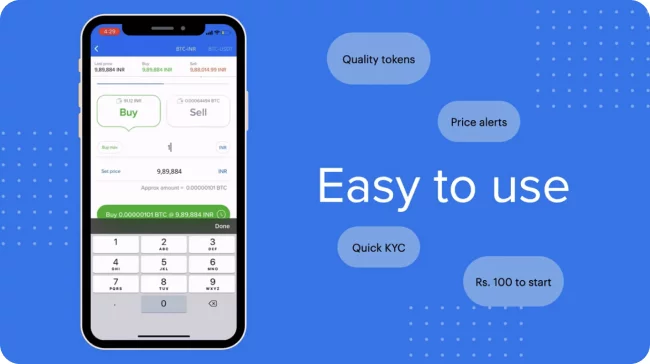
- Choose a secure exchange or app: Look for strong security, regulatory compliance, clear fees, and local fiat support. Established platforms like ZebPay often offer features like 2‑factor authentication, withdrawal whitelists, and educational content for users.
- Account creation and verification: The majority of regulated platforms demand KYC. In most instances, this involves uploading some form of identification document and occasionally even a proof of residence to meet the requirements of the law in question.
- Fund your account: Deposit local currency, for instance, INR, through bank transfer, UPI, card, or any other method supported on the platform. Some allow deposits using stablecoins like USDT and USDC.
- Place an order
- Market Order: A market order executes immediately at the prevailing market price.
- Limit Order: This allows the buyer to specify a desired price at which to purchase.
- Store your Bitcoin safely:
After purchase, you can keep BTC in your exchange wallet for convenience or move it to a personal wallet (mobile, desktop, or hardware). Self‑custody wallets give you full control but also full responsibility for your keys and backups.
Read more: Top 10 crypto to invest in December 2025
How Bitcoin Mining Works?
Mining is central to how Bitcoin works. The transactions are confirmed and the way new coins enter the blockchain network. In layman’s terms, miners are like accountants who compete with each other to define the next block in the global ledger of transactions.
Here is the process that will give you a preview of how Bitcoin mining works:
- Whenever a BTC transfer is initiated, the transaction goes to a pool of unconfirmed transactions.
- Miners choose from this pool and gather the transactions into a candidate block.
- Miners must find a nonce, a specific number in a unique way, that when combined with the data within this block and run through a hash function, returns a value lower than a target value set beforehand. This trial-and-error process is what is referred to as Proof-of-Work and requires significant computational power and electricity.
- The first miner who finds a valid solution broadcasts the block to the network. In this regard, if other nodes agree on the validity, the block would then be added to the blockchain. The successful miner gets the block reward with the transaction fees involved in the particular block, denominated in BTC.
- Due to the high competition and hardware intensity of modern mining, all mining activities are carried out by large facilities with dedicated hardware-ASICs and cheap electricity.
Individual participants usually do not conduct direct mining; instead, they either:
- Joining a mining pool grants block rewards that are proportional to the hash power contributed, or
- Buy and hold BTC instead of trying to mine it yourself.
Read more: Michael Saylor’s Bitcoin Theory of Long-term Investment
How to Use Bitcoin?
The following are the ways you can use Bitcoin:
- As a long‑term investment or store of value
Many people buy Bitcoin expecting its value to rise over the long term because of its limited supply and growing adoption. They hold it through market cycles, similar to how some people accumulate gold over time.
- For payments and remittances
Bitcoin allows you to send value across borders relatively quickly, without needing a bank or card network. Some merchants, online businesses, and even charities accept BTC directly. In countries with capital controls or unstable currencies, people sometimes use Bitcoin as an alternative way to move or store value.
- As collateral or in DeFi‑like services
On certain platforms, users can lock up Bitcoin as collateral to borrow stablecoins or earn yield, though this introduces additional counterparty and smart contract risks.
Risks of Investing in Bitcoin and the Role of Regulation
While Bitcoin has delivered very strong returns over the long term, investing in it comes with important risks that every user should understand. Bitcoin’s price can move up or down by 10–20% in a single day, and it has seen bear markets where prices fell more than 70–80% from prior peaks. This volatility can be stressful and unsuitable for anyone who might need their capital in the short term.
Regulatory and Policy Risk
Regulation of Bitcoin varies by country and continues to evolve. Some governments have:
- Recognised it as a digital asset and taxed it accordingly.
- Imposed strict rules on exchanges (KYC/AML, reporting).
- Restricted or banned certain activities (for example, leveraged trading or privacy coins).
Regulatory news can move the market sharply. However, clear regulation can also increase institutional adoption by reducing uncertainty.
Security and Custody Risk
Bitcoin itself has never been hacked at the protocol level, but exchanges and poorly secured wallets have been compromised. Common mistakes include:
- Storing large amounts of BTC on unsecured or unregulated platforms.
- Losing recovery phrases or sending funds to the wrong address.
Using reputable platforms, enabling security features like 2FA, and learning basic wallet safety practices are essential.
Technological and Competition Risk
Bitcoin is the first and largest crypto, but it operates in a fast‑moving technology space. While Bitcoin’s core design is conservative and focused on security and decentralisation, new scaling solutions and competing protocols continue to emerge. Investors should understand that Bitcoin’s long‑term dominance, while historically strong, is not guaranteed.
Conclusion
Bitcoin started as an idea in a nine‑page white paper and has grown into a global, decentralised monetary network with a market presence measured in trillions of dollars. It combines cryptography, economics, and open-source software to create digital money that is not centralized.
For investors at ZebPay, or anywhere, that blend of patience, prudence, and conviction remains the most grounded long-term strategy.
FAQs
1. Who invented Bitcoin?
Bitcoin was created by an anonymous person or group using the name Satoshi Nakamoto, who published the white paper in 2008 and launched the network in January 2009.
2. How many bitcoins will ever exist?
The protocol caps supply at 21 million BTC. New coins are created as block rewards, which halve roughly every four years until issuance eventually stops.
3. Is Bitcoin legal?
Legality depends on the country. In many jurisdictions, Bitcoin is allowed as a digital asset, but exchanges must follow regulations such as KYC/AML and tax reporting. Some countries restrict or ban it, so users should always check local rules.
4. Can I buy less than 1 bitcoin?
Yes. Bitcoin is divisible down to 1 satoshi (0.00000001 BTC). Many platforms allow purchases as low as the equivalent of a few dollars or a few hundred rupees.
5. Is Bitcoin secure from hacking?
The Bitcoin network itself has never been hacked at the protocol level. However, exchanges and wallets can be compromised if not properly secured. Using reputable platforms, strong passwords, 2FA, and safe storage practices greatly reduces risk.