



Over the past few years, the crypto market has evolved far beyond simply buying and holding Bitcoin. As decentralized finance (DeFi), stablecoins, and cross-chain ecosystems expanded, investors increasingly began asking a practical question:
How do you quickly move from one crypto asset to another without converting back to cash?
This is where crypto swapping becomes essential.
For anyone exploring how to start crypto trading or looking to buy crypto beyond just buy bitcoin, understanding swapping is no longer optional. It is a core function of the modern blockchain ecosystem.
In this guide, we will break down what crypto swapping means, how it works technically, how centralized and decentralized swaps differ, what risks are involved, and how market infrastructure in 2026 is shaping the future of digital asset exchanges.
What Is Crypto Swapping?
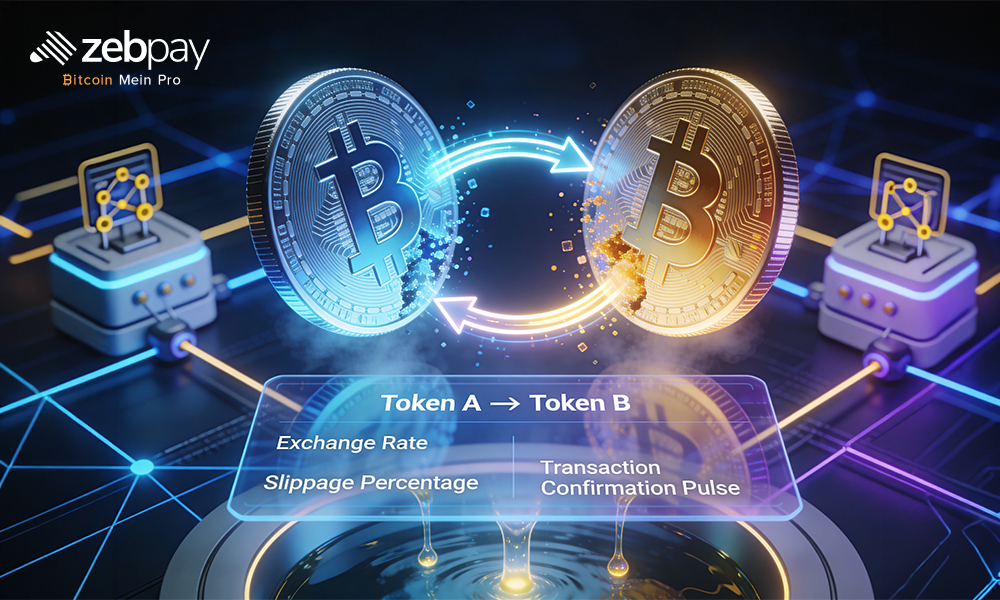
Crypto swapping refers to the direct exchange of one crypto for another without first converting into fiat currency.
For example:
- Bitcoin (BTC) → Ethereum (ETH)
- Ethereum (ETH) → USDT
- USDT → Solana (SOL)
Instead of selling Bitcoin for dollars and then using dollars to buy Ethereum, a swap executes the exchange in a single step.
According to educational resources from Ledger and BitPay, swapping is essentially a simplified trading mechanism integrated into exchanges and wallets that sources liquidity automatically and executes at market price. In simple terms, swapping allows portfolio flexibility inside the crypto ecosystem itself.
How Crypto Swapping Works
The mechanism behind swaps depends on the platform used. Broadly, swaps operate under two models:
- Order-book matching (used by centralized exchanges)
- Liquidity pool algorithms (used by decentralized exchanges)
Let us examine each carefully.
Centralized Exchange Swaps (CEX Model)
On centralized exchanges, swaps are executed through traditional order books.
When a user selects a trading pair, such as BTC/ETH, the exchange:
- Matches a seller of ETH with a buyer of ETH
- Executes both trades simultaneously
- Updates balances internally
- Charges a trading fee
Because centralized exchanges aggregate liquidity from millions of users, execution is typically fast, and slippage is minimal.
This model is generally beginner-friendly and ideal for users just entering crypto trading for beginners.
Decentralized Exchange Swaps (DEX Model)
Decentralized swaps operate differently. Instead of matching buyers and sellers directly, decentralized exchanges use liquidity pools powered by Automated Market Makers (AMMs).
Liquidity providers deposit token pairs into a smart contract pool. When a user initiates a swap:
- The smart contract calculates the exchange rate
- The swap executes directly on-chain
- Gas fees are paid to network validators
The most important distinction is that the user retains control of private keys throughout the process.
This model gained massive popularity during the DeFi expansion between 2020 and 2021.
Read more: Top 10 DeFi Tokens to Invest in March 2026
Difference Between Centralized and Decentralized Swaps
This structural difference explains why beginners often start with centralized platforms before experimenting with decentralized environments.
| Feature | Centralized Swap | Decentralized Swap |
| Custody of Funds | Exchange holds funds during trade | User retains private key control |
| Execution Method | Order book matching | Liquidity pool (AMM model) |
| Speed | Instant internal execution | Depends on the blockchain confirmation time |
| Fees | Trading fee + spread | Liquidity fee + gas fee |
| Slippage Risk | Generally low (high liquidity) | Can be high in low-liquidity pools |
| Security Risk | Exchange custody risk | Smart contract risk |
| Beginner Friendliness | High | Moderate |
| Transparency | Platform-based reporting | Fully on-chain |
Growth of Crypto Swapping
Crypto swapping expanded rapidly alongside decentralized finance.
According to DeFiLlama data:
Global DeFi Total Value Locked (TVL)
| Year | Estimated Crypto Users Globally (Millions) |
| 2015 | 5 |
| 2017 | 15 |
| 2019 | 35 |
| 2021 | 100 |
| 2023 | 220 |
| 2025 | 350 |
The rise in DeFi infrastructure directly correlates with increased decentralized swap activity.
In addition, centralized exchanges have reported increased spot conversion volumes, especially during high-volatility periods when investors rotate between Bitcoin and stablecoins.
Step-by-Step: How to Perform a Crypto Swap
The process is straightforward, but understanding each step reduces costly mistakes.
Step 1: Choose a reputable exchange or wallet that supports swaps.
Step 2: Select the cryptocurrency currently held.
Step 3: Choose the asset to receive.
Step 4: Enter the amount to exchange.
Step 5: Review exchange rate, fees, and slippage tolerance.
Step 6: Confirm the transaction.
On decentralized platforms, a wallet approval and blockchain confirmation are required.
Fees Involved in Crypto Swapping
While swapping simplifies trading, it does not eliminate costs.
Common fee components include:
- Trading fees (0.1%–1% on centralized platforms)
- Spread between bid and ask prices
- Liquidity provider fee (DEX platforms)
- Blockchain gas fee
- Slippage cost during volatility
Understanding these costs is crucial before reallocating into what might be considered the best crypto to buy or top crypto to buy during a bullish phase.
Market Sentiment Around Swapping in 2026
In 2026, swapping has evolved into a strategic tool rather than a speculative shortcut. Institutional participants increasingly rotate between Bitcoin, Ethereum, and stablecoins to manage exposure. Stablecoin dominance often rises during uncertain macroeconomic cycles, indicating heavy swap activity from volatile assets into stable holdings.
Additionally:
- Cross-chain bridges have improved
- Wallet user interfaces have simplified
- Regulatory clarity has increased in several regions
This maturity has made crypto swapping a fundamental infrastructure component rather than a niche DeFi experiment.
Risks to Consider Before Swapping
- Despite its convenience, crypto swapping carries risk.
- Price volatility can lead to unfavorable execution if markets move quickly.
- Low liquidity pools can cause slippage, significantly impacting large transactions.
- Smart contract vulnerabilities remain a risk in decentralized ecosystems.
- Taxation is another important factor. In many jurisdictions, swapping one cryptocurrency for another is considered a taxable event.
These considerations are especially important for individuals learning how to start crypto trading responsibly.
Swapping Bitcoin to Ethereum
Assume an investor holds $5,000 worth of Bitcoin.
If Ethereum shows stronger relative momentum, the investor may choose to swap BTC into ETH directly.
Instead of:
Selling BTC → Receiving fiat → Buying ETH
The swap executes in a single step.
This reduces exposure time between transactions and may lower cumulative fees.
Conclusion
Crypto swapping has become one of the most important operational tools in the digital asset ecosystem. It simplifies asset conversion, increases capital efficiency, and enables strategic portfolio adjustments without relying on traditional banking systems.
For beginners exploring buy crypto opportunities, understanding swaps builds foundational knowledge. For experienced traders, swaps provide tactical flexibility during volatile market cycles.
As blockchain infrastructure continues evolving in 2026 and beyond, swapping is expected to become faster, more cost-efficient, and increasingly cross-chain compatible.
Educated participation remains the most powerful risk management strategy in crypto markets.
In the grand scheme of things, ZebPay blogs are here to provide you with crypto wisdom. Get started today and join 6 million+ registered users to explore endless features on ZebPay!
FAQs
What is crypto swapping?
Crypto swapping is the direct exchange of one cryptocurrency for another without converting into fiat currency first.
Is crypto swapping better than selling and rebuying?
It is generally faster and reduces friction, but fees and slippage must be considered.
Are decentralized swaps safer?
They offer greater self-custody but introduce smart contract risks.
Do I pay tax when swapping crypto?
In many countries, yes. Swaps may trigger capital gains tax.
Is swapping suitable for beginners?
Yes, especially through centralized platforms designed for crypto trading for beginners.