



Bitcoin has undergone a remarkable transformation from an obscure digital experiment to an asset with growing relevance in the global financial system. What began as an idea shared among a small community of enthusiasts has evolved into a widely recognised digital asset, influencing how individuals, businesses, and institutions think about value, ownership, and financial infrastructure. Bitcoin’s journey has also been shaped by significant challenges, including sharp price fluctuations, evolving regulatory frameworks, and scepticism from traditional financial institutions. Despite these hurdles, its resilience through multiple market cycles has strengthened its position within the broader crypto ecosystem. This continued evolution has also fuelled interest in Bitcoin price prediction and Bitcoin future price predictions, as investors and market participants assess the factors that could influence its trajectory.
Today, Bitcoin represents more than a digital asset. It sits at the intersection of technological innovation, decentralised finance, and changing approaches to financial ownership. Growing adoption, developments in transaction infrastructure, and expanding real-world use cases are contributing to its integration with the broader financial system. This has also increased interest in Bitcoin long-term price prediction as market participants evaluate its potential role in the future of finance. Bitcoin’s evolution demonstrates how an idea that once existed on the margins of technology can gradually develop into a significant force within the global financial landscape.
Also Read: What is Bitcoin Options Trading? A Beginner’s Guide
Bitcoin (BTC) Price and Technical Analysis
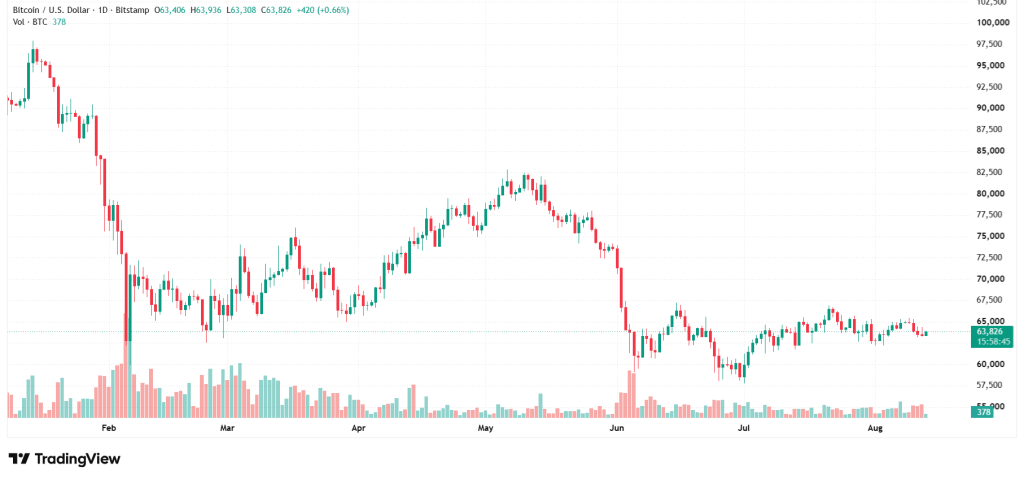
Price movements and technical analysis are important tools for understanding potential market trends. Traders often analyse historical price data alongside technical indicators to identify patterns, assess market momentum, and determine potential entry and exit levels. While these signals can provide useful insights into market behaviour, they cannot guarantee future price movements.
Technical analysis helps traders evaluate factors such as momentum, support and resistance levels, trading volume, and prevailing market trends. By combining these indicators with broader market analysis and appropriate risk management, traders can make more informed decisions and better navigate changing crypto market conditions. As a result, technical analysis remains an important component of many crypto trading strategies.
Also Read: What is Bitcoin Mining
A Snapshot of Key Bitcoin Metrics
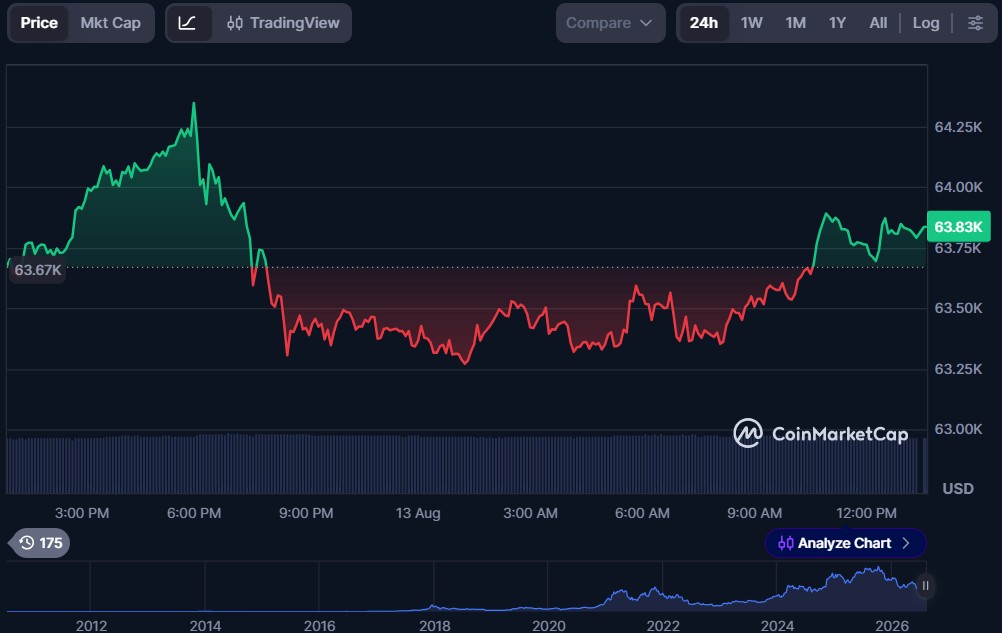
| Current Price | $63,779.19 |
| Market Capitalisation | $1.28 trillion |
| 24-Hour Volume | $22.40 billion |
| 50 Day SMA (1 Day) | $63,387 |
| 100 Day SMA (1 Day) | $67,228 |
| 200 Day SMA (1 Day) | $69,632 |
| 14-Day Relative Strength Index (1 Day) | 48 |
| All-Time High | $126,272 |
| Circulating Supply | 20.06 million |
| Total Supply | 21 million |
Also Read: Why is Bitcoin Down Today? BTC Price, Prediction, and Market Analysis
Historical Price Movement of Bitcoin
When Bitcoin emerged in 2009, it was far from the established financial asset it is today. It began as an experimental form of digital money, supported by a relatively small community of developers and early adopters. Over time, however, Bitcoin has evolved into a globally recognised digital asset, influencing financial markets, institutional strategies, and discussions around the future of money. Its price history has been marked by significant rises and declines, yet each market cycle has been accompanied by continued development, broader adoption, and deeper integration into the financial ecosystem.
Bitcoin’s evolution extends beyond its price. Developers continue to improve its underlying infrastructure, while businesses, investors, and institutions increasingly explore its potential applications. At the same time, regulatory frameworks and market infrastructure surrounding digital assets continue to develop across jurisdictions. Despite these challenges and changing economic conditions, Bitcoin has demonstrated considerable resilience and established itself as an important part of the broader digital asset landscape.
What Affects the Value of Bitcoin?
1. Market Demand and Supply: Similar to traditional assets, Bitcoin’s price is determined by the basic principles of supply and demand. When more people want to buy Bitcoin than sell it, the price rises, and vice versa. Also, Bitcoin is a deflationary asset with its supply reducing over time. If the market demands remain constant or grow, the price should increase because the supply is decreasing.
2. Adoption and Acceptance: Wider adoption of Bitcoin as a means of payment or store of value can positively impact its price. Acceptance by businesses and institutions can boost investor confidence.
3. Regulation: Government regulations and policies significantly affect Bitcoin’s price. Favourable regulations can encourage investment and drive up prices, while restrictive measures can have the opposite effect.
4. Technological Developments: Changes and advancements in the underlying technology of Bitcoin, like upgrades to the blockchain, can influence investor sentiment and price movements.
5. Market Sentiment: News, social media, and public perception can sway sentiment quickly, causing rapid price fluctuations. Positive news often leads to price increases, while negative news can trigger sell-offs.
6. Global Economic Events: Economic crises, inflation fears, and currency devaluation concerns can drive individuals and institutions to seek alternatives like Bitcoin, boosting its price.
7. Whale Activity: Large holders of Bitcoin, known as “whales,” can impact the market by buying or selling substantial amounts.
8. Market Liquidity: Thin trading volumes can lead to price manipulation and sharp price swings. Increased liquidity can stabilize prices.
9. Competition: The presence of other crypto tokens and digital assets can affect Bitcoin’s market dominance and, consequently, its price.
Also Read: What is Bitcoin Halving
Key Factors That Influence Bitcoin Price Predictions
Supply and Demand Dynamics
At its core, Bitcoin’s price is driven by the fundamental principle of supply and demand. With a fixed supply capped at 21 million coins, scarcity plays a defining role in shaping its value. As demand rises, whether from retail investors, institutions, or new market entrants, upward price pressure tends to follow. Conversely, periods of reduced interest or profit booking can lead to corrections. This balance is central to most Bitcoin price prediction frameworks, as even small shifts in demand can have a significant impact on price movements.
Bitcoin Halving Events
Bitcoin halving events are among the most closely watched milestones in the crypto ecosystem. Occurring roughly every four years, these events reduce the reward miners receive for validating transactions, effectively slowing the rate at which new Bitcoin enters circulation. Historically, halvings have preceded major bull cycles, as reduced supply meets sustained or growing demand. This pattern often becomes a key reference point in Bitcoin future price predictions, especially when analysts attempt to map long term cycles.
Institutional Adoption
The entry of institutional players has significantly altered Bitcoin’s market dynamics. From hedge funds to publicly listed companies and asset managers, institutional participation brings both capital and credibility. This influx tends to reduce volatility over time while also increasing liquidity. As more institutions integrate Bitcoin into their portfolios, confidence in its long term viability grows, influencing Bitcoin long term price prediction narratives and reinforcing its position as a mainstream financial asset.
Global Macroeconomic Conditions
Bitcoin does not operate in isolation. Broader macroeconomic factors such as inflation, interest rates, geopolitical tensions, and currency devaluation can all influence its price. In times of economic uncertainty, Bitcoin is often viewed as a hedge or alternative store of value, similar to gold. On the other hand, tighter monetary policies or reduced liquidity in global markets can impact investor appetite. These external forces play a crucial role in shaping both short term movements and long range forecasts.
Also Read: A New Chapter: Understanding the SEC’s Latest Crypto Update
Role of Technical Analysis in Bitcoin Price Forecasts
Moving Averages
Moving averages are among the most widely used tools in technical analysis. They help smooth out price data to identify trends over specific time periods. Common indicators include the 50 day and 200 day moving averages, which are often used to detect bullish or bearish momentum. Crossovers between these averages can signal potential entry or exit points, making them an essential component in many Bitcoin price prediction strategies.
Relative Strength Index (RSI)
The Relative Strength Index measures the speed and magnitude of recent price movements to determine whether Bitcoin is overbought or oversold. Typically ranging between 0 and 100, an RSI above 70 may indicate overbought conditions, while below 30 suggests oversold territory. Traders use this indicator to anticipate potential reversals, adding another layer of insight to short term forecasts.
MACD Indicator
The Moving Average Convergence Divergence indicator focuses on the relationship between two moving averages of Bitcoin’s price. It helps identify changes in momentum, trend direction, and potential turning points. When the MACD line crosses above the signal line, it is often interpreted as a bullish signal, while a crossover below may indicate bearish momentum. This makes it a valuable tool for refining entry and exit decisions.
Bitcoin Price Prediction Models Explained
Stock-to-Flow Model
The Stock-to-Flow model evaluates Bitcoin’s scarcity by comparing its existing supply (stock) to the rate of new production (flow). Assets with higher stock to flow ratios are generally considered more scarce and potentially more valuable. Bitcoin’s predictable issuance schedule makes it particularly suitable for this model, which has been widely used in Bitcoin future price predictions despite ongoing debates about its accuracy.
On-Chain Analysis Models
On-chain analysis looks directly at blockchain data to assess network activity and investor behavior. Metrics such as active addresses, transaction volumes, and holding patterns provide insights into market trends. These models help analysts understand whether Bitcoin is being accumulated or distributed, offering a data driven perspective that strengthens Bitcoin long term price prediction efforts.
Market Sentiment Indicators
Market sentiment plays a powerful role in Bitcoin’s price movements. Indicators such as the Fear and Greed Index, social media trends, and trading volumes help gauge investor psychology. Extreme fear can signal potential buying opportunities, while excessive greed may indicate overheating markets. By combining sentiment analysis with technical and fundamental factors, analysts can develop more balanced and informed forecasts.
Price Predictions
2026
If major macroeconomic factors remain stable, experts predict the price of Bitcoin will continue to rise and can touch the $150K mark by the end of 2026.
2027
Experts predict BTC will continue its bullish trend, with some predicting its value to touch the $160K mark.
2028
As per experts, the lowest price of BTC will be around $174K and the maximum price will be about $191K by the end of 2028.
2029
Crypto analysts predict the upward price trend will continue in 2029. They predict the minimum price of BTC will be around $200K, and the maximum price could touch approximately $240,000 by the end of 2029.
2030
Although the crypto market is volatile, experts predict the value of BTC will grow in the long term. They predict the price of BTC to touch $340,000, with a minimum value of $270K if global macroeconomic factors remain constant.
How Investors Use Price Predictions in Crypto Strategies
Bitcoin price prediction insights can help investors develop a more structured approach to the market. While no forecast can accurately predict future price movements, projections can provide a framework for evaluating potential scenarios, setting expectations, and making decisions based on analysis rather than speculation alone.
Short-term traders may use price forecasts alongside technical indicators to identify potential entry and exit levels. By analysing factors such as market momentum, support and resistance levels, and broader Bitcoin future price predictions, traders can assess potential opportunities while managing the risks associated with short-term price movements.
Long-term investors typically take a different approach, using Bitcoin long-term price prediction models to inform accumulation strategies. Systematic methods such as rupee-cost averaging (RCA) allow investors to spread purchases over time, helping reduce the impact of short-term price fluctuations rather than relying on a single entry point.
Price projections can also support portfolio allocation decisions. Investors may compare Bitcoin’s potential growth and risk profile with those of other assets when determining how much exposure to include in a portfolio. In this context, Bitcoin price prediction frameworks can serve as one reference point for evaluating risk and opportunity in an evolving market, rather than as a guarantee of future returns.
Key Considerations Before Relying on Bitcoin Price Forecasts
Despite their potential usefulness, Bitcoin price prediction models should be approached with caution. The crypto market is highly dynamic, and prices can be influenced by factors such as market sentiment, regulatory developments, macroeconomic conditions, liquidity, and broader market trends. While Bitcoin future price predictions attempt to identify potential trends, they cannot reliably account for sudden disruptions or unexpected events. The limitations of prediction models are also important to consider, as forecasts based on historical data, technical indicators, or on-chain metrics rely on assumptions that may not remain relevant as market conditions evolve.
This is particularly significant when evaluating Bitcoin long-term price prediction models, where longer time horizons introduce greater uncertainty and a wider range of possible outcomes. Investors should also be mindful of potential bias, as forecasts can vary significantly depending on the methodology, assumptions, and market outlook of the source. Comparing multiple Bitcoin price prediction perspectives can therefore provide a broader and more balanced view of potential market scenarios.
Ultimately, forecasts should complement rather than replace independent research and sound risk management. Investors should consider the underlying factors influencing Bitcoin alongside price projections and assess potential outcomes within the context of their own financial goals and risk tolerance. A well-informed approach that combines market analysis, diversification, and risk management can support more thoughtful decision-making in the evolving crypto market.
Is Bitcoin a Good Investment?
Bitcoin has established itself as a key reference point for the broader crypto market. Its price movements can influence market sentiment, trading activity, and investor allocation across digital assets. When Bitcoin moves sharply, its impact can often extend beyond the asset itself, shaping how market participants assess opportunities and risks across the wider ecosystem. While this creates potential opportunities, it also highlights the need to understand the rapid price movements that characterise digital assets.
Technical tools such as charts and indicators can help investors assess market trends and identify potential scenarios, but they are only one part of the decision-making process. Understanding market fundamentals, broader economic conditions, and the factors driving price movements can provide important context alongside technical analysis. No single indicator or strategy can consistently predict how the market will behave.
A disciplined approach can therefore be valuable when navigating the crypto market. Clear objectives, informed decision-making, appropriate risk management, and a long-term perspective can help investors respond more effectively to changing market conditions. In an environment where sentiment and trends can shift quickly, maintaining a measured approach can be just as important as identifying potential opportunities.
Also Read: Crypto Trading Strategies
Should I Invest in Bitcoin?
How investors approach Bitcoin often reflects their investment objectives, whether they focus on long-term accumulation or shorter-term market opportunities. Institutional participation has added further credibility to the asset, with firms such as Strategy (formerly MicroStrategy), BlackRock, Fidelity, and ARK Invest gaining Bitcoin exposure through direct holdings and ETFs. Continued institutional interest, alongside evolving regulatory frameworks, has strengthened Bitcoin’s position within mainstream finance and increased its relevance as a potential portfolio asset.
On-chain data also highlights the growing conviction among long-term Bitcoin holders. More than 60% of circulating Bitcoin has reportedly remained untouched since early 2022, indicating that a substantial portion of the supply is held with a longer-term outlook. While such holding behaviour reflects confidence in Bitcoin’s scarcity and future potential, it does not eliminate market risk. Bitcoin remains influenced by market sentiment, regulatory developments, and broader economic conditions, making informed research and risk management essential.
You can now buy Bitcoin on ZebPay. Keep yourself up to date with the latest crypto news on ZebPay blogs!
FAQs on Bitcoin Price Prediction
What factors influence Bitcoin price predictions?
Bitcoin price prediction is influenced by factors such as supply and demand dynamics, halving events, institutional adoption, regulatory developments, and global macroeconomic conditions. Market sentiment and technological advancements also play a role in shaping Bitcoin future price predictions.
How reliable are Bitcoin price prediction models?
No Bitcoin price prediction model is completely reliable. While some models offer valuable insights based on historical trends or blockchain data, the unpredictable nature of the market means outcomes can vary widely. They are best used as directional guidance rather than absolute indicators.
What role does Bitcoin halving play in price predictions?
Bitcoin halving reduces the rate of new supply entering the market, which can create upward pressure on price when demand remains strong. Because of this, halvings are often a central component in both Bitcoin future price predictions and Bitcoin long term price prediction models.
How do analysts use technical indicators to forecast Bitcoin prices?
Analysts use tools such as moving averages, RSI, and MACD to identify trends, momentum, and potential reversals. These indicators help refine short term Bitcoin price prediction strategies by offering data driven insights into market behavior.
Can institutional adoption impact Bitcoin’s future price?
Yes, institutional adoption can significantly influence Bitcoin’s trajectory. Increased participation from large investors enhances liquidity and market confidence, often strengthening Bitcoin long term price prediction outlooks.
What risks should investors consider when relying on Bitcoin price predictions?
Investors should consider risks such as volatility, regulatory uncertainty, model limitations, and sudden shifts in sentiment. Over reliance on any single Bitcoin price prediction without proper risk management can lead to unfavorable outcomes.
How do macroeconomic trends affect Bitcoin price forecasts?
Macroeconomic factors such as inflation, interest rates, and global economic conditions influence investor behavior. These elements are often incorporated into Bitcoin future price predictions to better understand how external forces may impact the market.
Should investors rely solely on Bitcoin price predictions when making decisions?
No, investors should not rely solely on Bitcoin price prediction models. While they provide useful insights, they should be combined with thorough research, diversification strategies, and a clear understanding of risk to make well informed investment decisions.