

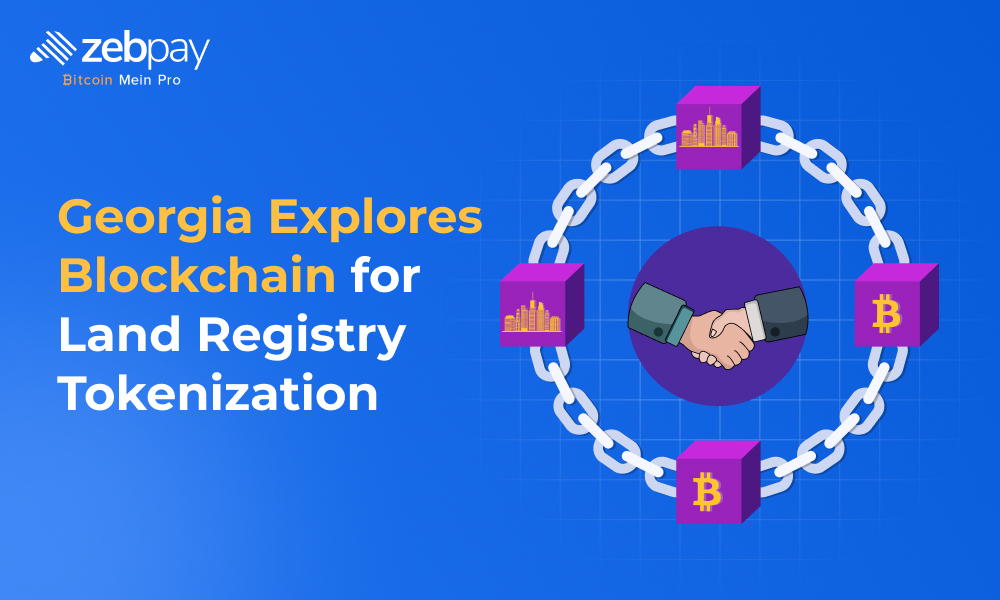
Georgia has taken another step in its long-standing experimentation with blockchain in public administration. On 1 December 2025, the country’s Ministry of Justice signed an MoU with Hedera public distributed-ledger network to look into:
- Migrating the National Agency of Public Registry Database to Blockchain
- Assessing the Feasibility of Real Estate Tokenization
This announcement continues Georgia’s position among the earliest government adopters of blockchain for property records.
Georgia’s Blockchain Legacy
Georgia already has an established history of using blockchain in public institutions and thus is one of the first countries to integrate these systems at scale.
2016–2017: Georgia Land Registry Blockchain Integration on Bitcoin
- In April 2016, Georgia collaborated with BitFury Group and NAPR to create a blockchain-based land-title registry system.
- In February 2017, a formal agreement allowed the system to start using the Bitcoin blockchain for anchoring land-title hashes, enabling tamper-proof verification.
- By April 2017, the system reportedly logged more than 100,000 land-title records using this hybrid model of private registry plus Bitcoin anchoring. This made Georgia a global case study on government implementation of blockchain, using public-chain transparency with private-chain efficiency.
What is the Hedera MoU All About?
The headlines say things like: “Georgia is moving its entire registry to Hedera.” The MoU is exploratory, not a rollout contract.
The MoU covers:
- On-Chain Registry Migration Feasibility Study
- Determine if NAPR’s land records can be migrated to Hedera
- Study potential benefits:
- Tamper-proof storage
- Faster verification
- Improved transparency
- Research into Real-Estate Tokenization
- Check and represent property rights with regulated digital tokens.
- Study fractional ownership, programmable compliance, and smart-contract automation.
The Possibility of Real Estate Tokenization in Georgia
Tokenization is one of the core elements being explored, not yet implemented. Countries like Sweden, the UAE, Dubai, and the U.S. have run pilots in similar domains. Tokenization opens a new frontier in the realm of financial investments for the future. It allows:
- Ownership stakes represented in digital tokens
- Fractional property investment
- Programmable transfers with smart contracts
- Better access to real estate markets
Why This Matters for Crypto and RWA Adoption
Georgia’s decision to assess Hedera for national-scale infrastructure marks:
- Growing interest in blockchain by world governments
- Growing momentum behind Real-World Assets (RWAs)
- Increasing confidence in public yet enterprise-governed networks more legitimate use cases beyond DeFi speculation
Final Thoughts
From a Bitcoin-based land-title anchoring to a possible registry migration and real-estate tokenization with Hedera, Georgia has adopted blockchain in state systems for over a decade.
The MoU represents a modern feasibility study, not a full commitment. But the fact that a national government is considering public ledgers and tokenization frameworks underlines how blockchain has moved on from early experimentation to serious infrastructure consideration.
In the grand scheme of things, ZebPay blogs are here to provide you with crypto wisdom. Get started today and join 6 million+ registered users to explore endless features on ZebPay!
FAQs
1. What did Georgia actually sign with Hedera?
A non-binding MoU to explore blockchain-based registry systems and possible real-estate tokenization.
2. Did Georgia use blockchain for land records previously?
Yes. Georgia incorporated BitFury’s blockchain technology and anchored hashes into the Bitcoin blockchain between 2016 and 2017.
3. Is Georgia definitely moving its registry to Hedera?
No. Only the feasibility and research are confirmed.
4. Will ownership of property be tokenized?
While tokenization is under consideration, no infrastructure or legal frameworks have yet been agreed upon.
5. What’s next?
Detailed assessments will be carried out by working groups between Hedera, NAPR, and the Ministry of Justice.