

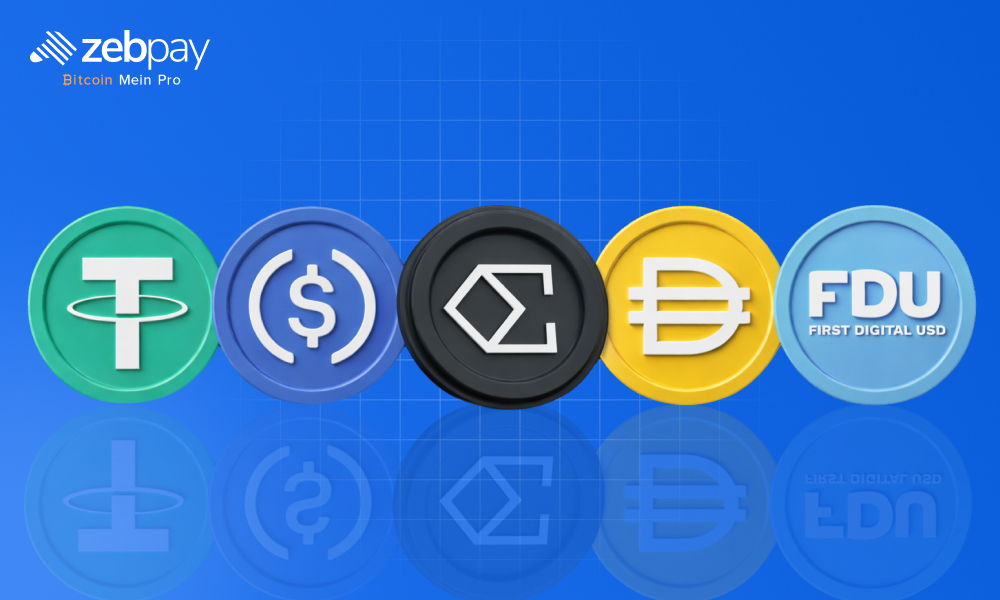
Stablecoins have become the backbone of crypto trading, DeFi, and global payments, offering dollar stability amid volatile markets. As we enter 2026, the largest stablecoin by market cap remains Tether (USDT), but competition heats up from regulated challengers and innovative synthetics. This analysis compares the top stablecoins to invest in: USDT, USDC, USDe, and USD1, covering market dominance, backing mechanisms, and real-world utility to help you pick the best stablecoin for your needs.
Comparative Analysis
Here’s a snapshot of the top 4 stablecoins by market capitalization as of late 2025, showing their scale and peg stability:
USDT dominates as the largest stablecoin, powering 60%+ of trading volume, while USD1’s rapid rise makes it a top stablecoin to invest in for growth potential.
Four Largest Stablecoins
Tether (USDT)
USDT launched in 2014 as the first major stablecoin, now the largest stablecoin with $140B market cap. Issued by Tether Limited, it’s backed by a mix of cash, Treasuries, and other assets, maintaining a rock-solid $1 peg through massive liquidity.
Pros:
- Unmatched liquidity: 5x trading volume of competitors, essential for arbitrage and high-frequency trading.
- Multi-chain: Ethereum, Tron, Solana, ubiquitous across CEXs and DEXs.
- Proven resilience: Survived multiple depeg scares with quick recoveries.
Cons:
- Transparency concerns: Past reserve controversies, though 2025 audits show improved compliance.
- Offshore issuer: Based in the British Virgin Islands, outside US regulation.
- Centralization risk: Relies on Tether’s operational stability.
USD Coin (USDC)
USDC from Circle and Coinbase’s Centre Consortium holds $42B market cap, fully backed by USD cash and short-term Treasuries with monthly attestations from Grant Thornton.
Pros:
- Gold-standard transparency: US-regulated issuer with real-time reserve proofs.
- Strong institutional adoption: Preferred by Visa, Mastercard, and BlackRock for payments.
- Rapid recovery: Bounced back from the 2023 SVB depeg within days.
Cons:
- Compliance focus attracts enterprises but limits some DeFi integrations.
- Slower growth vs USDT due to conservative issuance.
- Higher fees on the Ethereum mainnet.
Read more: Difference between USDT vs USDC
Ethena (USDe)
USDe from Ethena Labs ($5.9B market cap) is a synthetic stablecoin using delta-neutral hedging: long staked ETH + short perpetuals to capture funding rates, backed by crypto collateral rather than fiat.
Pros:
- High yields: 10-20% APY from basis trades, attracting DeFi farmers.
- Crypto-native: No banking intermediaries, fully on-chain transparency.
- Scalable growth: $6B TVL proves demand for yield-bearing stables.
Cons:
- Complexity risk: Relies on perpetual funding staying positive; reversals could pressure peg.
- Higher volatility: Mini-depegs during ETH drawdowns.
- Smart contract exposure despite audits.
World Liberty Financial USD (USD1)
USD1 price hovers at $0.9993 with $2.1B+ market cap, launched by Trump-linked World Liberty Financial (WLFI) in March 2025. Fiat-backed by USD reserves and Treasuries in BitGo custody, multi-chain on Ethereum/BNB/Tron.
Pros:
- Explosive growth: Fastest-growing stablecoin ever, hitting $2B in months via Binance/MGX deals.
- Institutional custody: BitGo secures reserves with a proven track record.
- Political tailwinds: WLFI branding drives retail hype and partnerships.
Cons:
- New entrant: Limited longevity testing vs USDT/USDC.
- Concentration risk: Heavy WLFI/Trump family ownership raises centralization flags.
- Hype dependency: Growth tied to political narratives.
Read more: Top 10 Crypto to Invest
How Stablecoins Work
Stablecoins are digital dollars designed to always stay worth $1. They work by being backed by real money or smart strategies that keep their value steady.
Fiat-backed stablecoins (like USDT and USDC) hold actual US dollars or safe investments like government bonds in bank accounts. When you buy one token, the company puts away $1 to back it. If the price dips below $1, smart traders buy it cheap and exchange it back for full dollars, pushing the price up again.
Synthetic stablecoins (like USDe) use clever trading tricks instead of holding cash. They bet on crypto markets in opposite directions, buying one thing while betting against it, so profits from the trade keep the $1 value steady.
No matter the type, arbitrage keeps the peg: if a stablecoin trades at $0.99, people buy it and cash out for $1, making a quick profit while fixing the price.
Are Stablecoins Safe?
Stablecoins are much safer than regular cryptocurrencies because they aim to hold a steady $1 value, but they’re not completely risk-free.
Main risks:
- Depegging: During big market stress, stablecoins can temporarily drop below $1 (like USDC did during a bank crisis). Most recover quickly, but it creates short-term worry. This is how depegging works.
- Company problems: The issuer might face hacks, legal issues, or not have enough backing money.
- New stablecoins: Less-tested ones carry more uncertainty than established leaders.
How to stay safe:
- Use big, well-known stablecoins with years of history.
- Check if they share proof of their money reserves regularly.
- Don’t put all your money in one type—spread across a few.
- Keep only what you need for trading; store the rest safely.
Stablecoins are reliable for everyday crypto use, but treat them like digital cash, not a guaranteed savings account.
Conclusion
Stablecoins make crypto trading and DeFi simple by offering a steady $1 value amid market ups and downs. USDT leads with unmatched liquidity, USDC shines for trust and regulation, USDe brings smart yields, and USD1 shows exciting growth. Pick the best stablecoin based on your needs. Traders love USDT, and institutions choose USDC. Spread across a few for safety and watch 2026 unfold.
In the grand scheme of things, ZebPay blogs are here to provide you with crypto wisdom. Get started today and join 6 million+ registered users to explore endless features on ZebPay!
FAQs
What’s the top stablecoin in 2026?
Tether (USDT) at $140B market cap, powers most trading volume.
Which is the best stablecoin to invest in?
USDC for safety/transparency; USD1 for growth as the top stablecoin to invest.
How do synthetic stablecoins like USDe work?
Hedging strategies capture market premiums instead of holding fiat reserves, higher yield, and higher complexity.
Is USD1 a good top stablecoin to invest in?
Promising growth but newer; diversify with established names like USDT/USDC.