

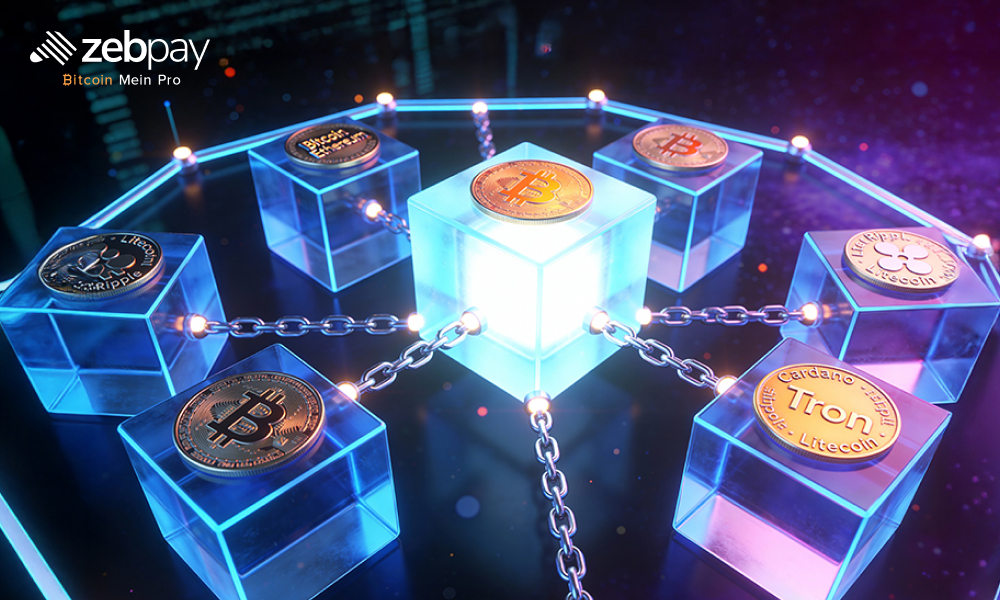
As blockchain ecosystems expand, liquidity is no longer confined to a single network. Users today interact with multiple blockchains, decentralized applications (dApps), and scaling solutions. This evolution has made cross-chain liquidity one of the most important building blocks of the modern crypto ecosystem, especially across L1 & L2 blockchains.
Understanding how liquidity flows between Layer 1 (L1) and Layer 2 (L2) networks helps users, developers, and investors navigate DeFi more efficiently. This guide explains what L1 and L2 blockchains are, how cross-chain liquidity works, why it matters, and how it is shaping the future of blockchain interoperability.
What Is Cross-Chain Liquidity?
Cross-chain liquidity refers to the ability to move assets, capital, or value seamlessly across different blockchain networks without friction. Instead of liquidity being locked within a single chain, cross-chain systems allow users to access, deploy, and use their assets across multiple blockchains.
For example, a user holding ETH on Ethereum may want to use it on an L2 network like Arbitrum or on another L1, such as Polygon. Cross-chain liquidity mechanisms make this possible without selling assets or relying on centralized intermediaries.
At its core, cross-chain liquidity solves fragmentation, one of the biggest challenges in decentralized finance (DeFi).
What Is an L1 Blockchain?
A Layer 1 (L1) blockchain is the main or base blockchain network where transactions are created, verified, and permanently recorded. It operates independently and does not rely on another blockchain for security or validation.
In simple terms, an L1 blockchain is the foundation layer of a blockchain ecosystem. It maintains the network’s rules, consensus mechanism, and transaction history.
Popular examples of L1 blockchains include Bitcoin, Ethereum, Solana, Avalanche, Cardano, and Polygon (PoS).
How an L1 Blockchain Works
L1 blockchains handle all core responsibilities directly on-chain. This includes:
- Validating transactions
- Securing the network through consensus mechanisms like Proof of Work or Proof of Stake
- Maintaining decentralization
- Storing the complete transaction ledger
Every transaction submitted to an L1 blockchain must be verified by the network’s validators or miners before being added to a block
What Is an L2 Blockchain?
A Layer 2 (L2) blockchain is a scaling solution built on top of a Layer 1 blockchain. Its purpose is to improve transaction speed and reduce costs while still relying on the L1 for security and final settlement.
In simple words, an L2 blockchain handles transactions off the main chain, then settles the final result back on the L1 blockchain.
Popular examples of L2 blockchains include Arbitrum, Optimism, zkSync, Starknet, and Base, all of which are built on Ethereum.
How an L2 Blockchain Works
Instead of processing every transaction directly on the L1 blockchain, an L2:
- Executes transactions separately
- Groups or compress multiple transactions
- Sends a summarized proof back to the L1 blockchain
This significantly reduces the load on the main blockchain while preserving its security.
L1 vs L2 Blockchain: Key Differences
Understanding L1 vs L2 blockchain helps clarify why cross-chain liquidity is critical.
L1 blockchains offer maximum security and decentralization, but struggle with scalability. L2 blockchains provide faster and cheaper transactions by batching or compressing data before settling it on L1.
However, since L1 and L2 operate as separate environments, liquidity can become fragmented unless efficient cross-chain solutions are in place.
Why Cross-Chain Liquidity Matters for L1 & L2
The growth of multiple L1 and L2 networks has created isolated liquidity pools. Without cross-chain liquidity, users face several challenges:
- Assets are stuck on specific chains
- Capital efficiency drops
- Users must bridge or swap assets manually
- DeFi yields become fragmented
Cross-chain liquidity ensures that capital flows freely across networks, improving user experience and maximizing asset utility.
How Cross-Chain Liquidity Works
Cross-chain liquidity relies on several technical mechanisms that enable asset movement and interoperability.
1. Blockchain Bridges
Bridges lock assets on one chain and mint equivalent wrapped assets on another chain. This is the most common method for moving liquidity between L1 and L2 networks.
2. Liquidity Pools Across Chains
Some protocols maintain synchronized liquidity pools on multiple chains, allowing users to swap assets without directly bridging them.
3. Messaging and Validation Layers
Advanced systems use cross-chain messaging protocols to verify transactions and transfer value securely across chains.
Each method balances trade-offs between security, speed, and decentralization.
Cross-Chain Liquidity Between L1 and L2 Networks
Cross-chain liquidity plays a unique role when moving assets between L1 and L2 blockchains.
When users transfer assets from an L1 like Ethereum to an L2, such as Arbitrum, liquidity must be locked on L1 and represented on L2. This allows users to interact with DeFi protocols on L2 at lower fees while retaining L1 security.
Similarly, liquidity must be easily withdrawable back to L1 to ensure trust and flexibility.
Efficient cross-chain liquidity between L1 & L2 ensures:
- Faster onboarding to L2 ecosystems
- Lower transaction costs
- Higher DeFi participation
- Reduced friction for everyday users
Benefits of Cross-Chain Liquidity
Cross-chain liquidity delivers tangible advantages across the blockchain ecosystem.
Improved Capital Efficiency
Assets can be deployed wherever returns are best, rather than being confined to a single chain.
Better User Experience
Users no longer need to manage multiple wallets or manually bridge assets repeatedly.
Stronger DeFi Ecosystems
Liquidity aggregation across chains improves depth, reduces slippage, and enhances protocol stability.
Faster Innovation
Developers can build applications that tap liquidity from multiple chains simultaneously.
Challenges in Cross-Chain Liquidity
Despite its promise, cross-chain liquidity also introduces risks.
Security remains a primary concern, as bridges have historically been targeted by exploits. Complexity increases as more chains are added, and maintaining decentralization across networks is difficult.
Additionally, liquidity fragmentation can still occur if protocols are not well-integrated or widely adopted.
These challenges have led to the rise of more secure and modular cross-chain designs.
Role of Cross-Chain Liquidity in DeFi
DeFi relies heavily on liquidity to function effectively. Lending, trading, staking, and yield farming all depend on access to deep liquidity pools.
Cross-chain liquidity enables:
- Multi-chain decentralized exchanges
- Cross-chain lending and borrowing
- Unified liquidity for stablecoins
- Seamless asset movement across DeFi protocols
As DeFi expands beyond a single blockchain, cross-chain liquidity becomes essential infrastructure rather than an optional feature.
Future of Cross-Chain Liquidity for L1 & L2
The future of blockchain is multi-chain by design. No single L1 or L2 is expected to dominate entirely. Instead, ecosystems will coexist and specialize.
Cross-chain liquidity will increasingly rely on:
- Trust-minimized bridges
- Interoperability standards
- Unified liquidity layers
- Better security audits and validation mechanisms
As these systems mature, moving assets across L1 and L2 networks may feel as seamless as sending tokens within a single chain today.
Why Beginners Should Understand Cross-Chain Liquidity
For new users, cross-chain liquidity explains why fees differ across networks, why assets sometimes need bridging, and how L2s improve scalability.
Understanding these fundamentals helps users:
- Choose the right network for transactions
- Avoid unnecessary fees
- Use DeFi more efficiently
- Make informed investment decisions
Conclusion
Cross-chain liquidity is the connective tissue of the modern blockchain ecosystem. As L1 & L2 blockchains continue to grow, seamless liquidity movement ensures that capital remains efficient, accessible, and productive.
By enabling interoperability between L1 and L2 networks, cross-chain liquidity reduces fragmentation, improves scalability, and unlocks the true potential of decentralized finance. For users and developers alike, it is a foundational concept shaping the future of crypto.
In the grand scheme of things, ZebPay blogs are here to provide you with crypto wisdom. Get started today and join 6 million+ registered users to explore endless features on ZebPay!
FAQs
What is cross-chain liquidity?
Cross-chain liquidity allows assets to move and be used across different blockchains without selling or converting them manually.
What is the L1 blockchain?
An L1 blockchain is a base-layer network like Ethereum or Bitcoin that validates transactions independently.
What is the L2 blockchain?
An L2 blockchain is a scaling solution built on top of an L1 to improve speed and reduce costs.
Why is cross-chain liquidity important for L1 & L2?
It ensures assets can flow easily between layers, improving usability and capital efficiency.
Is cross-chain liquidity risky?
While it introduces security challenges, improved designs and audits continue to reduce risks.