

As crypto adoption matures in India and globally, investors are no longer asking whether crypto is here to stay, but how to manage it responsibly. One of the most common and important questions that arises at this stage is the difference between a crypto wallet and a crypto exchange. While the two are often used together, they serve fundamentally different purposes within the crypto ecosystem.
Understanding how crypto wallets and crypto exchanges function, and when each should be used, is essential for making informed decisions in Bitcoin and broader crypto markets.
This guide explains the roles of wallets and exchanges in detail, highlights their differences, and helps you decide what makes sense for your goals, whether you’re long-term holding or active trading on the best bitcoin trading platform in India.
Understanding the Role of Crypto Infrastructure
Before comparing wallets and exchanges directly, it is important to understand how crypto ownership works at a structural level. Crypto operates on blockchains, distributed ledgers that publicly record ownership and transactions. Access to crypto assets is controlled through cryptographic keys, not through accounts in the traditional banking sense.
This is where wallets and exchanges come into play. Both provide access to crypto, but they interact with the blockchain in different ways and place responsibility in different hands.
What Is a Crypto Wallet?
A crypto wallet is a digital tool that allows users to store and manage the private keys required to access their crypto holdings on the blockchain. The wallet itself does not “hold” crypto in a physical sense. Instead, it acts as a secure interface that proves ownership and enables transactions.
The defining feature of a crypto wallet is key ownership. When you control your private keys, you control your assets. This principle is widely regarded as a cornerstone of decentralization in crypto.
Types of Crypto Wallets and How They Work
Crypto wallets are broadly categorized based on how they connect to the internet and how keys are stored.
Hot wallets are connected to the internet and include mobile, desktop, and browser-based wallets. They are designed for convenience and frequent transactions, making them popular among users who actively interact with decentralized applications or transfer funds regularly. However, because they remain online, they are more exposed to phishing attacks, malware, and other digital threats.
Cold wallets, on the other hand, store private keys offline. Hardware wallets and paper wallets fall into this category. Because they are disconnected from the internet, cold wallets are considered significantly more secure for long-term storage, particularly for large holdings. The trade-off is reduced convenience, as accessing funds typically requires additional steps.
From a risk-management perspective, crypto wallets are best suited for users who are comfortable handling private keys responsibly and are focused on long-term custody rather than frequent trading.
Read more: Hot Wallet vs Cold Wallet: Understanding the Key Differences
What Is a Crypto Exchange?
A crypto exchange is a platform that facilitates the buying, selling, and trading of crypto. It functions as a marketplace where users can exchange fiat currency for crypto, trade one crypto asset for another, and access liquidity at market-driven prices.
Unlike wallets, exchanges usually operate on a custodial model, meaning the platform holds users’ private keys on their behalf. This allows exchanges to provide a smoother trading experience, faster execution, and advanced features such as order books, charts, and risk management tools.
In the Indian market, regulated exchanges such as ZebPay have become popular because they combine ease of use with compliance, security infrastructure, and INR support. For many users, a trusted exchange serves as the primary gateway into crypto and remains the best crypto trading platform for active participation in the market.
Differences Between Crypto Wallets and Crypto Exchanges
Although both wallets and exchanges provide access to crypto assets, their roles differ significantly when it comes to ownership, security, and functionality.
Ownership and Control
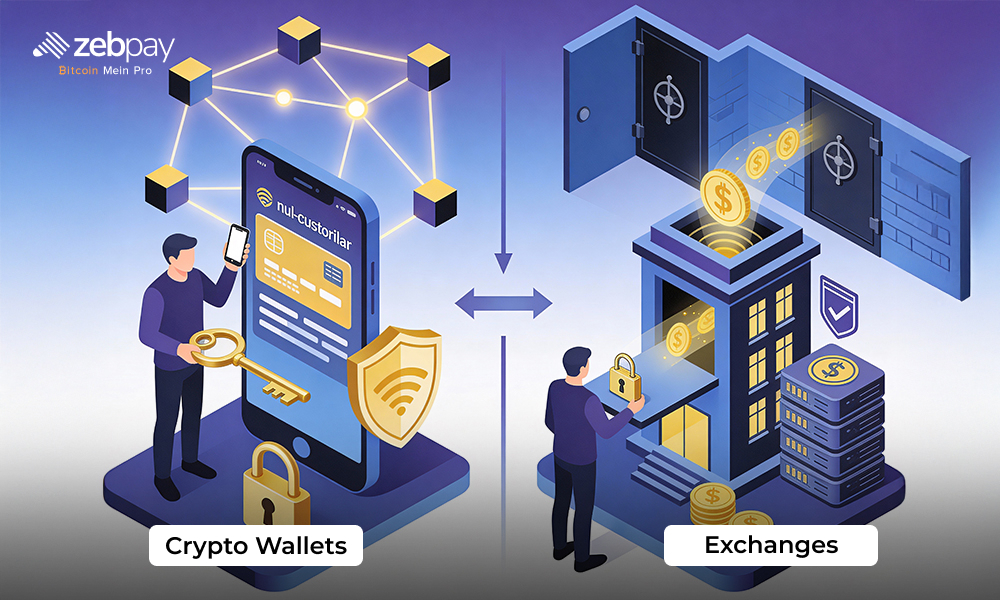
The most important difference between a crypto wallet and an exchange lies in who controls the private keys. With a wallet, the user retains full control and responsibility. With an exchange, the platform manages custody, allowing users to focus on trading rather than key management.
This distinction has philosophical as well as practical implications. Wallets align more closely with the decentralized ethos of crypto, while exchanges prioritize usability and market access.
Purpose and Use Case
Crypto wallets are primarily designed for storage and asset management. They are ideal for users who want to hold crypto over the long term, minimize counterparty risk, and maintain full control over their funds.
Crypto exchanges are optimized for trading and liquidity. They enable users to react quickly to market movements, access deep order books, and participate in price discovery. For anyone actively trading Bitcoin or altcoins, a reliable Bitcoin exchange is essential.
Security Considerations
Security in crypto is not absolute; it is contextual. Wallets eliminate platform risk but introduce personal responsibility risk. Exchanges reduce user-side complexity but introduce counterparty risk.
Leading exchanges mitigate this through cold storage, insurance mechanisms, multi-signature wallets, and regular audits. For many users, especially beginners, these protections make exchanges a safer starting point than self-custody.
Crypto Wallet vs Exchange: Which One Is Better?
The answer depends entirely on how you intend to use crypto.
For long-term investors who plan to hold assets for years, crypto wallets, particularly cold wallets, offer greater autonomy and security when managed correctly. For traders and active market participants, exchanges provide the speed, liquidity, and tools necessary to operate efficiently.
In practice, most experienced users do not choose one over the other. Instead, they use both as part of a balanced strategy.
How Experienced Users Combine Wallets and Exchanges
A common approach among seasoned investors is to use exchanges for trading and wallets for storage. Assets intended for long-term holding are moved off the exchange into a personal wallet, while funds allocated for trading remain on the platform.
This approach reduces exposure to unnecessary risk while preserving flexibility. It also reflects a broader industry understanding that wallets and exchanges are complementary components of the crypto ecosystem rather than competing solutions.
As Andreas M. Antonopoulos has noted, ownership in crypto is ultimately about key control, but participation in markets requires liquidity, and exchanges remain central to that function.
Read more: Top 10 crypto to invest in 2026
Approach to Wallets, Exchanges, and Regulation
In India, regulatory clarity, compliance, and transparency play a significant role in how users choose platforms. Exchanges that follow KYC norms, offer clear tax reporting, and maintain high security standards are often preferred, particularly by new investors.
ZebPay, for instance, has positioned itself as one of the best bitcoin trading platforms in India by focusing on trust, security, and user education. For Indian users navigating both opportunity and regulation, starting with a reputable exchange often provides the right balance of access and protection.
Final Thoughts
Understanding the difference between a crypto wallet and exchange is not just a technical exercise; it is a foundational step toward responsible crypto participation. Wallets emphasize ownership and long-term security, while exchanges enable trading, liquidity, and market access.
Rather than viewing them as alternatives, it is more accurate to see wallets and exchanges as distinct tools designed for different stages of a crypto journey. Knowing when and how to use each allows investors to align their strategy with their risk tolerance, experience level, and financial goals.
As the crypto ecosystem continues to evolve, this distinction will remain central to how users interact with digital assets.
In the grand scheme of things, ZebPay blogs are here to provide you with crypto wisdom. Get started today and join 6 million+ registered users to explore endless features on ZebPay!
FAQs
What is the main difference between a crypto wallet and an exchange?
A crypto wallet gives users control over their private keys and assets, while a crypto exchange provides a platform for buying, selling, and trading cryptocurrencies through custodial services.
Is it safe to keep crypto on an exchange?
Reputable exchanges with strong security measures are generally safe for trading, but long-term holdings are often better stored in personal wallets to reduce custodial risk.
Do beginners need a crypto wallet immediately?
Not necessarily. Many beginners start on exchanges to learn how crypto markets work before moving assets to wallets later.
Can I use both a wallet and an exchange?
Yes. Many users trade on exchanges and store long-term holdings in wallets as part of a balanced strategy.