


No single force explains it. Bitcoin fell sharply as SpaceX went public and Anthropic and OpenAI prepared their own listings, and crypto ETFs recorded record outflows in the same window. But the drop was also driven by a broader risk-off shift, a hawkish Fed, and arbitrage unwinding unrelated to the IPOs.
Key Takeaways
- SpaceX’s IPO, the largest in history, landed in the same weeks Bitcoin fell sharply, and OpenAI and Anthropic listings could add over $200 billion more in new equity supply.
- Spot Bitcoin ETFs posted record monthly outflows during this period, which some analysts tied directly to capital rotating into the IPOs.
- Altcoins fell harder than Bitcoin, which fits the pattern of investors liquidating their most volatile holdings first when raising cash.
- Whether this is a temporary reallocation or a lasting shift away from crypto investment will show up in ETF flows and altcoin performance over the coming months.
What Actually Happened?
SpaceX went public in June 2026 in what became the largest IPO on record, raising tens of billions of dollars at a valuation north of $1.7 trillion. OpenAI and Anthropic are expected to follow with listings of their own, and combined, this cluster of mega-IPOs could pull more than $200 billion in fresh equity supply into the market by the end of the year.
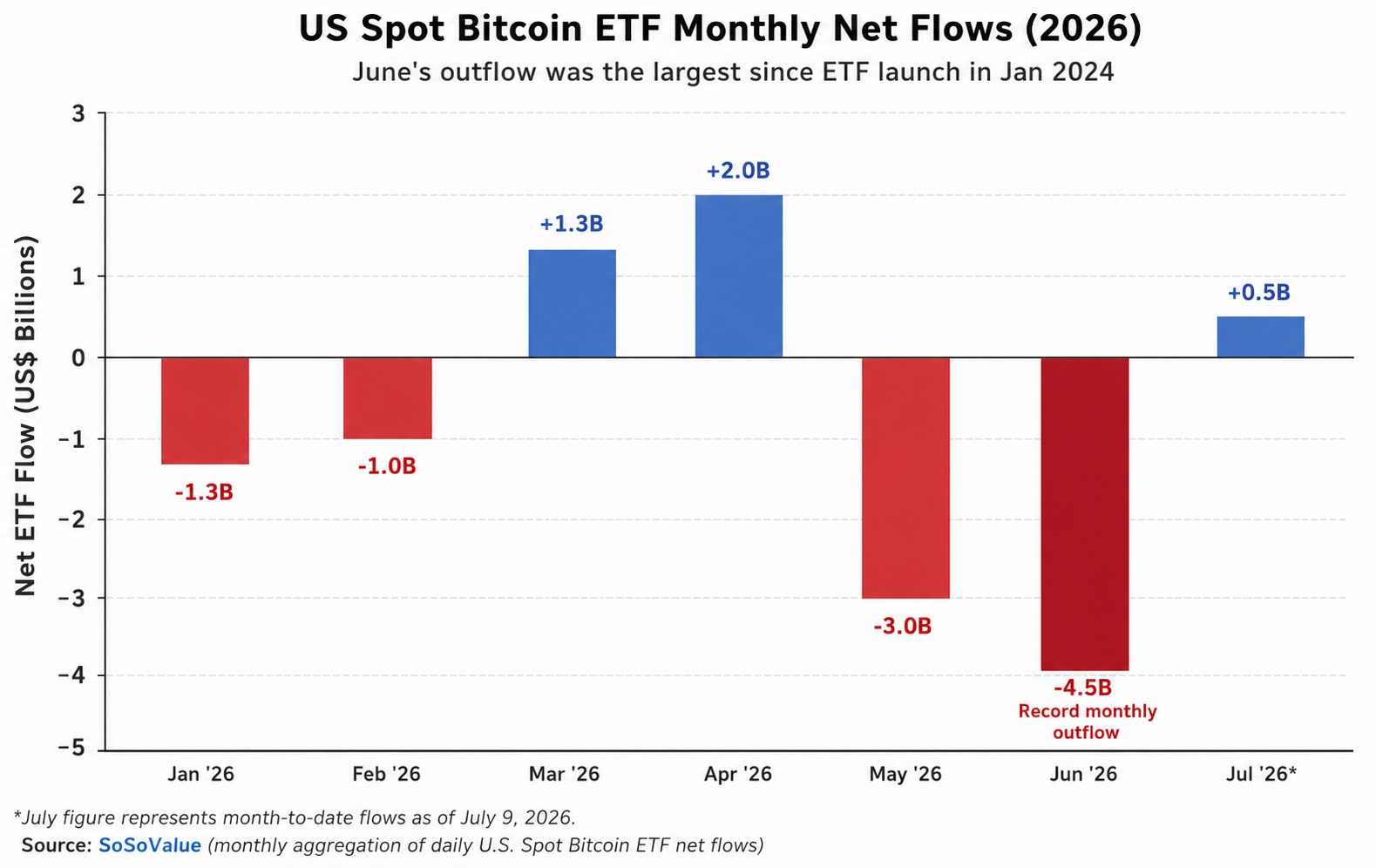
In the same window, Bitcoin fell hard, dropping toward the $58,000-$60,000 range after trading near its 2026 highs earlier in the year. U.S. spot Bitcoin ETFs recorded their worst month of net outflows since the products launched, and altcoins underperformed Bitcoin by a wide margin. The timing was close enough that a narrative formed almost immediately: investors were pulling money out of crypto to fund allocations in the SpaceX IPO, with OpenAI and Anthropic expected to extend the same pattern.
That narrative is plausible on its face. Whether it holds up depends on separating correlation from causation, which is harder than the headlines suggest.
Why an IPO Could Pull Money Out of Crypto?
The logic behind the drain theory rests on one basic fact: an IPO does not create new money. It transfers capital that already exists from investors into a newly public company. To buy into a hot listing, investors need cash on hand, and they typically raise it by selling something they already own.
Crypto is an easy target for that kind of selling. It trades 24/7, moves fast, and can be liquidated in minutes when someone needs capital quickly. A few specific channels reinforce this idea. Retail investors chasing IPO allocations overlap heavily with retail crypto holders, so some of the buying power for SpaceX shares plausibly came directly from crypto positions.
Once a company the size of SpaceX enters major indices, index funds are forced to buy in, and they often raise the cash by trimming other holdings. Institutions holding Bitcoin through ETFs also face pressure to rebalance toward the IPO opportunity rather than sit on existing crypto exposure.
The Evidence Supporting the Drain Theory
The market data gives this theory real support, not just a coincidence of timing. Around the SpaceX listing, Bitcoin dropped by roughly 20% from recent levels. U.S. spot Bitcoin ETFs shed about $4.5 billion in June 2026 alone, their heaviest monthly outflow since the products launched in January 2024, with BlackRock’s IBIT accounting for the bulk of it.
The pattern extended beyond Bitcoin ETF flows. Space and AI-adjacent equities rallied in the same stretch that crypto weakened, suggesting money was moving from one asset class into the other. Altcoins also fell harder than Bitcoin, which is consistent with investors liquidating their most volatile, easiest-to-sell positions first when they need cash on short notice.
The Case Against a Clean Cause-and-Effect Story
The counter-argument is just as well-documented. Fabian Dori, chief investment officer at Sygnum, has pointed out that the ETF outflow pattern lines up more closely with the unwinding of cash-and-carry arbitrage trades than with a genuine rotation into equities. In this trade, institutions hold Bitcoin spot positions while shorting Bitcoin futures to capture a pricing gap. When that gap narrows, traders close both sides, which shows up as an ETF outflow even though nobody involved is turning bearish on Bitcoin or reallocating toward the SpaceX IPO.
Supporting that view, exchange balances and stablecoin supply stayed largely stable through the period, which would be unusual if investors were broadly cashing out of crypto to fund equity purchases. Riskier crypto products also kept attracting inflows during the same stretch, which cuts against the idea of a wholesale exit from the asset class.
At the same time, the broader market was under pressure for reasons that had nothing to do with any IPO. Equities sold off sharply on AI bubble concerns, geopolitical tension pushed oil prices higher, and a hawkish Federal Reserve kept rate-cut expectations low. Bitcoin trades as a high-beta risk asset in conditions like these, and it would likely have fallen even without a single IPO on the calendar.
What This Means for a Crypto Investment Strategy?
The honest takeaway is that both stories are partly right, and neither fully explains what happened. The IPO wave is large enough to matter, and the timing of the ETF outflows lines up with it closely enough to be a genuine factor. But arbitrage unwinding and macro pressure were clearly at work too, and untangling the exact weight of each is not something the current data supports with confidence.
For anyone building a crypto investment approach around this event, the more useful question is not “did the IPOs cause the drop” but “is this pressure temporary or structural. An IPO is a one-time reallocation of capital, not a permanent shift in how much money exists. If the selling was driven mainly by IPO funding needs, it should ease once SpaceX, OpenAI, and Anthropic allocations are settled, and some of that capital could rotate back into crypto.
If the selling was driven mainly by macro conditions, crypto could stay under pressure regardless of how the IPOs play out, since a hawkish Fed and weak risk appetite would weigh on Bitcoin either way.
This is also why long-term Bitcoin investment decisions are rarely well served by reacting to a single month of ETF flow data, especially when the same data is open to more than one credible explanation.
What to Watch Next?
A few signals will clarify which story is winning. ETF flow direction is the clearest one: a return to sustained inflows would suggest capital is coming back, while continued outflows would support the ongoing-drain case. The timing of the OpenAI and Anthropic listings matters too, since a wide gap between them would spread out any funding pressure, while a tight cluster would concentrate it.
The altcoin-versus-Bitcoin spread is another useful indicator. If altcoins start recovering ahead of Bitcoin once the IPO allocations are digested, that would point to the forced-selling phase ending. If they continue to underperform for months after the listings close, it would suggest something more structural is going on beyond a one-time reallocation.
Conclusion
The idea that SpaceX, OpenAI, and Anthropic’s IPOs are draining crypto’s liquidity is not a myth, but it is not the full story either. Real outflow data supports part of the theory, while arbitrage dynamics and macro pressure explain a meaningful share of the rest. Investors trying to make sense of Bitcoin’s recent moves are better off tracking flows and macro signals over the coming months than reacting to a single narrative.
In the grand scheme of things, ZebPay blogs are here to provide you with crypto wisdom. Get started today and join 6 million+ registered users to explore endless features on ZebPay!
FAQs
Are SpaceX, OpenAI, and Anthropic’s IPOs really pulling money out of crypto?
Partly, but it’s not settled. Bitcoin ETFs saw record outflows around the same time these IPOs came into focus, and some analysts directly linked the two.
Should I sell crypto to invest in these IPOs?
That depends entirely on your own financial goals, risk tolerance, and portfolio strategy, and it’s not something general market commentary can decide for you.
Is Bitcoin still a good investment right now?
Bitcoin’s fundamentals haven’t changed because of this IPO wave; what’s changed is short-term liquidity and sentiment. Whether it fits your portfolio depends on your time horizon and risk appetite.
Can I invest in the SpaceX, OpenAI, or Anthropic IPOs directly?
Access to pre-IPO and IPO share allocations is typically limited to institutional investors, employees, and select retail programs depending on the offering, and availability varies by listing and by country.
Will crypto recover once these IPOs are done?
If the recent selling was mainly driven by investors freeing up cash for IPO allocations, some of that capital could rotate back into crypto once the listings settle.