



Bitcoin’s (BTC) resilience remains one of the key indicators investors are closely watching. Macro uncertainty has returned after U.S. President Donald Trump backed away from the Iran ceasefire, weighing on overall market sentiment. The renewed geopolitical tensions pushed oil prices up by more than 5%, with crude now approaching the $75 level—a price range that has historically been associated with increased volatility and corrections across risk assets, including cryptocurrencies.
The shift in sentiment has already impacted the derivatives market, with more than $13 million in Bitcoin long positions liquidated over the past 24 hours as leveraged traders were forced to exit. On the network side, Bitcoin’s mining difficulty declined by 5% on July 11 to 127.17 trillion during its 14th difficulty adjustment of 2026, bringing the metric closer to its lowest level of the year. While short-term uncertainty persists, Bitcoin has continued to show resilience despite the broader macro headwinds.
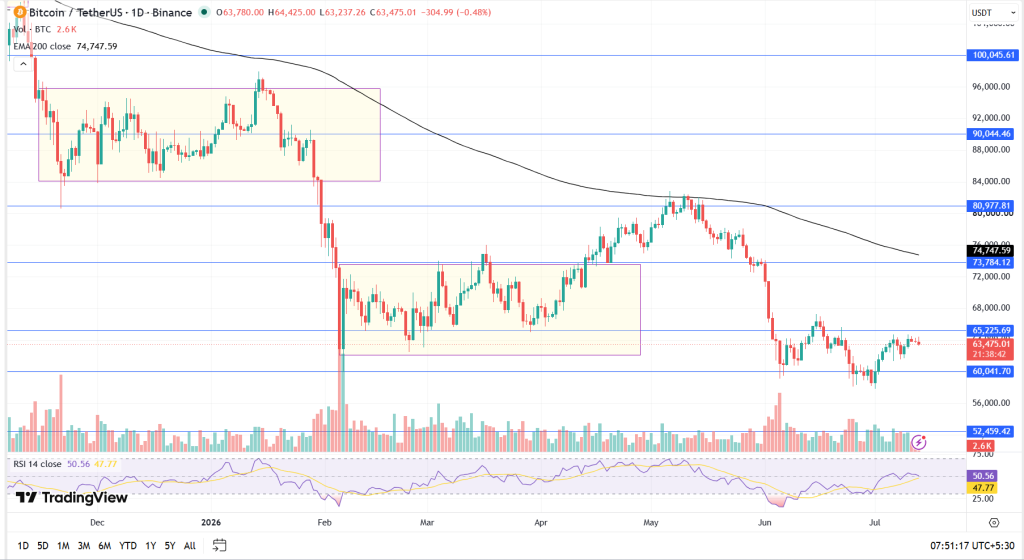
At the time of writing, BTC was trading at $63,500.
Also Read: Average Crypto SIP Returns in the Last 10 Years
BTC, on the daily time frame, made a low of $57,800 on 1st July. However, it failed to sustain below the key support level of $60,000 and staged a relief rally of almost 11%, reaching $64,700. Bitcoin is currently trading in a range between $60,000 and $65,000 with declining volumes. A breakout on either side of the range, supported by strong volumes, will likely determine the asset’s next trend.
Key Levels
| Support 2 | Support 1 | Asset | Resistance 1 | Resistance 2 |
| $52,000 | $60,000 | BTC | $70,000 | $84,500 |
Unravel everything that you need for your crypto journey via ZebPay blogs. Get started today and join 6 million+ registered users on ZebPay!