



Over the past decade, Bitcoin has evolved from an obscure digital experiment into a globally recognized asset class. What began as a peer-to-peer electronic cash system is now discussed alongside equities, commodities, and alternative investments. Between 2016 and early 2026, Bitcoin’s price rose from under ₹30,000 per coin to well over ₹70 lakh, driven by supply halvings, growing institutional participation, and increasing recognition of digital scarcity.
However, Bitcoin’s journey has been far from linear. The asset is known for sharp bull markets followed by deep corrections, often exceeding 70%. For most retail investors, consistently timing these cycles is nearly impossible. This is where Bitcoin SIP (Systematic Investment Plan), also known as rupee cost averaging, comes into play.
A Bitcoin SIP allows investors to invest small amounts at regular intervals, smoothing entry prices across market cycles. Research from asset managers like Fidelity Digital Assets and Bitwise suggests that disciplined accumulation strategies often outperform emotional, lump-sum decision-making over long horizons, especially in volatile assets like Bitcoin.
This guide explains how Bitcoin SIP works in India, how it has performed historically, how bull and bear markets affect returns, and how Indian investors can approach it responsibly.
What Is a Bitcoin SIP?
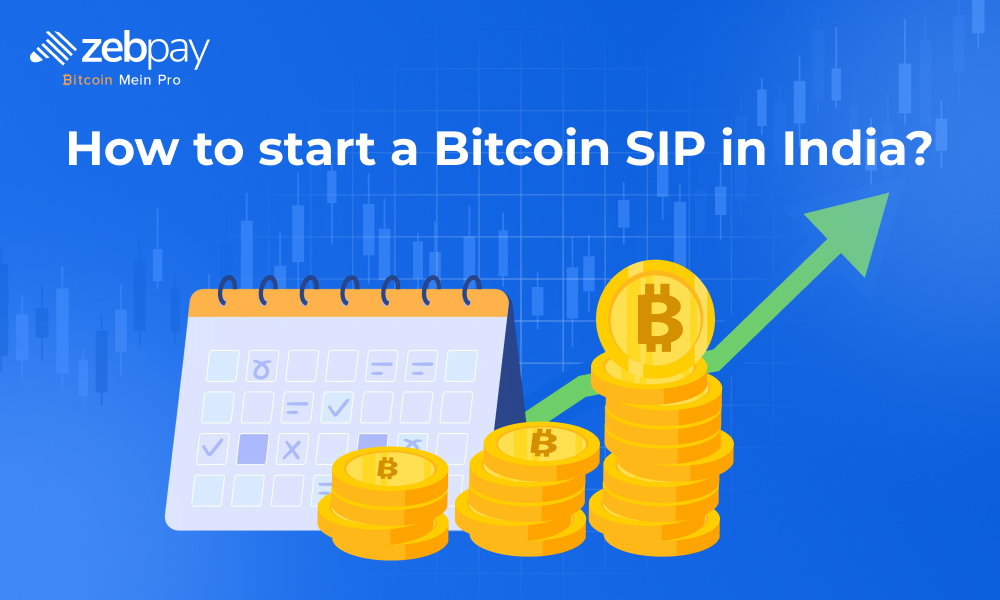
A Bitcoin SIP is a disciplined investment approach where a fixed amount of money is invested in Bitcoin at regular intervals, daily, weekly, or monthly, regardless of price.
Instead of attempting to buy at “the bottom” or sell at “the top,” SIP investors focus on long-term accumulation.
How SIP Works in Crypto Markets
- When prices fall, the same investment amount buys more Bitcoin
- When prices rise, it buys fewer units
- Over time, this averages out the purchase costs
This concept, known as dollar cost averaging, has been studied extensively in traditional finance and increasingly analyzed in crypto markets by firms such as Vanguard, CoinMetrics, and Glassnode.
Read more: Michael Saylor’s Bitcoin Theory of Long-term Investment
Bitcoin’s Long-Term Performance
Bitcoin’s long-term appreciation is often quoted in headline numbers, but understanding why it performed this way is critical.
Key Drivers of Bitcoin’s Growth
- Fixed supply cap of 21 million coins
- Halving cycles every four years, reducing new issuance
- Expansion of global liquidity during low-interest-rate eras
- Institutional access via regulated custodians and ETFs
- Growing use as a macro hedge against currency debasement
According to CoinMetrics, Bitcoin’s supply growth rate fell below that of gold after the 2024 halving, strengthening its scarcity narrative.
SIP vs Lump Sum Over Long Horizons
Academic-style simulations using historical data (2016–2025) show that:
- Lump-sum investing delivers higher returns only if timing is perfect
- SIP strategies reduce drawdowns during bear markets
- Volatility-adjusted returns favor systematic accumulation
This is particularly relevant in India, where retail participation tends to surge near market tops.
Bitcoin Bull and Bear Cycles Explained
Bitcoin historically moves in roughly four-year cycles, largely influenced by its halving mechanism.
Major Bitcoin Market Phases (2016–2026)
2016–2017 Bull Market
- Triggered by the 2016 halving
- Rapid retail adoption and ICO boom
- Price rose nearly 20x from cycle lows
2018 Bear Market
- Regulatory uncertainty and speculative excess unwound
- Drawdowns exceeded 80%
- Network fundamentals (hash rate, development) continued improving
2020–2021 Bull Market
- COVID-era liquidity
- Entry of listed companies and hedge funds
- Bitcoin reached new all-time highs
2022 Bear Market
- Aggressive global rate hikes
- High-profile collapses (Terra, FTX)
- Leverage flushed from the system
2023–2025 Expansion Phase
- Post-2024 halving supply shock
- Launch of spot Bitcoin ETFs in major markets
- Institutional custody and compliance improvements
On-chain data from Glassnode shows that long-term holders increased accumulation during every major drawdown, supporting the logic behind SIP investing.
Why Bitcoin SIP Works Better Than Timing
Volatility Is Structural
Bitcoin’s volatility is not a flaw, it is a byproduct of:
- A fixed supply
- 24/7 global markets
- Relatively small market size compared to equities or bonds
SIP transforms volatility from a risk into a mechanism for accumulation.
Behavioural Finance Advantage
Studies in behavioural finance consistently show that investors underperform markets due to emotional decisions. SIP:
- Removes fear and greed
- Enforces consistency
- Reduces decision fatigue
According to a Dalbar-style behavioural analysis adapted for crypto, most retail investors underperform Bitcoin’s market return despite holding it.
Step-by-Step: How to Start a Bitcoin SIP in India
Starting a Bitcoin SIP in India is a structured and straightforward process when done through compliant crypto platforms.
- The first step is selecting a FIU-registered Indian crypto exchange that supports INR deposits and offers automated SIP or recurring buy features for Bitcoin.
- After creating an account, investors must complete the mandatory Know Your Customer (KYC) process, which typically includes PAN verification, identity proof, and bank account linking.
- Once KYC is approved, funds can be deposited in INR using UPI, IMPS, NEFT, or other supported banking methods, depending on the exchange.
- Investors can then navigate to the SIP or recurring investment section, select Bitcoin as the asset, and choose the investment amount, frequency, and start date.
- After confirmation, the SIP executes automatically at the chosen intervals using prevailing market prices, without requiring manual intervention.
- SIP parameters can usually be modified, paused, or stopped at any time, offering flexibility without locking in capital.
Bitcoin SIP and Taxation in India
Under current Indian tax laws, gains from Bitcoin and other virtual digital assets are taxed at a flat rate of 30%, regardless of the holding period or income slab. Additionally, a 1% Tax Deducted at Source (TDS) is applied on each crypto transaction, including SIP purchases, which impacts liquidity but is adjustable during annual tax filing.
Losses incurred from Bitcoin investments cannot be offset against gains from other assets or carried forward to future years, which makes long-term investing more favourable than frequent trading. SIP investing helps minimise unnecessary taxable events by reducing the need for repeated buying and selling, unlike active trading strategies.
Risks to Understand Before Starting a Bitcoin SIP
Bitcoin SIP is not risk-free.
Market Risk
Bitcoin can experience prolonged drawdowns. SIP reduces timing risk, not market risk.
Regulatory Risk
While crypto is legal in India, regulatory frameworks continue to evolve.
Platform Risk
Use exchanges with strong custody practices and transparent disclosures.
Portfolio Allocation Risk
Experts from ARK Invest and Fidelity suggest limiting crypto exposure to 5–10% of total investable assets for most retail investors.
SIP vs Lump Sum vs Trading
| Strategy | Risk Level | Skill Required | Suitability |
| SIP | Moderate | Low | Long-term investors |
| Lump Sum | High | Medium | Experienced investors |
| Active Trading | Very High | Very High | Professionals only |
For most individuals, SIP aligns best with real-world behaviour and risk tolerance.
The India-Specific Advantage
Bitcoin is priced globally in USD. For Indian investors:
- INR depreciation historically adds to long-term returns
- Bitcoin acts as a partial hedge against currency weakness
- SIP allows participation without large upfront capital
RBI data shows long-term INR depreciation averaging 3–4% annually against the USD, which indirectly benefits USD-denominated assets.
Conclusion
Bitcoin SIP offers Indian investors a disciplined, practical way to participate in one of the most volatile yet high-performing assets of the past decade. Rather than relying on market timing or speculation, SIP aligns with long-term wealth-building principles backed by data, behavioural finance, and on-chain evidence.
While Bitcoin remains a high-risk asset, structured accumulation through SIP, combined with proper allocation and regulatory awareness, can help investors navigate volatility responsibly.
In the grand scheme of things, ZebPay blogs are here to provide you with crypto wisdom. Get started today and join 6 million+ registered users to explore endless features on ZebPay!
FAQs
What is the minimum amount to start a Bitcoin SIP in India?
Most platforms allow SIPs starting from ₹100 per interval.
Is Bitcoin SIP legal in India?
Yes, crypto trading and investing are legal, subject to taxation and KYC norms.
Can Bitcoin SIP give guaranteed returns?
No. Returns are market-dependent. SIP reduces timing risk, not price risk.
Is Bitcoin SIP better than lump-sum investing?
For volatile assets like Bitcoin, SIP generally offers better risk-adjusted outcomes.
How long should I continue a Bitcoin SIP?
Most research supports a minimum horizon of 5–10 years to capture full market cycles.