

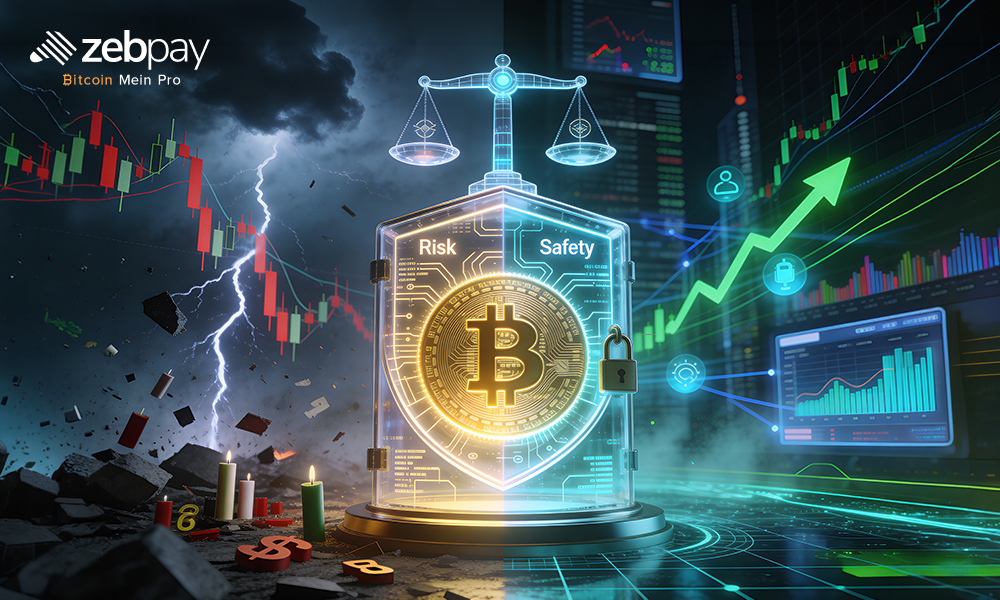


In the global financial conversation of 2026, one question remains persistent: “Is it safe to invest in Bitcoin or is it just a bubble?” With Bitcoin price seeing dramatic rises and sharp corrections over the last decade, investors, financial advisors, and regulators are asking whether Bitcoin’s meteoric growth reflects sustainable value or a speculative bubble ready to burst.
Bitcoin has often been compared to historical bubbles like the dot-com surge of the late 1990s and the housing market crash of the late 2000s. Yet unlike those assets, Bitcoin continues to function, attract institutional capital, and evolve into a recognized component of diversified portfolios.
To evaluate whether Bitcoin is a safe investment in 2026, whether you are considering buying Bitcoin, watching its price movement, or holding it long-term, we must examine historical performance, market sentiment, expert insights, risks, and broader adoption trends.
What Does “Safe to Invest” Really Mean?
When investors ask, “is Bitcoin safe?” they are usually evaluating a mix of factors:
- Price stability
- Security of the underlying system
- Regulatory clarity
- Institutional participation
- Long-term viability
These factors differ from traditional investments like stocks or bonds. Bitcoin is neither backed by a corporation’s earnings nor guaranteed by governments. Instead, it relies on decentralized blockchain technology, the same innovation that underpins its security and transparency.
For some investors, safety means predictable returns with minimal downside. For others, it means the underlying technology is secure even if prices fluctuate. Understanding these different interpretations is key to answering whether Bitcoin is a safe investment.
Historical Volatility: Bubble Calls vs. Reality
Bitcoin’s history is marked by extreme volatility. Price surges have often been followed by sharp corrections, leading critics to label it a speculative bubble.
Financial historian Nouriel Roubini recently reiterated that Bitcoin is a “pseudo-asset class” and called it a speculative bubble that could destabilize financial markets if embraced recklessly. He warned that Bitcoin lacks the traditional characteristics of money or stable investment assets.
Indeed, Bitcoin has experienced corrections exceeding 50% in short periods, a pattern many associate with bubble dynamics. Retail investors, particularly those new to markets, often face panic selling during such declines. However, there is also a distinction between classic bubbles that lose value permanently and Bitcoin’s price pattern, which historically rebounds and establishes new cycles of growth.
While Bitcoin has exhibited bubble-like behavior, several analysts argue that it does not behave like a typical bubble that collapses and disappears. Its network continues to grow, and price corrections often lead to new adoption cycles rather than extinction.
Institutional Adoption: A Confidence Indicator
One of the most compelling developments in Bitcoin’s evolution is institutional participation.
The approval of multiple spot Bitcoin ETFs by the U.S. Securities and Exchange Commission (SEC) in 2024 marked a milestone for mainstream adoption. These regulated financial products have attracted billions in capital, allowing institutions, hedge funds, asset managers, pensions, and even sovereign wealth funds to gain exposure without directly holding Bitcoin.
Bit.com reports that Bitcoin’s realized capitalization surged significantly after ETF launches, with institutional products attracting over $58 billion in net inflows since early 2024. This kind of demand reflects serious long-term interest beyond speculation.
Bitcoin’s integration with traditional finance is also evidenced by its growing correlation with major equity indices like the S&P 500 and Nasdaq, suggesting it is increasingly treated as a global financial asset rather than an isolated novelty.
Institutional capital injection typically signals confidence and maturity, traits that have historically helped stabilize markets and reduce speculative extremes over time.
Read more: Are Big Investment Banks and Hedge Funds Trading in Bitcoin?
Market Sentiment in 2026: Bullish, Bearish, or Balanced?
Sentiment toward Bitcoin in 2026 is mixed, but nuanced.
Bullish Signals
- Many investors believe Bitcoin’s limited supply and increasing adoption will drive long-term value.
- Approval of Bitcoin ETFs and regulatory advancement in some jurisdictions suggest increasing institutional trust.
- Reports indicate companies and funds are adopting Bitcoin as part of treasury diversification strategies.
Bearish and Cautious Views
- Some economists argue that Bitcoin lacks intrinsic value and may be a bubble influenced by speculative flows.
- Recent price downturns have illustrated how quickly markets can shift sentiment from exuberance to caution.
- Critics emphasize that macro conditions like tightening liquidity, inflation changes, or broader risk assets sell-offs can heavily impact Bitcoin.
These diverse perspectives reflect that while Bitcoin’s narrative has matured, it is still subject to the emotional dynamics of global investors.
Read more: Top 10 cryptos to invest in 2026
Risks to Consider Before Investing in Bitcoin
While Bitcoin’s underlying blockchain technology is robust and secure, several risk factors affect whether it is safe to invest:
1. High Price Volatility
Bitcoin experiences rapid price swings. This volatility can deliver outsized returns but also steep losses, sometimes within very short windows. Short-term traders and risk-averse investors must consider this carefully.
2. Regulatory Uncertainty
Although Bitcoin ETFs have shown regulatory acceptance in some markets, global regulation remains uneven. Bans or restrictions in some countries could limit Bitcoin’s adoption or create localized sell-offs.
3. Security and Custody Risks
While the Bitcoin network itself has never been hacked, individual investors may experience losses from exchange hacks, phishing attacks, or lost private keys.
4. Perception vs Reality
Some analysts argue that Bitcoin is digital gold, offering a hedge against inflation. Others see it as correlated with high-growth tech risk assets rather than safe havens like traditional commodities.
5. Quantum Computing Risk
Some strategists have flagged long-term threats like quantum computing, potentially challenging Bitcoin’s cryptographic security, though this remains speculative and far from immediate.
Expert Views and Long-Term Potential
Several financial institutions and analysts have a more optimistic outlook:
- Forbes and mainstream financial media highlight Bitcoin’s growing integration with traditional finance and institutional capital.
- Some surveys show that a majority of experts believe Bitcoin still has room for growth, despite short-term volatility and corrections.
- Institutional accumulation trends, such as corporations adding Bitcoin to their treasury balance sheets, reflect deeper strategic allocation rather than purely speculative trading.
Is Bitcoin a Bubble or Fundamental Innovation?
The label “bubble” has stuck with Bitcoin for years. While rapid price increases and corrections resemble bubble behavior, many analysts argue that Bitcoin’s persistence distinguishes it from classic financial bubbles that collapse and fade away.
Unlike a fleeting speculative mania that disappears, Bitcoin’s network is still active, widely adopted, and increasingly integrated into regulated financial markets. Even after price corrections, Bitcoin has continued to attract new capital and use cases, such as ETFs and treasury holdings.
This persistent evolution suggests Bitcoin isn’t simply a transient bubble but a nascent digital asset class still finding its role in the investment ecosystem.
Conclusion
So, “Is Bitcoin safe to invest in or just a bubble?” The answer depends on your investment objectives, risk tolerance, and financial horizon.
Bitcoin’s decentralized blockchain remains secure, and institutional adoption has increased its credibility. Regulatory progress in major markets and the launch of financial products like ETFs have supported Bitcoin’s integration into traditional finance.
However, Bitcoin is not without risks. Its price remains volatile, regulatory environments evolve, and cybersecurity concerns persist. For many investors, Bitcoin is not a short-term haven; it’s a long-term speculative asset that may offer high returns alongside high risk.
In the grand scheme of things, ZebPay blogs are here to provide you with crypto wisdom. Get started today and join 6 million+ registered users to explore endless features on ZebPay!
FAQs
Is Bitcoin safe to invest in today?
Bitcoin’s underlying network is technologically secure, but investment safety depends on volatility tolerance, regulatory clarity, and personal risk profile.
Is Bitcoin a good investment in 2026?
Many experts see long-term potential due to institutional adoption, but risks such as price swings and regulatory uncertainty remain important considerations.
Is Bitcoin a bubble?
Bitcoin has exhibited bubble-like price behavior historically, but its persistence and adoption suggest it may not fit traditional bubble characteristics.
How safe is Bitcoin compared to traditional assets?
Bitcoin is generally considered riskier than traditional assets like stocks or bonds due to its volatility, but it offers diversification benefits when balanced within a broader portfolio.
Should I buy Bitcoin now?
Investors considering buying Bitcoin should conduct thorough research, understand risk tolerance, and ideally use a long-term investment strategy.