


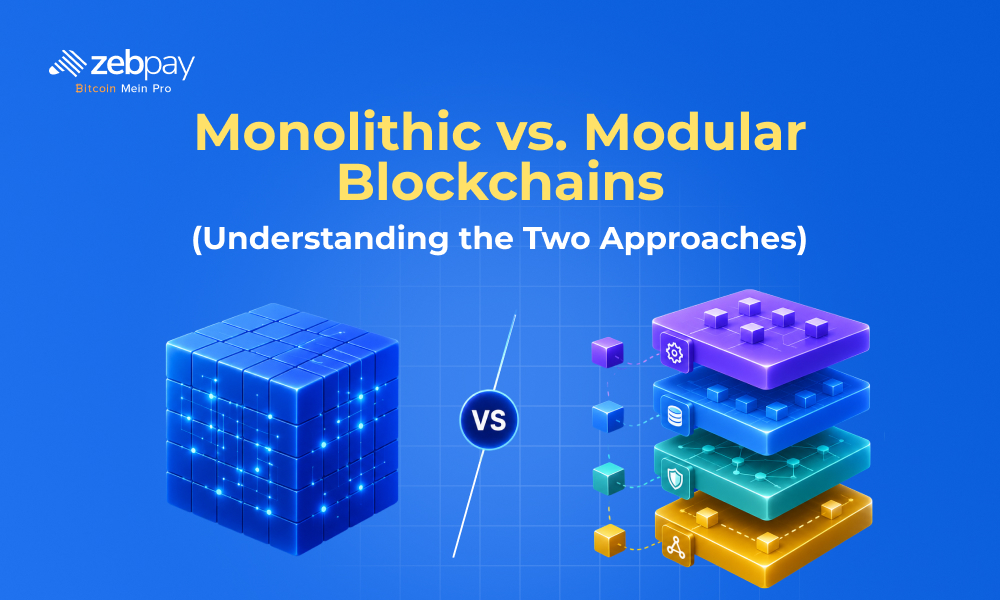
As blockchain technology continues to evolve, developers are constantly searching for ways to improve scalability, security, and decentralization. While early blockchains relied on a single system to execute all core functions, newer designs have been increasingly adopting specialised layers to distribute responsibilities more efficiently. This has given rise to two distinct approaches towards blockchain infrastructure, them being:
- Monolithic Blockchains
- Modular Blockchains
From what is understood, understanding how these two frameworks function has become imperative for developers, especially for the next generation of Layer-1 networks and scaling solutions. In this article, we’ll take a look at how these two technologies work, their advantages and disadvantages, and how they are setting the tone for long-term blockchain scalability.
What is a Monolithic Blockchain?
A monolithic blockchain is a blockchain architecture which comprises a single layer responsible for performing all required tasks. Instead of using a distributed mechanism, for performing functions, one network handles everything required to process and validate transactions. Typically, these functions include:
- Transaction Execution
- Consensus
- Data Availability
- Settlement
In this system, every node is responsible for maintaining the system, as all the functions happen within a Layer-1 network.
How Monolithic Blockchains Handle All Functions in One Layer
| Function | Role |
| Execution | Processes transactions and smart contracts. |
| Consensus | Ensures network participants agree on the blockchain state. |
| Data Availability | Makes transaction data accessible for verification. |
| Settlement | Finalises transactions and records outcomes. |
Examples of Monolithic Blockchains
Some of the most well-known blockchain networks, following a monolithic design, are:
- Bitcoin
- Solana
- Cardano
- BNB Chain
- Avalanche (Primary Chain Architecture)
Although these networks differ in their consensus mechanisms and transaction throughput, they all perform execution, consensus, data availability, and settlement within a unified system.
What is a Modular Blockchain?
A modular blockchain separates core blockchain functions into specialized blockchain layers rather than handling everything within a single network. Instead of requiring one blockchain to manage execution, consensus, settlement, and data availability simultaneously, modular architectures allow different systems to emphasize on specific tasks. This separation enables networks to optimize performance while improving blockchain scalability.
How Modular Blockchains Separate Execution, Consensus, and Data Availability
| Function | Role |
| Execution Layer | Processes transactions and smart contracts. |
| Consensus Layer | Maintains agreement across the network. |
| Data Availability Layer | Stores and distributes transaction data. |
| Settlement Layer | Finalises transactions and resolves disputes. |
Examples of Modular Blockchains
Several blockchain projects are embracing modular design principles, including:
- Celestia
- Avail
- Fuel Network
- Eclipse
- Ethereum’s Rollup Ecosystem
These projects focus on separating blockchain functions to improve scalability and flexibility.
Key Differences
| Feature | Monolithic Blockchain | Modular Blockchain |
| Architecture | Single-layer design | Multi-layer design |
| Execution | On-chain | Can occur on separate layers |
| Consensus | Built into the same chain | Can be separated |
| Data Availability | Integrated | Dedicated layers possible |
| Scalability | Limited by one network | Higher scaling potential |
| Complexity | Simpler | More complex |
| Upgrade Flexibility | Lower | Higher |
| Infrastructure Requirements | Unified | Distributed |
Also Read: Best Crypto Wallets for NFTs, Web3, and DeFi in 2026
Scalability: Which Approach Handles More Transactions?
Monolithic Blockchains
- Increase a single network’s transaction capacity.
- Often raises hardware requirements for validators and nodes.
Modular Blockchains
- Parallel processing reduces congestion and lowers execution costs.
- Flexibility enables developers to develop applications efficiently.
Decentralisation and Node Requirements
Monolithic Blockchains
- Nodes must process all network activities.
- Hardware requirements may increase as throughput grows.
Modular Blockchains
- Responsibilities can be distributed.
- Individual nodes may only perform specific functions.
Security Trade Offs Between Monolithic and Modular Designs
Monolithic Blockchains
- Security is concentrated within 1 network.
- Validators secure all functions simultaneously.
- Fewer external dependencies exist.
Modular Blockchains
- Security may be distributed across different layers.
- Different components may rely on separate security assumptions.
- Inter-layer communication becomes vital.
Advantages and Disadvantages of Each Approach
| Blockchain | Advantages | Disadvantages |
| Monolithic | – Simpler blockchain architecture – Easier network coordination – Strong composability – Unified security model – Fewer moving parts | – Scalability limitations – Potential network congestion – Higher node requirements over time – Difficulty in optimizing individual functions |
| Modular | – Improved blockchain scalability – Greater flexibility – Easier upgrades – Specialized blockchain layers – Lower transaction costs in many cases | – Increased complexity – More dependencies between systems – Potential interoperability risks – More challenging user experience |
When a Monolithic Blockchain Makes More Sense
- Simplicity is a priority.
- Applications require strong composability.
- Security assumptions need to remain unified.
- Transaction demand is manageable within a single network.
When a Modular Blockchain is the Better Choice
- Large-scale adoption is expected.
- High transaction throughput is required.
- Developers need custom execution environments.
- Network flexibility and scalability are priorities.
Also Read: Top 5 Rollup Tokens in 2026
The Future of Blockchain Architecture
The debate between monolithic and modular blockchain architecture is unlikely to produce a single winner. Instead, the future may involve both models serving different requirements. Monolithic networks continue to innovate by increasing efficiency and throughput within a unified system. At the same time, modular ecosystems are expanding rapidly by leveraging specialized blockchain layers to achieve greater scalability. Rather than replacing monolithic blockchains entirely, modular systems may complement them by addressing use cases that require significantly higher transaction capacity.
Why Most New Blockchains are Choosing a Modular Approach
Many newer blockchain projects are adopting modular designs because they offer a practical path toward overcoming the limitations of the blockchain trilemma. The blockchain trilemma suggests that improving scalability often comes at the expense of security or decentralization. Modular architectures attempt to address this challenge by separating responsibilities across specialized layers. Key reasons for adoption include:
- Better Scalability Potential
- More Flexible Infrastructure
- Independent Layer Upgrades
- Customizable Execution Environments
- Reduced Bottlenecks
Keep yourself ahead of the crypto curve with ZebPay blogs. Click the button below and join 6 million+ users who trust ZebPay for their trading needs!
FAQs
What is the difference between monolithic and modular blockchains?
A monolithic blockchain performs execution, consensus, data availability, and settlement on a single network. A modular blockchain separates these functions across multiple blockchain layers.
What is a monolithic blockchain in simple terms?
A monolithic blockchain is a blockchain where all core functions such as transaction execution, consensus, data availability, and settlement are handled by a single network rather than being separated across multiple blockchain layers.
What is a modular blockchain in simple terms?
A modular blockchain divides blockchain functions among specialised layers, allowing each layer to focus on a specific responsibility such as execution, consensus, or data availability.
Can monolithic blockchains support smart contracts?
Yes. Many monolithic blockchains support smart contracts. The ability to support smart contracts depends on the blockchain’s design rather than whether it is monolithic or modular.
Why are modular blockchains considered more scalable?
Modular blockchains distribute workloads across multiple layers instead of relying on a single network to process every transaction. This reduces bottlenecks and improves blockchain scalability.
What is the trilemma and how does it relate to monolithic vs. modular blockchains?
The blockchain trilemma refers to the challenge of simultaneously achieving scalability, security, and decentralisation. Monolithic and modular blockchain architectures represent different approaches to balancing these three objectives.