


Pi Network aims to make crypto more accessible by giving everyday users a simple way to participate through their smartphones. Founded by Nicolas Kokkalis and Chengdiao Fan, the project takes a different approach to mining, allowing users to earn Pi coins through daily activity on its mobile app rather than requiring specialised hardware, high computing power, or advanced technical knowledge.
At the core of this model is Pi Network’s consensus mechanism, referred to as Stellar Consensus Protocol (SCP), which places greater emphasis on user participation than computational capacity. By lowering the technical and energy requirements traditionally associated with mining, the approach is designed to encourage wider participation while supporting a more energy-efficient entry point into the crypto ecosystem.
Pi Network reached a significant milestone on February 20, 2025, with the launch of its Open Network. The transition removed several of the restrictions that had previously limited the ecosystem, opening the door to greater connectivity, exchange listings and a wider range of real-world applications. It marked an important step in the project’s effort to expand beyond its closed ecosystem and build broader utility for Pi.
As the Pi community and ecosystem continue to develop, attention has increasingly turned towards the Pi Network price prediction and what the future price of Pi could look like. This article examines the key factors shaping Pi Network’s growth and explores what the next five years could potentially mean for the project and its evolving ecosystem.
Also Read: What is Pi Network
What is Pi Network and Why Does its Price Matter?
Pi Network takes a mobile-centric approach to crypto, aiming to lower the barriers that can prevent everyday users from engaging with digital assets. Rather than requiring specialised mining equipment or large amounts of computing power, the project allows users to earn Pi coins by regularly interacting with its mobile application. Its model places greater emphasis on user participation and trust-based validation, creating a blockchain ecosystem designed to be more accessible to people without extensive technical knowledge or costly infrastructure.
As Pi Network continues to expand, the potential value of its native asset has become an increasingly discussed topic. Pi’s valuation can be influenced by several factors, including the growth of its user base, ecosystem development, adoption and the emergence of practical use cases. These considerations form an important part of any Pi Network price prediction, while broader market conditions and the project’s ability to achieve greater utility will also shape longer-term expectations. Examining these developments can therefore provide useful context for a price prediction for Pi Network as it works towards deeper integrations and wider adoption across the crypto ecosystem.
Historical Performance of the Pi Network
Pi Coin’s market journey took a significant turn after Pi Network opened its ecosystem to external connectivity in February 2025. The launch of the Open Network on February 20 marked the beginning of broader interaction with the crypto market, and Pi quickly attracted considerable attention from traders and the wider crypto community. Within just a few days, the token surged to an all-time high of approximately $2.98 on February 26, 2025.
However, the initial price momentum proved difficult to sustain. As market sentiment changed and selling pressure intensified, Pi entered a steep and extended downtrend. By April 2025, its price had dropped to around $0.40, representing a substantial decline from its February peak. During the months that followed, Pi experienced a period of comparatively limited price movement, trading within a relatively narrow range for parts of the year before renewed selling pressure pushed the token lower.
The downward trend persisted towards the end of 2025, when Pi’s value fell to roughly $0.20. Weakness carried into 2026, with the token remaining below $0.20 for much of the year. Pi eventually reached an all-time low of approximately $0.0707 on July 14, 2026. Overall, its price performance since the Open Network launch reflects the substantial fluctuations the token has undergone as it gained exposure to the wider crypto market, while the ongoing expansion and development of the Pi ecosystem could remain relevant to its longer-term trajectory.
Also Read: How Derivatives Will Drive DEX Growth in 2026?
Pi Network’s (PI) Technical Analysis
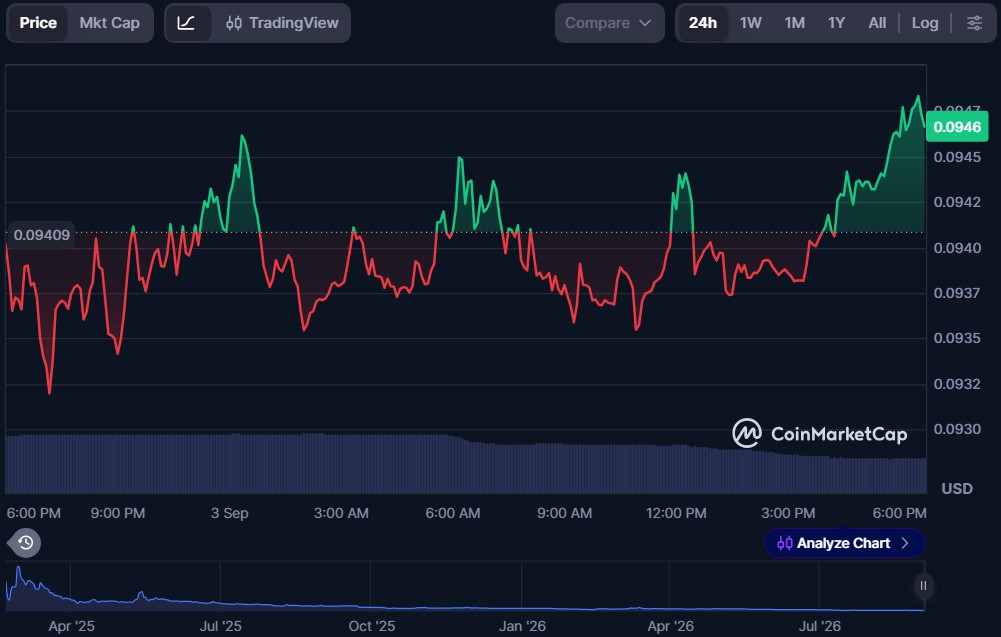
As of 3rd September 2026 (5:40 PM IST), Pi Network is trading at approximately $0.09447, with a market capitalization of around $1.05 billion and a 24-hour trading volume close to $4.06 million.
These figures point to the increasing market activity around Pi as the project continues to build out its broader ecosystem. The transition to the Open Network has further strengthened its long-term prospects by creating greater scope for interoperability and potential access to major crypto exchanges. At the same time, assessing Pi’s future price has become more nuanced, with factors such as changing market sentiment, a growing user base and evolving regulatory conditions likely to have a greater influence on its trajectory. An AI-based projection from CoinStats, a crypto analytics platform, offers one potential long-term scenario. Based on its projection, Pi Network could trade within the $1.65–$2.75 range approximately four to five years from its February 2026 levels, assuming continued ecosystem expansion and stronger adoption. This represents a potential outlook rather than a guaranteed price target, as the asset’s future performance will depend on how these underlying factors develop.
The development of Pi Network’s Node infrastructure advanced further with the rollout of Pi Node version 0.5.4 in November 2025. While mobile mining is designed for participation through smartphones, Pi Nodes run on desktop and laptop computers, enabling users to support the network by helping validate transactions and participate in its consensus process. Pi’s consensus model draws on the Stellar Consensus Protocol (SCP), relying on trusted relationships between participating nodes rather than the computational work required by Proof of Work. The 0.5.4 release also brought several improvements to Node performance, reliability and accessibility, alongside updates to reward calculations and a more robust system for verifying open ports. Beyond these technical enhancements, Pi Network considers its Node infrastructure a key element of its decentralisation model, giving individual participants the ability to contribute computing resources towards maintaining and securing the blockchain.
Also Read: Chelsea FC and Circle Join Forces to Bring USDC to Football
Key Factors That Influence Pi Network Price Predictions
Supply and Demand Dynamics
Like most digital assets, the long-term outlook for Pi is closely tied to supply and demand mechanics. As more coins enter circulation through mining rewards and ecosystem incentives, the available supply may increase over time. At the same time, demand can grow if more users, merchants, and applications begin utilising Pi within the network. These changing dynamics often shape a Pi Network price prediction, as analysts evaluate whether adoption is rising faster than the token supply.
Network Adoption and User Growth
A growing user base is often considered a positive signal for any blockchain ecosystem. As more individuals join the network, participate in transactions, or build applications, the overall utility of the asset may expand. Strong adoption trends are therefore frequently included in any price prediction for Pi Network, as they may indicate increasing demand and long-term ecosystem sustainability.
Exchange Listings and Market Liquidity
Listings on major crypto exchanges can significantly influence a digital asset’s market visibility and trading volume. If Pi becomes available on multiple exchanges, higher liquidity could make it easier for users to buy and sell the asset. Greater market participation can improve price discovery and reduce volatility over time, which is why exchange access is often considered when forming a Pi Network price prediction.
Global Macroeconomic Conditions
Crypto markets do not operate in isolation. Global economic trends such as inflation levels, interest rate policies, and geopolitical developments can influence investor behaviour across financial markets. During uncertain economic periods, some investors may turn toward alternative assets like crypto assets, which can indirectly impact sentiment and the broader price prediction for Pi Network.
Also Read: What is Crypto Swapping? How Does it Work in 2026?
Role of Technical Analysis in Pi Network Price Forecasts
Moving Averages
Moving averages are widely used technical indicators that help identify long-term price trends by smoothing out short-term fluctuations. Analysts often compare short-term and long-term averages to determine potential trend reversals or momentum shifts. These signals can contribute to forming structured forecasts when evaluating Pi Network.
Relative Strength Index (RSI)
The Relative Strength Index (RSI) measures whether an asset is potentially overbought or oversold by analysing the speed and magnitude of price movements. Values typically range between 0 and 100, helping traders gauge market momentum. When incorporated into broader analysis, RSI can provide additional insights for those attempting to understand Pi Network’s price behaviour.
MACD Indicator
The Moving Average Convergence Divergence (MACD) indicator tracks the relationship between two moving averages to identify momentum shifts in a market. Crossovers between the MACD line and signal line often indicate potential bullish or bearish trends. Analysts frequently combine MACD with other indicators when evaluating possible price trajectories for emerging crypto assets.i dropping under $50 in January and February, briefly jumping above $75, and then retreating again—reflecting its ongoing volatility and highly speculative market sentiment.
Also Read: How to Learn Technical Analysis
Risks and Uncertainties in Pi Network Price Predictions
Predicting the future value of any crypto asset involves a high level of uncertainty. Market volatility, regulatory changes, technological challenges, and evolving competition within the blockchain sector can all influence price movements. These factors can make even the most carefully constructed Pi Network price prediction subject to sudden shifts.
Additionally, emerging projects often face uncertainties regarding ecosystem adoption and long-term sustainability. As a result, analysts typically treat price forecasts as hypothetical scenarios rather than guaranteed outcomes.
Should I Invest in Pi Network (PI) in 2026?
Pi Network presents an accessible approach to crypto participation, but its long-term prospects remain closely tied to adoption, ecosystem development and the utility of Pi Coin. While the project’s original mining model has faced scrutiny, particularly as alternative consensus mechanisms such as Proof of Stake have gained wider attention, the launch of the Open Network represented an important step in Pi’s development. By enabling greater external connectivity and creating opportunities for exchange listings, the transition could support broader adoption and influence the token’s future value. For 2026 end, Pi Coin’s price is anticipated to be around $0.068, although actual market performance may differ significantly depending on broader market conditions and project-specific developments. As with any crypto investment, it’s essential to conduct thorough research and assess risk tolerance before making financial decisions.
Pi Network Price Prediction for 2030
Looking ahead to 2030, estimating Pi Network’s potential value becomes more challenging as both the project and the wider crypto industry continue to evolve. Long-term price projections can be influenced by several variables, including the maturity of Pi’s ecosystem, regulatory developments, technological advancements and the broader adoption of digital assets worldwide. If Pi continues to expand its ecosystem, strengthen its infrastructure and develop practical real-world use cases, these factors could support its longer-term growth prospects. Based on current projections, Pi Coin is expected to trade at roughly $0.20 by 2030 end, although the actual price could vary considerably depending on how these factors develop over time.
Also Read: How To Read Candlestick Patterns?
Key Considerations Before Relying on Pi Network Price Forecasts
Price forecasts can provide a useful framework for considering where Pi Network could potentially head, but they remain estimates rather than assurances of future performance. The crypto market can change rapidly in response to market conditions, regulation, technological developments and investor sentiment, while different forecasting methodologies can produce significantly different outcomes. As a result, no single Pi Network price prediction should be viewed in isolation when assessing the asset’s potential.
A more informed approach involves looking beyond price targets and examining Pi Network’s underlying technology, ecosystem progress, adoption and developing use cases. Investors should also assess their own financial objectives and risk tolerance before making any investment decision. Ultimately, understanding the factors that could influence Pi’s future may be more valuable than relying on any individual forecast when evaluating its long-term potential.
Conclusion
Pi Network takes a different approach to crypto mining by lowering the barriers to participation and allowing everyday users to engage through their mobile devices. Its transition to the Open Network represents an important milestone in the project’s development, creating greater scope for external connectivity and expanding the potential utility of Pi Coin beyond its earlier ecosystem.
The project’s longer-term direction will ultimately be shaped by how effectively it can grow adoption, develop meaningful use cases, and navigate regulatory changes, alongside broader movements across the crypto market. For anyone considering Pi as an investment, evaluating these factors carefully and making decisions based on thorough research and individual risk considerations remains essential.
In the grand scheme of things, ZebPay blogs are here to provide you with crypto wisdom. Get started today and join 6 million+ registered users to explore endless features on ZebPay!
FAQs on Pi Network Price Prediction
What factors influence Pi Network price predictions?
Several elements shape a Pi Network price prediction, including supply and demand dynamics, the growth of the user base, ecosystem development, and exchange listings. Broader crypto market sentiment and regulatory developments also play an important role. Analysts typically combine these factors with market data to estimate potential price trends.
How reliable are Pi Network price prediction models?
Price prediction models can offer useful insights, but they are not guaranteed to be accurate. Most forecasts rely on historical price patterns, technical indicators, and assumptions about future adoption. Since the crypto market is highly volatile and influenced by unpredictable events, a price prediction for Pi Network should be viewed as an estimate rather than a certainty.
How does network adoption affect Pi Network price forecasts?
Adoption is one of the most important drivers in any Pi Network price prediction. As more users join the ecosystem, participate in transactions, and build applications, the overall utility of the network increases. Higher utility often leads to stronger demand, which can positively influence long-term price forecasts.
How do analysts use technical indicators to forecast Pi Network prices?
Analysts commonly rely on technical tools such as moving averages, the Relative Strength Index (RSI), and the MACD indicator to assess price momentum and market trends. These indicators help identify potential entry or exit points and support short-term forecasts when forming a broader price prediction for Pi Network.
Can exchange listings impact Pi Network’s future price?
Yes, exchange listings can significantly influence the price outlook. When a crypto asset becomes available on major trading platforms, it usually gains higher liquidity, improved price discovery, and broader market access. These developments can increase investor participation and may influence a Pi Network price prediction.
What risks should investors consider when relying on Pi Network price predictions?
Investors should consider risks such as market volatility, regulatory changes, evolving token supply, and competition from other blockchain projects. Because the ecosystem is still developing, unexpected developments can influence price behaviour. As a result, any price prediction for Pi Network should be approached with caution.
How do macroeconomic trends affect Pi Network price forecasts?
Global economic conditions often influence the broader crypto market. Factors such as inflation, interest rate policies, and geopolitical events can impact investor sentiment and capital flows into digital assets. These macroeconomic trends can therefore affect how analysts approach a Pi Network price prediction.
Should investors rely solely on Pi Network price predictions when making decisions?
No, relying solely on forecasts is generally not recommended. While predictions can provide helpful perspectives, investors usually combine them with independent research, technical analysis, and an understanding of the project’s fundamentals. A balanced approach helps reduce risk when evaluating the price prediction for Pi Network and other digital assets.
What makes Pi Network different from traditional crypto assets?
Pi Network differs from traditional crypto assets because it focuses on mobile-first accessibility and community-driven participation. Unlike many blockchain projects that require expensive mining hardware or high energy consumption, Pi Network allows users to mine tokens directly through a smartphone application, making crypto participation more accessible to a wider audience.
How does Pi Network’s mining model work without expensive hardware?
Pi Network uses a lightweight mining approach that does not rely on intensive computational power like Bitcoin mining. Instead of solving complex mathematical problems, users earn Pi by verifying trust circles and participating in the network through the mobile app. This approach significantly reduces energy consumption while enabling broader user adoption.
What is the significance of Pi Network’s Open Network phase?
The Open Network phase represents an important milestone for Pi Network because it allows external connectivity with other blockchain ecosystems, exchanges, and decentralized applications. This phase is expected to improve utility, ecosystem expansion, and transaction capabilities, which could play a major role in future Pi Network price prediction discussions.
How does Pi Network’s consensus mechanism differ from Proof-of-Work systems?
Unlike Proof-of-Work systems that depend on mining hardware and high electricity usage, Pi Network uses the Stellar Consensus Protocol (SCP). This consensus mechanism relies on trusted user relationships and validation circles rather than computational competition, making the network more energy-efficient and mobile-friendly.
What role do Pi Nodes play in the Pi Network ecosystem?
Pi Nodes help support the decentralization, validation, and overall stability of the Pi Network blockchain. These nodes contribute to transaction verification and network security while helping maintain the ecosystem’s infrastructure as the project continues to scale and expand globally.
How could ecosystem expansion impact the long-term value of Pi Coin?
Ecosystem expansion could significantly influence the long-term utility and demand for Pi Coin. As more applications, merchants, developers, and decentralized services integrate with the network, the practical use cases for Pi may increase. This broader adoption is often considered an important factor in long-term pi price prediction models.
What are the biggest challenges facing Pi Network’s future growth?
Some of the biggest challenges facing Pi Network include achieving widespread real-world adoption, maintaining ecosystem utility, ensuring regulatory compliance, and sustaining long-term user engagement. Market competition and exchange adoption may also influence the project’s future development and investor confidence.
How does market liquidity influence Pi Network price movements?
Market liquidity plays an important role in determining how stable or volatile Pi Coin’s price movements can be. Higher liquidity generally allows smoother trading activity and reduced price fluctuations, while lower liquidity may result in sharper price swings. Liquidity conditions are often closely analyzed in Pi Network price prediction assessments.
Why is adoption considered important in Pi Network price forecasts?
Adoption is considered crucial because the long-term success of any crypto largely depends on real-world usage and ecosystem participation. If more users, businesses, and developers actively use Pi Coin for transactions and applications, demand may strengthen over time. This is why adoption trends remain a key factor in both pi network price prediction and broader market outlook discussions.